
Last Updated: August 2026
When you’re learning violin as an adult, posture advice can start to feel endless. Keep your shoulders relaxed. Don’t grip with your chin. Stand tall. Don’t lock your body.
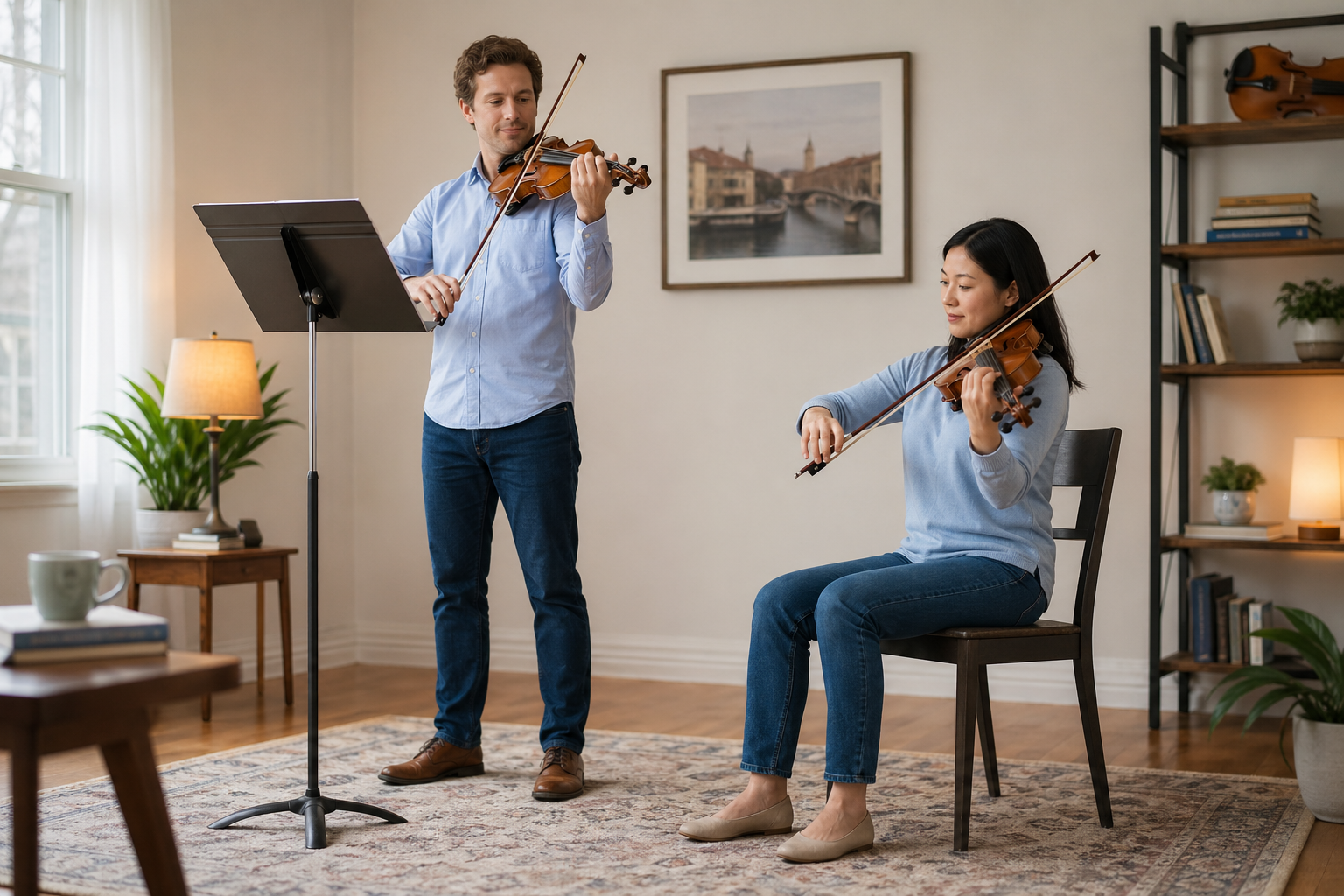
But one practical question comes up before all of that: should you sit or stand when you practice violin?
The simple answer is that both can work.
Standing often makes it easier to feel balanced and free. Sitting can be useful if you are tired, working from sheet music, practicing for orchestra or ensemble playing, or simply need a more relaxed setup at home.
The problem is not sitting itself or standing itself. The problem is staying in one position too long, practicing with poor setup, or letting the body collapse around the instrument.
For adult beginners especially, the best choice is usually not “always sit” or “always stand.” It is learning how each position affects your comfort, posture, and focus.
Standing Usually Feels More Natural at First
For many adult beginners, standing is the easier place to start.
When you stand, your body has more freedom. Your ribs can move more easily, your arms have space, and it is often easier to notice whether you are leaning, twisting, or gripping the violin.
Standing also makes it easier to feel the violin as part of your whole body position instead of something you are trying to hold in place with your neck, jaw, or left hand.
This does not mean standing fixes everything automatically. You can still lock your knees, raise one shoulder, lean back, or grip the instrument too tightly. But standing gives you a little more room to reset.
A good standing position should feel steady but not stiff. Your feet should be about hip-width apart, with your weight shared between both feet. Your knees should not be locked. Your shoulders should feel broad and relaxed, not pulled up toward your ears.
The goal is not to stand like a statue. The goal is to feel supported enough that your arms can move.
If your violin tends to slide or feel unstable when you stand, that is usually a setup or balance issue, not a sign that you need to squeeze harder. You may want to review How to Stop a Violin from Sliding on Your Shoulder (Quick Fixes & Setup Checks) or How to Keep Your Violin Stable (Without Tension or Gripping) before assuming the problem is your posture alone.
Sitting Can Work Well — But the Chair Matters
Sitting is not “wrong” for violin. Many orchestra players, chamber musicians, students, and adult learners spend plenty of time practicing while seated.
But sitting changes the way your body supports the instrument.
When you sit, it becomes easier to round your back, sink into the chair, lean toward the stand, or let your head drop forward. These small habits may not feel like a big problem during the first few minutes, but they can build into neck, shoulder, upper back, or left-hand tension.
A soft couch is usually one of the worst places to practice. It encourages your hips to sink backward, your spine to round, and your shoulders to come forward. Once that happens, the violin has less stable support, and the arms have to work harder.
A good chair is firm, flat, and simple. You do not need a special violin chair, but you do want something that lets you sit near the front edge with both feet on the floor.
Try this:
Sit toward the front half of the chair, not all the way back. Let your feet rest flat on the floor. Keep your torso upright without forcing your chest up. Bring the violin to you instead of folding your body toward the violin.
You should feel like you could stand up fairly easily from that position. If you feel stuck in the chair, slumped backward, or folded over the instrument, the setup is working against you.
The Biggest Sitting Mistake: Practicing From a Collapsed Position
The most common problem with seated violin practice is not the chair itself.
It’s sitting in a collapsed position.
A collapsed position usually looks like this: the back rounds, the shoulders drift forward, the head lowers, and the violin drops slightly. The player then tries to keep everything working by tightening the neck, lifting the left shoulder, squeezing the jaw, or pressing harder with the left hand.
At first, this may only feel like mild tiredness. Over time, it can make the violin feel heavier than it really is.
This is why some players feel fine for the first five minutes, then suddenly notice that their shoulder is creeping upward or their bow arm feels trapped. The body is trying to compensate for a position that is no longer balanced.
A simple way to check yourself is to pause before you play and ask:
Can I breathe comfortably in this position?
If your breathing feels shallow, your ribs feel compressed, or your shoulders rise every time you inhale, your posture is probably too tight or collapsed.
You do not need to take dramatic breaths while playing. You just want enough ease in your torso that your body is not bracing the whole time.
The Biggest Standing Mistake: Locking the Body in Place
Standing has its own problems.
Some adult players try so hard to “stand up straight” that they become rigid. The knees lock, the lower back tightens, the shoulders brace, and the violin feels like it has to be held in one perfect position.
That kind of posture may look organized, but it does not feel good for long.
Good violin posture is not military posture. You do not need to pull your shoulders back, arch your back, or freeze your body in place.
A better standing position is calm and flexible. You should be able to shift your weight slightly, release your knees, and move your bow arm without your whole body tightening.
If you notice that your lower back gets tired when you stand, check your knees first. Locked knees often cause tension to travel upward into the hips, back, shoulders, and neck.
Instead, let your knees stay soft. Keep your weight balanced through both feet. Think of standing tall enough to give the violin room, but relaxed enough that you could move at any time.
Your Music Stand Can Make Sitting or Standing Better — or Worse
Your music stand has a bigger effect on posture than many beginners realize.
If the stand is too low, you will look down, and your head will start to pull your neck and upper back forward. If the stand is too far to one side, you may twist your torso every time you read the music. If the stand is too close, your bow arm may feel boxed in.
This matters whether you sit or stand.
For most players, the stand should be high enough that you can read the music without dropping your head. It should be slightly to the left of center, because the violin is already positioned to your left. You should be able to look with your eyes more than your whole head.
For a more detailed setup guide, see How High Should Your Music Stand Be for Violin? And if your current stand is wobbly, too short, or difficult to adjust, you may also find Best Music Stands for Violin Practice helpful.
When Sitting Is the Better Choice
Standing is often useful for posture, but sitting can be the better choice in some situations.
If you are physically tired, recovering from a long day, working through slow note reading, or practicing for ensemble playing, sitting can make sense. It can also help if you are trying to reduce overall fatigue and stay focused for a short, calm practice session.
The key is to sit actively, not passively.
Active sitting does not mean tense sitting. It means you are supported by the chair, but not swallowed by it. Your feet are grounded, your torso is upright, and the violin is brought into position without your head collapsing toward it.
Sitting can also be useful for adult beginners who feel overwhelmed by too many things at once. If standing, balancing, reading music, bowing, and placing fingers all feel like too much, sitting may reduce the load temporarily.
That is perfectly fine.
Just make sure sitting does not become an excuse to fold into the instrument.
When Standing Is the Better Choice
Standing is usually the better choice when you are working on freedom of movement.
If your bow arm feels tight, your violin feels trapped against your body, or your posture feels small and compressed, standing may help you reset. It gives your ribs, shoulders, and arms more space.
Standing is also helpful when you are practicing tone, bow control, and longer bow strokes. The bow often feels different when the body is upright and balanced. You may notice that your sound opens up when your torso is not collapsed.
It can also help with confidence.
Many adult beginners practice in a guarded position, almost as if they are trying not to take up space. Standing encourages the opposite. It lets the instrument sit in a more open position and gives the bow arm room to travel.
If your sound feels weak or tight, posture may not be the only cause, but it is worth checking. A collapsed setup can make the bow arm feel restricted, which may affect volume, fullness, and control. For more help with that side of playing, see Why Your Violin Sounds Weak or Quiet and Why Your Violin Sounds Thin.
A Simple Practice Approach: Use Both
For many players, the best solution is to use both sitting and standing.
You do not have to choose one forever.
You might stand for warm-ups and tone work, then sit for note reading or slow piece practice. Or you might sit at the beginning of a tired evening practice session, then stand for the last few minutes to reset your posture and sound.
In a simple 20-minute practice session, you might start standing for open strings, tone, and relaxed bow movement. Then you could sit for slow reading, finger placement, or a difficult section of music. To finish, stand again for one final play-through so your body does not end the session in a collapsed position.
That last step is helpful. The way you end practice often becomes the way your body remembers the instrument. If you always finish tired, slumped, and gripping, that feeling can carry into the next session.
Even two minutes of standing reset at the end can make the whole practice feel cleaner.
Use Position Changes as a Tension Check
Switching between sitting and standing can reveal habits you might not notice otherwise.
For example, if your violin feels stable when standing but awkward when sitting, your chair or stand height may be affecting your setup. If your violin feels easier when sitting but tense when standing, you may be locking your knees or lifting your shoulders.
The goal is not to judge one position as good and the other as bad. The goal is to learn what each position shows you.
Try playing the same simple passage once while sitting and once while standing. Do not change the music. Just notice what changes in your body.
Does your bow arm move more freely in one position?
Does your left shoulder lift more in one position?
Does your head drop toward the violin when you sit?
Does your lower back tighten when you stand?
These small observations are more useful than trying to copy a perfect posture from a photo. Your body gives you information while you play.
Don’t Let Practice Length Decide Your Posture for You
Many adult beginners often squeeze practice into whatever time is available. That might mean practicing after work, after chores, late at night, or in a small room where the chair, stand, and lighting are not ideal.
That is real life.
But when you are tired, your posture choices matter more, not less.
A tired player is more likely to slump, grip, rush, or stay in one position too long. If you know you are practicing at the end of a long day, choose a setup that helps you stay comfortable from the start.
That may mean standing for only five minutes instead of forcing a long session. It may mean sitting in a better chair instead of practicing from the couch. It may mean raising the music stand before you begin instead of adjusting your neck around a bad stand height.
Small setup choices can prevent a lot of unnecessary tension.
If you want a more guided way to keep practice balanced, our free structured practice plans in Practical Violinist Studio can help you organize tone work, technique, and piece practice without making every session feel overwhelming. It can be especially helpful if you are trying to build consistency while still paying attention to comfort.
Signs Your Setup Needs Adjustment
You may need to adjust your sitting or standing setup if you notice the same discomfort showing up repeatedly.
A little tiredness during learning is normal. Sharp pain, numbness, tingling, or discomfort that keeps returning is not something to ignore.
Pay attention if you regularly feel strain in your neck, jaw, left shoulder, upper back, lower back, or left thumb. Those areas often become “helpers” when the violin is not balanced well.
If neck or shoulder discomfort is the main issue, our guide to playing violin without neck and shoulder pain is a good next step. If the discomfort feels more specific, you may also find our articles on why your jaw hurts while playing violin, why your left thumb hurts after playing violin, and violin shoulder pain for adult beginners helpful.
So, Should You Sit or Stand?
If you are brand new to violin, start by practicing while standing for short periods. It often makes balance, bow movement, and posture easier to feel.
If you are tired, reading music carefully, or practicing for an ensemble setting, sitting is fine — as long as your chair and stand support a healthy position.
The most important thing is not whether you sit or stand. It is whether your body can stay balanced, relaxed, and responsive while you play.
A good practice position should let you breathe, move your bow arm freely, support the violin without gripping, and stop before fatigue turns into tension.
For adult violinists, comfort is not a luxury. It is part of learning well.
The better your setup feels, the easier it is to practice consistently — and consistency is what helps your playing grow.
Leave a Reply