
Last Updated: August 2026
If your violin feels like it might slip, wobble, or fall unless you hold it in place, the problem is not strength, it’s balance.
This usually shows up quietly. You start holding on with your left hand. Your jaw presses a little harder than it needs to. Your shoulder lifts slightly without you noticing. Nothing feels dramatic, but everything feels just a bit tense.
That’s because when the violin doesn’t feel stable, your body tries to stabilize it.
And that leads directly to tension, discomfort, and inconsistent playing.
The goal is not to hold the violin.
The goal is to let it rest securely without effort.
What “Stable” Feels Like
A stable violin does not feel locked in place or rigid.
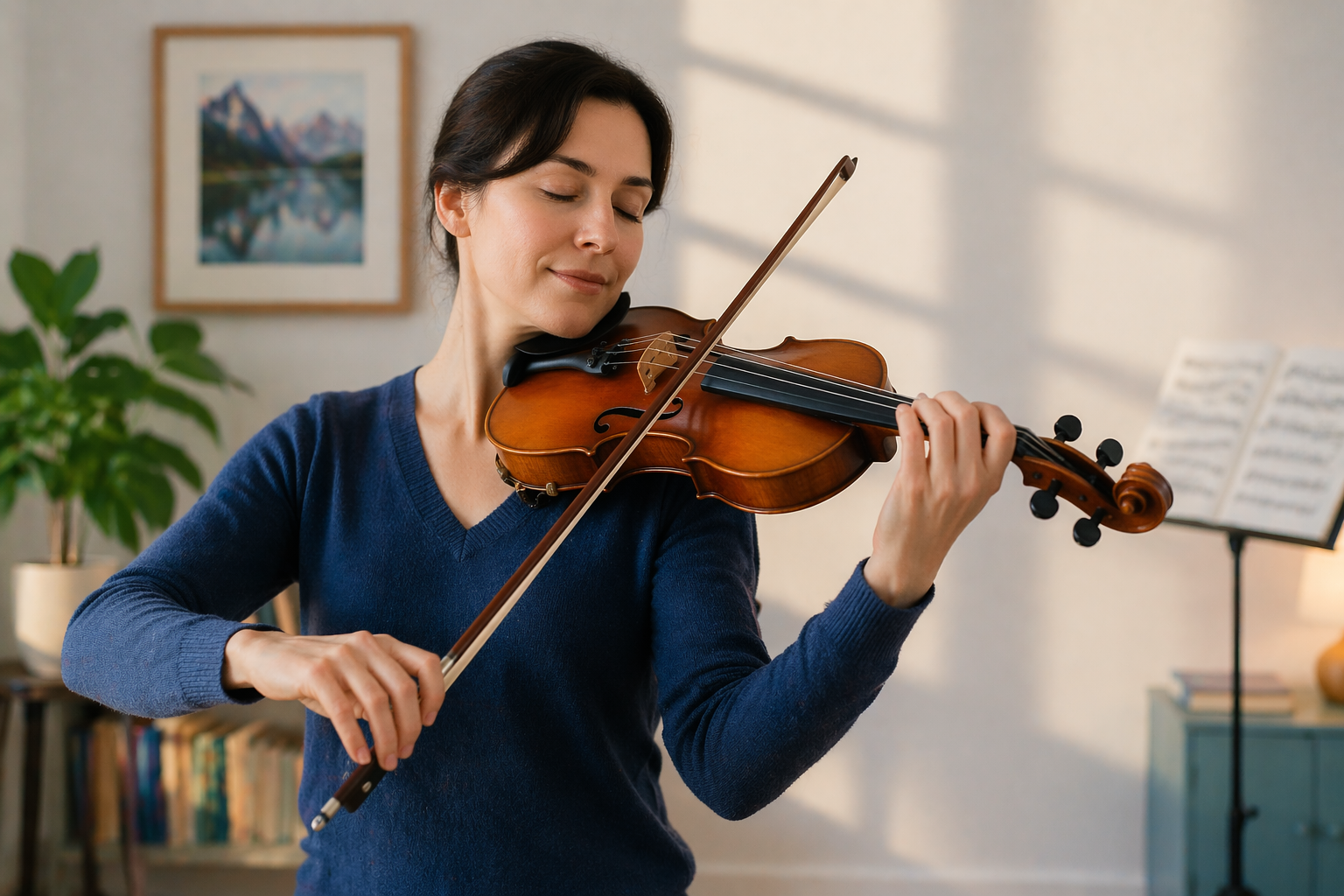
It feels lightly supported and balanced between your jaw and shoulder, with just enough contact to keep it secure.
Your left hand should feel free. Not completely off the instrument, but not responsible for holding it up either.
If you briefly reduce pressure in your left hand, the violin should stay in place without immediately shifting.
Not perfectly still, just stable enough that you’re not managing it constantly.
If that’s not happening, something in the balance needs to be adjusted.
Why Your Violin Feels Unstable
Most instability comes from a mismatch between how the violin is resting and how your body is trying to control it.
You’re Holding Instead of Letting It Rest
When the violin feels insecure, your instinct is to help it. You grip slightly with the left hand, press with the chin, or lift the shoulder just enough to “catch” it.
It works in the moment, but it turns into constant tension.
If your left hand or thumb has been feeling tight or sore, that’s often a result of this compensation rather than a separate issue. See Why Your Left Hand Gets Tense on Violin (and How to Fix It) or Why Your Left Thumb Hurts After Playing Violin (And How to Fix It) if that’s happening.
Your Setup Doesn’t Naturally Meet You
For the violin to feel stable, it has to meet your body, not the other way around.
If you find yourself lowering your head to reach the chin rest, or feeling like the violin sits too low or too high, your body will start compensating without you realizing it.
Even small mismatches can make the instrument feel insecure.
If you haven’t checked this yet, start here:
How to Find the Right Chin Rest Height for Violin (Quick Tests & Safe Fixes)
Do You Really Need a Shoulder Rest for Violin?
You’re Using Constant Pressure Instead of Balance
Sometimes everything looks correct from the outside, but the violin still doesn’t feel secure.
That’s usually because you’re using steady pressure instead of allowing the instrument to settle.
Holding your head in a fixed position, keeping constant downward force, or bracing slightly through the shoulder can all create the feeling of instability over time.
If you’re also noticing discomfort, those patterns often show up as neck or jaw tension. See Why the Left Side of Your Neck Hurts After Playing Violin (And How to Fix It) or Why Your Jaw Hurts While Playing Violin (And How to Identify the Cause).
Stability comes from alignment, not force.
A Simple Way to Check Your Balance
Bring the violin into playing position and let it settle for a moment before you start.
Then gently reduce pressure in your left hand.
The violin should remain in place without immediately slipping or dropping.
If it doesn’t, your body is stepping in to compensate and that’s what needs to change.
How to Make the Violin Feel Stable
Most players try to fix instability by trying harder.
That usually makes it worse.
Instead, focus on removing unnecessary effort and letting the balance do the work.
Let the Violin Settle First
After you bring the violin up, pause briefly.
Let it sit naturally between your jaw and shoulder. This makes it easier to feel whether it’s actually balanced before you start playing.
Use Less Pressure Than You Think
If something feels unstable, the instinct is to press more.
Try easing off slightly instead.
A small reduction in chin pressure and a relaxed shoulder often makes the violin feel more secure, not less.
Make Small Adjustments, Not Big Changes
If the violin still doesn’t feel stable, look at positioning rather than force.
Small changes in angle, shoulder rest placement, or how the instrument sits on your collarbone can improve balance significantly.
If your violin is actually sliding down your shoulder, that’s a different issue — see How to Stop a Violin from Sliding on Your Shoulder (Quick Fixes & Setup Checks).
Here, the goal is a position where the violin naturally stays in place without effort.
Allow Natural Movement
Stability doesn’t mean staying completely still.
If your head is locked in one position, the same muscles stay engaged the entire time, which leads to tension.
Allow small, natural adjustments as you play. The violin should feel secure, but not rigid.
Why This Affects So Many Other Problems
When the violin doesn’t feel stable, everything else becomes harder.
Your bow control becomes less consistent. Your left hand starts to grip. Shifting feels less reliable. Tone suffers because of the added tension.
Fixing balance often improves multiple issues at once because you’re removing the need to compensate.
If your practice has been feeling tense or inconsistent overall, see Why Your Violin Practice Feels Scattered (And How to Fix It) — instability is often part of the reason.
Think “Rest,” Not “Hold”
Instead of asking:
“How do I hold the violin?”
Think:
“How can I let the violin rest securely?”
That small shift changes everything.
If You Want Help Making This Feel Natural
This kind of adjustment is hard to lock in just by thinking about it.
In Practical Violinist Studio, you can create a daily plan which helps reinforce relaxed setup and balance while you play, so stability develops naturally instead of something you have to manage.
→ Learn more by creating a free practice plan
Final Thought
If your violin feels unstable, don’t try to control it more.
That usually leads to more tension.
Instead, step back and improve the balance.
When the instrument rests securely, everything else starts to feel easier and playing becomes much more comfortable.
Leave a Reply