
Last Updated: June 2026
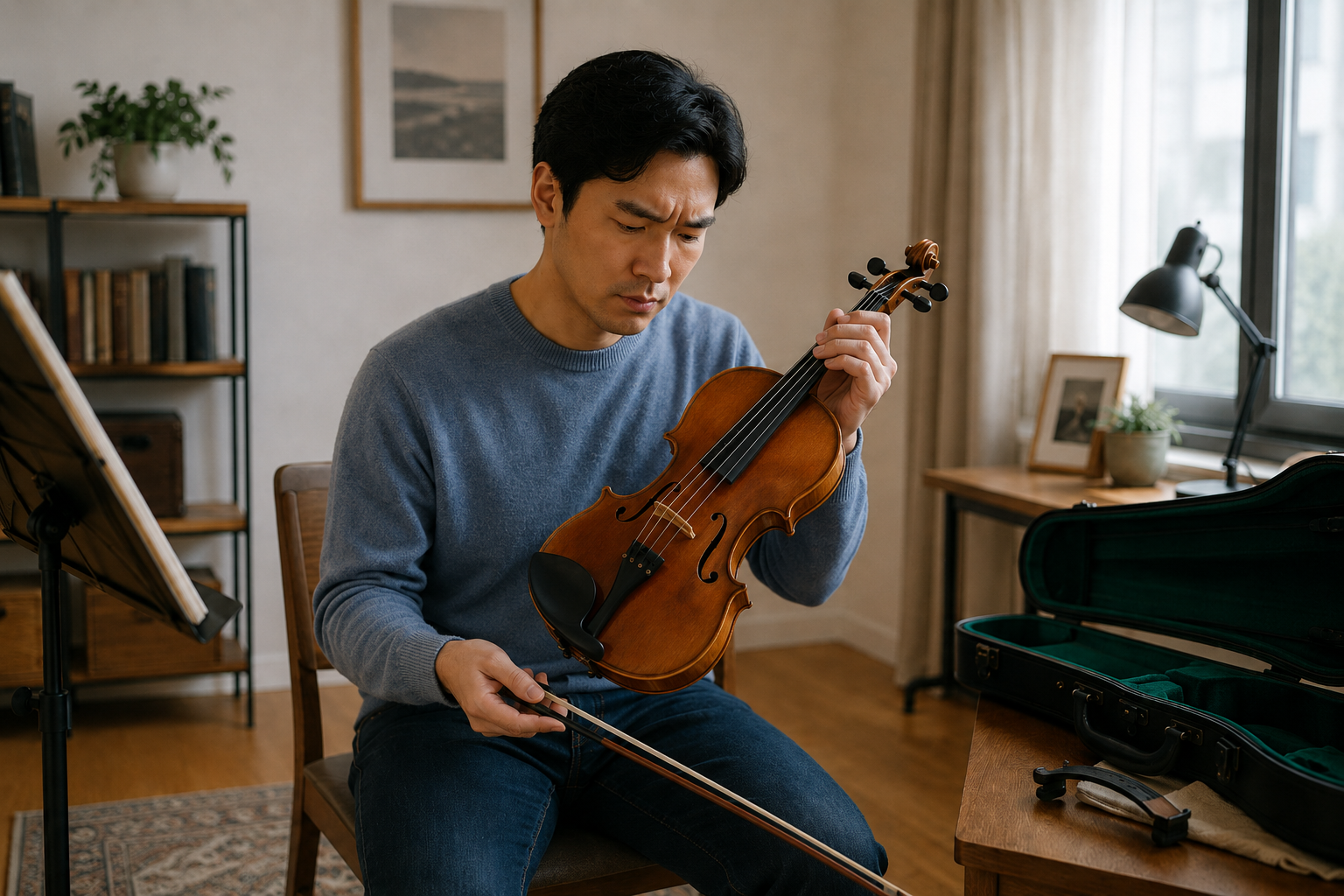
A buzzing or rattling violin can be frustrating, especially when you are not sure whether the problem is your playing, the strings, or the instrument itself.
The good news is that a buzz does not always mean something serious is wrong. Sometimes the cause is as simple as a loose fine tuner, a shoulder rest touching the violin in an odd spot, or something nearby vibrating while you play.
But some causes do need a luthier, so it helps to know what you can safely check at home and what you should leave alone.
This guide will walk you through the most common reasons a violin buzzes or rattles, the simple checks adult beginners can do safely, and when it is time to have the instrument looked at professionally.
First, Make Sure the Buzz Is Coming From the Violin
Before you assume the violin itself is damaged, check the simple outside causes first.
A buzzing sound can come from something near the violin rather than from the instrument. Music stands, clip-on tuners, buttons, jewelry, zippers, loose sheet music, or even something on a nearby table can vibrate when you play certain notes.
Try playing in a different spot in the room. Then remove anything attached to the violin, such as a clip-on tuner or practice mute, and play a few open strings again.
Also check your shoulder rest. A shoulder rest that is slightly loose, uneven, or touching the violin in the wrong place can sometimes create a small rattle. Remove the shoulder rest and play a few notes carefully. If the buzz disappears, the rest may need to be repositioned or adjusted.
If the sound is still there after these quick checks, then it is time to look more closely at the violin.
Check the Fine Tuners
Fine tuners are one of the most common sources of buzzing or rattling sounds on a violin.
A fine tuner can buzz if the screw is loose, if the mechanism is worn, or if part of the tuner is sitting too low and getting close to the top of the violin. This is especially common on beginner violins that have four fine tuners built into the tailpiece. If you are not sure why some violins have four fine tuners while others only have one, see Why Some Violins Have One Fine Tuner and Others Have Four.
Look at the fine tuners while the violin is resting safely in your lap or on a padded surface. Do not turn the violin over carelessly or press on the bridge.
Check whether any fine tuner screws feel very loose. If one is backed out too far, gently turn it clockwise a little and test the sound again. You are not trying to force anything. You are just checking whether a loose screw is vibrating.
Also look underneath the tailpiece area. If a fine tuner arm or screw is extremely low and close to the violin top, that can sometimes cause noise or even risk contact with the instrument. If you are not sure what you are seeing, stop there and ask a teacher or luthier.
Do not use pliers or tools on the fine tuners. If they do not turn normally by hand, the violin should be checked by someone who knows the instrument.
Look at the Chin Rest
A loose chin rest can also cause a violin to buzz or rattle.
Gently hold the violin and see whether the chin rest moves. It should not wiggle around loosely. A tiny amount of surface movement may simply be your hand moving the instrument, but the chin rest itself should feel secure.
Also check whether the chin rest is touching the tailpiece. On some violins, a poorly fitted or shifted chin rest can sit too close to the tailpiece and cause unwanted vibration.
This is where beginners need to be careful. It is tempting to tighten the chin rest clamps yourself, but overtightening can damage the ribs of the violin. If the chin rest is clearly loose, crooked, or touching something it should not touch, it is better to have a teacher or luthier adjust it.
If chin rest comfort has been an issue for you too, see How to Reduce Chin Rest Pain: A Comfort Guide for Adult Violinists and How to Find the Right Chin Rest Height for Violin. A chin rest should be comfortable, but it also needs to fit the instrument safely.
Check the Strings
Sometimes a buzzing sound comes from the strings themselves.
A string can buzz if it is old, damaged, unraveling, or not seated correctly. Look closely at each string, especially near the bridge, nut, and where your fingers usually press. If the winding looks frayed, flattened, or separated, the string may need to be replaced.
A worn string can also sound false, harsh, thin, or unstable before it fully breaks. If the buzz seems to happen mostly on one string, that string is a good place to start.
You can gently run a fingertip along the string to feel for rough spots, but do not pull the string sideways or lift it out of place. Also check that each string is sitting in its groove at the bridge and nut.
If you already suspect the strings are old, you may want to compare this with Signs Your Violin Strings Are Worn Out and How Often Should You Change Violin Strings? Those articles can help you decide whether the string is likely part of the problem.
Notice When the Buzz Happens
One of the most useful things you can do is pay attention to the pattern.
Does the buzz happen on every note, or only one note? Does it happen on one string, or all four strings? Does it happen only when you play loudly? Does it happen only on open strings?
If the buzz happens on just one open string, it may point toward the string, nut, fine tuner, or something connected to that string.
If it happens across all strings, it may be coming from a loose part, chin rest, shoulder rest, tailpiece area, or something nearby vibrating.
If it happens only when you press a certain note with the left hand, the issue may be related to finger placement, finger pressure, the fingerboard, or the string itself.
You do not need to diagnose everything perfectly. Your goal is simply to gather enough information so you can explain the problem clearly if you do need help.
A useful way to test is to play each open string slowly with a relaxed bow. Then play a few simple notes on each string. Keep the sound gentle and steady. You are listening for where the buzz appears, not trying to practice normally.
Check the Shoulder Rest and Accessories
Shoulder rests can create noise if they are loose, uneven, or not attached securely.
Take the shoulder rest off and play carefully without it for a moment. You do not need to play a full practice session. Just test a few open strings or simple notes. If the buzzing disappears, the shoulder rest may be the source.
Check the feet of the shoulder rest. Make sure the rubber parts are not loose, cracked, or slipping. Also make sure the rest is not touching the back of the violin in a strange way.
A practice mute can also rattle if it is not seated properly. If you use a rubber or metal mute, remove it from the bridge and test again.
Clip-on tuners are another common culprit. If a tuner is clipped to the scroll or body of the instrument, take it off and see whether the sound changes.
If your violin often feels unstable or you are constantly adjusting your setup, you may also find How to Stop a Violin from Sliding on Your Shoulder helpful.
When the Buzz May Be a Repair Issue
Some buzzing sounds come from problems that should not be fixed at home.
An open seam can create a buzz or rattle. This happens when part of the violin’s glued seam begins to separate. It may not look dramatic at first, but it should be repaired by a luthier.
A loose internal part, crack, bridge problem, nut issue, fingerboard issue, or soundpost problem can also cause strange noises. These are not beginner repairs.
You should take the violin to a luthier if:
- the buzz started after the violin was dropped or bumped
- you see a crack or open seam
- something sounds loose inside the violin
- the bridge looks badly leaning, warped, or out of place
- the buzz keeps happening after you remove accessories and check the strings
- the sound is getting worse instead of better
If you are not sure whether the issue needs professional attention, see Signs Your Violin Needs a Luthier. That article pairs well with this one because it helps separate simple maintenance from true repair concerns.
What Not to Do
When a violin buzzes, it is easy to start touching and tightening things randomly. Try not to do that.
Do not glue anything yourself. Do not try to adjust the soundpost. Do not sand the bridge or nut. Do not use household cleaners, oils, or sprays. Do not overtighten chin rest hardware. Do not force a fine tuner that does not want to turn.
Violins are delicate, and many small parts affect the sound. A simple adjustment in the wrong place can create a bigger problem.
The safest beginner approach is:
Check loose accessories.
Check the shoulder rest.
Check the fine tuners by hand.
Look for obvious string wear.
Notice when the buzz happens.
Then stop before you start forcing or repairing anything.
That is enough for most adult beginners.
What If the Violin Is Fine?
Not every buzzing or rough sound is caused by the instrument.
Sometimes what feels like a buzz is really a playing issue. The bow may be too close to the bridge, too heavy, too angled, or not moving steadily enough. A left-hand finger may not be pressing the string cleanly. You may also be brushing another string by accident.
This is especially common for beginners because the violin is very sensitive. A small change in bow pressure, speed, or contact point can create a sound that feels much worse than the actual problem.
If your violin has been checked and nothing is loose or damaged, then the next step is usually slower, calmer practice. Work with open strings, simple rhythms, and easy notes so you can hear whether the sound improves when your bow contact becomes steadier.
You may also want to read Why Your Violin Sounds Scratchy, Why Does My Violin Sound Bad?, or Why Your Violin Sounds Out of Tune Even After Tuning if the issue seems more related to playing than maintenance.
Once you have ruled out loose parts, worn strings, or setup issues, a guided plan in our free Practical Violinist Studio can help you return to steady practice without guessing what to work on next. Studio gives you a simple plan for tone, bow control, and daily practice so you can rebuild clean sound one step at a time.
A Simple At-Home Buzz Check
Here is a safe order to follow before you visit a luthier:
First, remove loose accessories such as a tuner, mute, or shoulder rest. Play a few open strings and listen.
Next, check whether the chin rest feels loose or is touching the tailpiece.
Then look at the fine tuners. If one screw is very loose, gently turn it by hand and test again.
After that, inspect the strings for fraying, rough spots, or unraveling.
Finally, notice whether the buzz happens on one string, one note, open strings, or everything you play.
If the buzz disappears during one of those steps, you probably found the source. If it does not, or if you see anything cracked, loose, warped, or separated, take the violin to a luthier.
Final Thoughts
A buzzing or rattling violin does not always mean your instrument is badly damaged. Many causes are simple: a loose fine tuner, a shoulder rest issue, a worn string, a mute left on the bridge, or something nearby vibrating.
But if the buzz continues after basic checks, do not keep guessing. A luthier can often find the cause quickly and prevent a small issue from becoming a larger repair.
For adult beginners, the best approach is calm and simple: check the obvious things, avoid risky adjustments, and get help when the problem is beyond basic maintenance.
Leave a Reply