
Last Updated: October 2026
Your violin bow doesn’t wear out all at once.
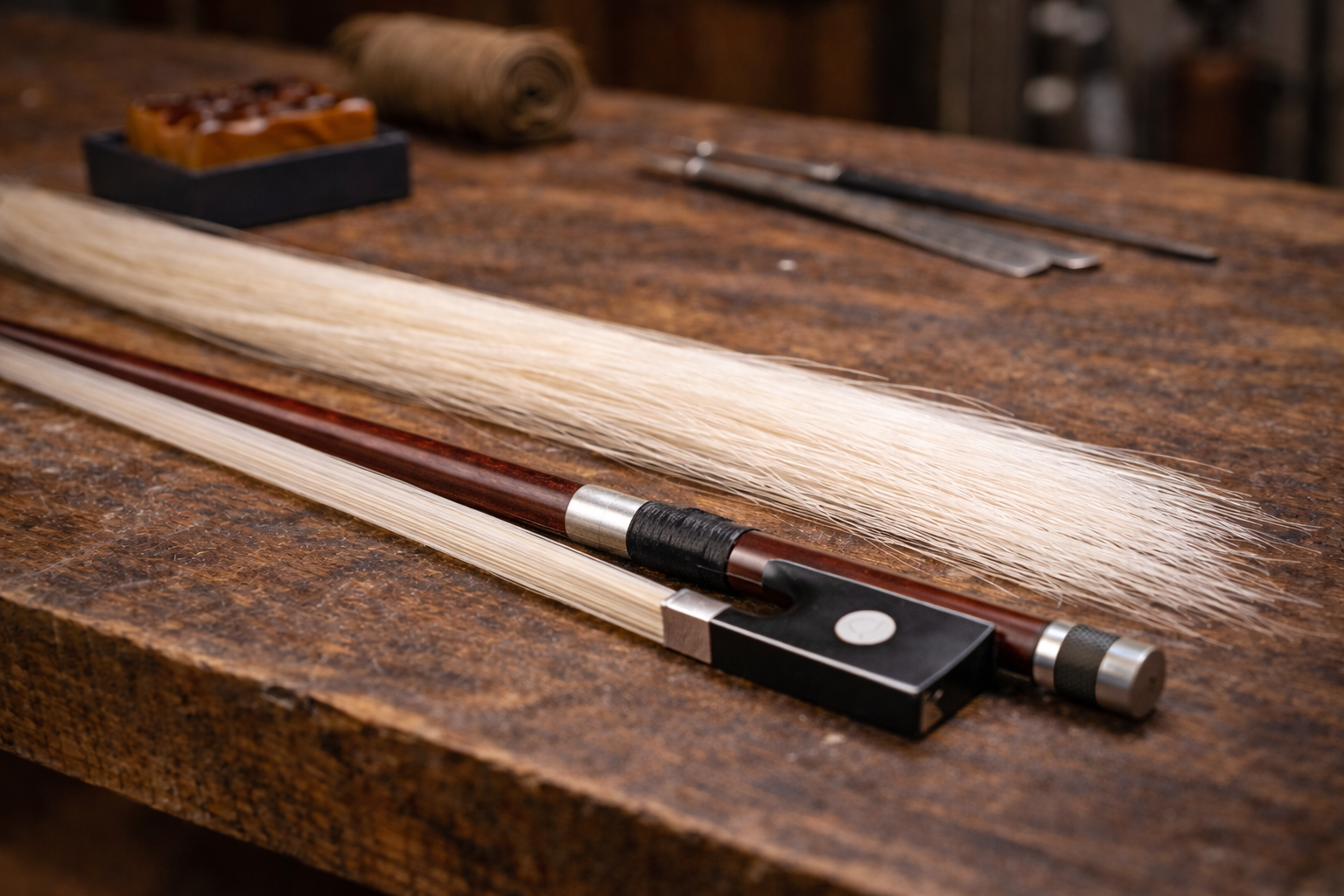
Most of the time, the bow hair is what slowly stops doing its job, often long before players realize it.
For adult beginners and intermediate players, worn bow hair is a common cause of slipping, scratchy tone, and loss of control. This guide explains what bow hair is made of, how it wears out, when rehairing makes sense, and when replacing the entire bow may be the better option.
What Violin Bow Hair Is Made Of (and Why It Wears Out)
Most violin bows are haired with natural horsehair. Horsehair works well with rosin, which provides the friction needed for the bow to grip and release the string as it moves.
The surface of horsehair has a microscopic texture that helps hold rosin. As the bow moves across the string, the rosined hair repeatedly grips and releases it, setting the string into vibration.
Over time, several things can affect how well the hair responds:
- The surface gradually wears from repeated contact with the strings
- Skin oils can contaminate the hair if it is touched
- Dust and rosin buildup collect on the hair
- Changes in humidity and regular use can affect hair tension
Even if the bow stick itself is perfectly fine, older or contaminated hair may stop gripping the string as consistently. The bow can begin to feel slippery or require more effort to produce a clear sound.
This kind of wear is normal and does not necessarily mean your technique is the problem.
Types of Violin Bow Hair (White, Black, and Blended)
White Bow Hair (Most Common for Violin)
White horsehair is the standard choice for violin bows and is what most violinists will encounter.
For most players, from beginners through advanced violinists, good-quality white horsehair is the practical choice.
Black Bow Hair (Less Common for Violin)
Black hair is generally coarser and is more commonly used for bass bows. It is uncommon on violin bows and usually unnecessary for most violinists.
Salt-and-Pepper (Blended) Hair
Blended hair combines white and black strands. It is also uncommon for violin bows and offers little practical reason for most adult learners to choose it over standard white hair.
For most violinists, good-quality white horsehair installed by an experienced rehairer is the simplest choice.
Signs Your Bow Hair Is Worn Out (and Not Just Needing More Rosin)
Many players assume slipping or weak tone means they simply need more rosin. While rosin choice matters, it cannot restore worn hair.
Common signs of worn bow hair include:
- The bow slips even after applying fresh rosin
- You need noticeably more pressure to start notes
- The sound feels thin or unstable across strings
- Hair is breaking frequently along the ribbon
- The ribbon looks uneven or sparse in spots
The wrong amount or type of rosin can sometimes make the problem harder to judge. If you’re unsure whether rosin may be contributing, see Best Violin Rosin for Adult Beginners (What Actually Matters)
When several of these signs appear together and fresh rosin does not improve the bow’s grip, the hair may be ready for a professional evaluation or rehairing.
How Often Adult Players Typically Need a Rehair (and Why)
There’s no fixed schedule for rehairing a bow. Bow hair wears out based on use, environment, and playing habits rather than calendar time.
Several factors influence how quickly hair degrades:
- Practice frequency: Frequent playing wears hair faster
- Pressure habits: Heavy bow pressure can contribute to wear
- Environment: Humidity and temperature changes affect hair tension
- Hand contact: Touching the hair transfers skin oils that reduce grip
As a rough guideline, some casual adult players may go 18–24 months between rehairs, while regular players may need one around 12 months or sooner. These are only general ranges.
The better indicator is how the bow responds. If it no longer grips consistently despite proper rosining, or if the hair has become sparse or uneven, it may be time for a rehair.
Rehair or Replace the Bow? (A Practical Decision)
This decision is not about upgrading for better performance. It’s about whether maintenance makes sense for the bow you have.
Rehair the Bow If:
- The stick is straight and stable
- The frog tightens smoothly and evenly
- The bow feels balanced and comfortable in the hand
- The cost of rehairing is reasonable compared to the bow’s value
A well-made bow with worn hair almost always deserves a rehair.
Replace the Bow If:
- The bow was very inexpensive to begin with
- The stick feels weak, unresponsive, or unstable
- There are issues with the frog or screw mechanism
- Rehairing would cost close to the bow’s replacement price
With very inexpensive bows, the cost of a professional rehair can sometimes approach the cost of replacing the bow. In that case, replacement may make more sense, especially if the stick or frog already has other problems.
If replacement makes more sense than rehairing, Best Violin Bows for Adult Beginners and Intermediates (Smooth Tone & Control) focuses on reliable, easy-to-control bows rather than performance upgrades.
Where to Get a Bow Rehaired (and What to Expect)
A proper bow rehair is performed by a trained technician or luthier and includes:
- Removing old hair
- Cleaning the frog and tip
- Installing new, evenly tensioned hair
- Aligning and finishing the ribbon correctly
Many full-service violin shops that offer rentals also handle bow repairs and rehairs, or can refer you to someone who does. Your local violin shop is usually a good place to start.
If you use a mail-in service, look for a shop that specializes in bowed-string instruments and clearly explains who performs the rehair and how the bow will be handled.
When the Problem Isn’t the Bow Hair
Sometimes the bow feels inconsistent even when the hair is still in good condition. Bow speed, contact point, pressure, and coordination can all change the way the bow grips and sounds.
If you’re not sure whether the problem is the equipment or your bowing, spend a few practice sessions paying attention to the same basic bow-control skills before deciding that something needs to be repaired or replaced.
That is one of the reasons I created Practical Violinist Studio. Its guided practice sessions give you a consistent way to work on bow control, tone, and technique, which can make it easier to notice patterns in your playing over time.
If that kind of structure would be useful, take a look at how Practical Violinist Studio works.
Summary
Bow hair is a wear item. As it becomes worn, contaminated, stretched, or uneven, the bow can lose grip and consistency even when the stick itself is still in good condition.
Pay attention to how the bow responds rather than relying only on a calendar. That will give you a better idea of whether the bow simply needs rosin, is ready for a professional rehair, or has reached the point where replacement makes more sense.
Leave a Reply