
Last Updated: September 2026
If you’re an adult learning or returning to the violin, you may eventually wonder:
Should I stick with an acoustic violin, or would an electric violin be a better fit for the way I practice?
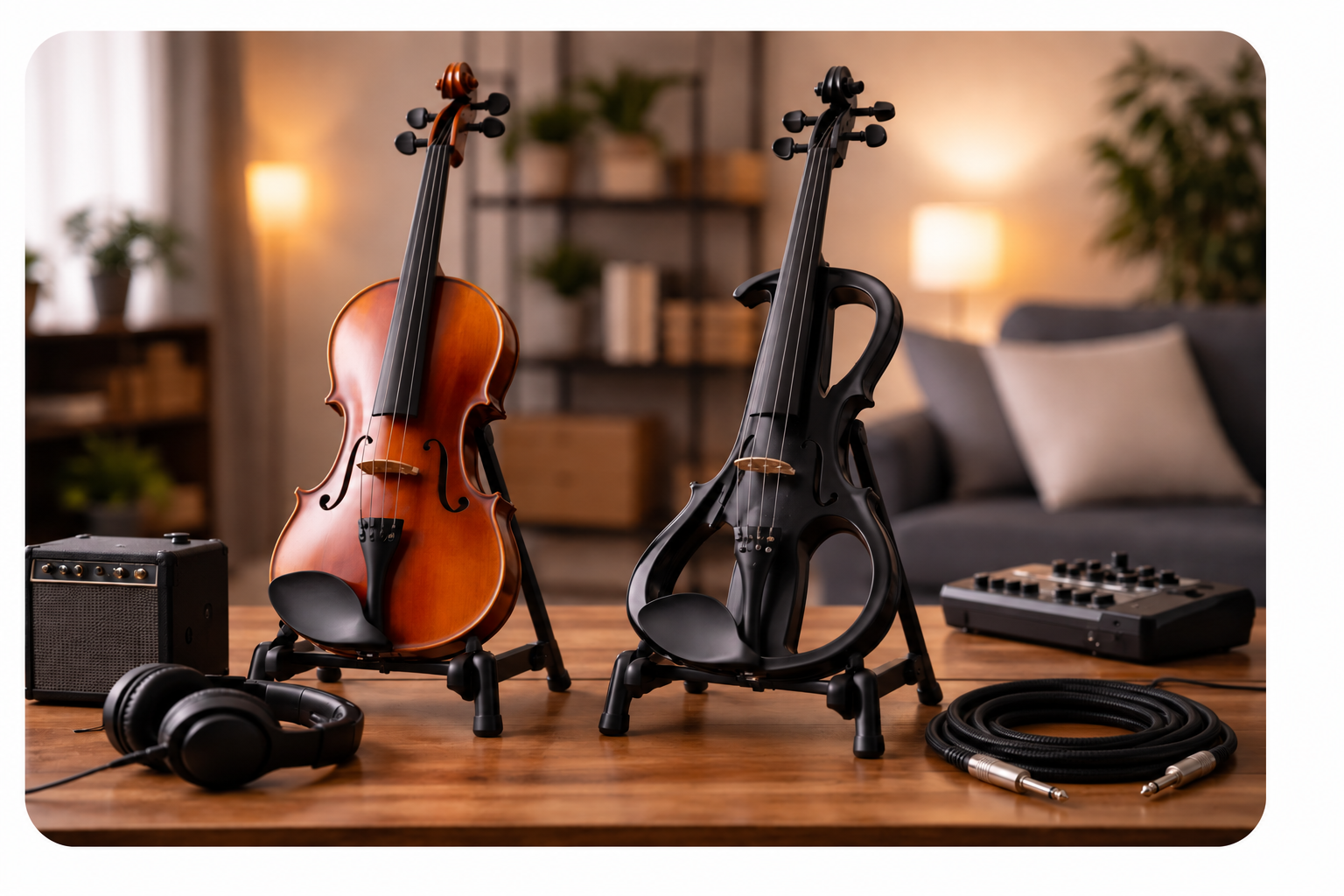
Electric violins are more than stage instruments. They offer some practical advantages, particularly when volume control matters, but they also feel and respond differently from traditional acoustic violins.
This guide explains the key differences between acoustic and electric violins, the pros and cons of electric violins, the different types available, and how to decide which makes sense for you.
Acoustic vs Electric Violins: What’s the Real Difference?
Acoustic Violins
An acoustic violin produces sound through the vibration of its strings, bridge, and wooden body. The body amplifies and shapes those vibrations, which gives an acoustic violin its natural tone and response.
Key characteristics
- Natural, complex tone
- Direct feedback from the bow and left hand
- No electronics or amplification required
- Standard choice for lessons, orchestras, and classical repertoire
For most beginners, the acoustic violin is still the usual starting point because it teaches you to work directly with the instrument’s natural response and resonance.
If the traditional instrument itself interests you, The History of the Violin Through Its Makers follows the development of the violin through makers such as Amati, Stradivari, Guarneri del Gesù, and important later makers. It is separate from learning playing technique, but it gives useful background on how the acoustic violin developed into the instrument we know today.
Electric Violins
An electric violin uses a pickup to turn string vibration into an electronic signal. Most electric models have little or no resonant body, so the sound you hear through headphones or amplification depends much more on the pickup and electronics.
Key characteristics
- Very low acoustic volume on their own
- Volume and tone controlled electronically
- Can be used with headphones or amplification
- Designed for flexibility rather than natural projection
Electric violins are not really replacements for acoustic violins. They solve a different set of problems.
Pros and Cons of Electric Violins
Advantages of Electric Violins
Volume control
An electric violin gives you much more control over how loudly you practice or perform. With the right setup, you can use headphones for quieter practice or connect to amplification when you need more volume.
Practice flexibility
Electric violins can be useful in apartments, shared homes, or situations where you need to keep practice volume down.
Consistent sound output
A pickup sends the violin’s signal directly to your headphones, amplifier, or other equipment, which gives you more control over the output level.
Environmental stability
Solid-body electric violins generally rely less on a resonant wooden body than acoustic violins, so changes in humidity and temperature have less effect on the way they produce sound.
Limitations to Understand
Different tone development
An electric violin does not respond exactly like an acoustic instrument, especially when you are learning how bow speed, pressure, and contact point affect natural projection and resonance.
Bow response can feel different
Depending on the instrument and electronics, some of the smaller changes in bow technique may not come through in quite the same way they do on an acoustic violin.
Additional equipment required
Depending on the model, you may need cables, headphones, an amplifier, an interface, or other equipment.
Rarely ideal as an only instrument
For most adult beginners, an acoustic violin is still the better primary instrument. An electric violin often makes the most sense as a second violin for quiet practice or amplified playing.
Types of Electric Violins
1. Solid-Body Electric Violins
This is the most common type of electric violin.
- Minimal or no resonant body
- Very quiet acoustically
- Designed mainly for amplified or headphone use
Best for: Flexible practice, modern styles, and controlled-volume environments
2. Silent / Practice-Focused Electric Violins
These are designed primarily for players who want quieter practice while keeping a familiar violin feel.
- Traditional or partly traditional outline and balance
- Headphone-focused electronics
- Some models can be used without a separate amplifier
Best for: Adult learners, apartment players, and players looking for a secondary practice instrument
3. Stage-Oriented Electric Violins
These models are designed primarily for amplification and live performance.
- Strong output signal
- Often used with pedals and effects
- Designs may look very different from traditional acoustic violins
Best for: Live performance
Less suited for: Traditional beginner practice
Electric Violins for Quiet Practice (Silent & Practice-Focused)
These models are designed mainly for low-volume practice, particularly in apartments or shared spaces. Their emphasis is usually on headphone sound, playing comfort, and familiar handling rather than stage volume.
Yamaha YSV104 Silent Violin

- Designed specifically for quiet home practice
- Built to give players a balance and playing position similar to an acoustic violin
- Headphone system is integrated into the practice setup
- Well suited to players who want a dedicated quiet-practice instrument
The YSV104 is worth considering if quiet practice is your main reason for buying an electric violin and you want something designed specifically for that purpose.
Yamaha SV200 Silent Violin

- Higher-end Yamaha silent violin
- Designed for both headphone use and amplification
- More performance-oriented than basic practice models
- Suitable for players who want an electric violin they can use beyond quiet practice
This model makes more sense for someone who plans to use an electric violin regularly and wants something that can handle both practice and amplified playing.
Budget & Starter Electric Violin Options
These models are aimed at players who want to try electric violin without moving immediately into higher-priced instruments. Many are sold as complete outfits with the basic accessories needed to get started.
Electric Bunnel Edge Violin Outfit (with Carrying Case & Accessories)

- Outfit includes violin, bow, case, shoulder rest, and other accessories
- Solid-body design keeps unamplified volume relatively low
- Fine tuners make small tuning adjustments easier
- Complete kit reduces the number of accessories you need to buy separately
This is one option for players who want to try electric violin with a complete package rather than assembling the setup piece by piece.
Bunnel NEXT Electric Violin Outfit (Electric Violin with Case & Accessories)

- Includes violin, bow, case, shoulder rest, rosin, cable, and other basic accessories
- Solid-body construction keeps its natural acoustic volume low
- Fine tuners provide easier small tuning adjustments
- Complete outfit can be convenient for someone buying an electric violin for the first time
The Bunnel NEXT is another starter option for players who prefer an all-in-one package.
Pyle Full Size Electric Violin

- Sold with basic accessories
- Can connect to compatible amplification or headphone equipment
- Solid-body design keeps its unamplified sound relatively low
- Intended as an accessible entry point into electric violin
This may appeal to someone who wants a relatively simple, lower-cost way to experiment with an electric violin.
Performance-Focused Electric Violin (Best for Amplified Playing)
Some players are not primarily looking for quiet practice. They want an electric violin specifically for amplified playing.
Yamaha YEV104NT Electric Violin

- Designed for amplified playing and live performance
- Solid-body construction
- Built to work with amplifiers, pedals, and effects
- More performance-focused than Yamaha’s silent-practice models
The YEV104 makes more sense for players who want an electric violin as a performance instrument rather than mainly as a quiet-practice tool.
What Extra Gear Do Electric Violins Require?
An electric violin usually needs more supporting equipment than an acoustic violin.
Common Essentials
- Instrument cable (¼”) for compatible amps, interfaces, or other equipment
- Closed-back headphones for private listening when your setup supports headphones
- Headphone adapter if your equipment uses a different headphone connection
Optional (Depending on How You Practice)
- Small practice amp for playing through a speaker at low volume
- Audio interface for recording or playing through a computer
- Light effects such as reverb if you want to shape the amplified sound
You do not necessarily need all of this equipment. What you need depends on the violin and whether you plan to use headphones, an amplifier, a computer, or a performance setup.
Where Quiet Practice Fits In
One of the main reasons adult players consider electric violins is noise management, especially in apartments or shared living spaces.
An electric violin can make it easier to practice:
- Early in the morning or late at night
- In a home with thin walls or nearby neighbors
- Without relying entirely on a heavy practice mute
Keep in mind that an electric violin is not completely silent. You will still hear the physical sound of the strings and bow in the room, but it is generally much quieter than a normal acoustic violin played without a mute.
If controlling practice volume is your main concern, you may also want to read:
Quiet Violin Practice Setup for Apartments & Small Spaces (Complete Guide)
That guide covers several ways to reduce practice volume, including acoustic violin mutes and electric options, so you can compare them before buying another instrument.
Which Should You Choose?
Choose an Acoustic Violin If:
- You’re buying your first violin
- You want to develop traditional acoustic tone and bow control
- You take lessons or play traditional repertoire
- Your practice situation does not require very low volume
If you are buying your first violin and still sorting out the basic accessories, the Beginner Violin Starter Kit gives you a simple checklist of what you actually need before you buy more than necessary.
Consider an Electric Violin If:
- You already own an acoustic violin
- Noise limits how often or when you can practice
- You want a secondary instrument for flexibility
- You want to play amplified music or experiment with effects
- Volume control is an important part of your practice setup
Many adult players eventually find that the two instruments serve different purposes. An acoustic violin can remain the main instrument for technique and traditional playing, while an electric violin provides another option when volume or amplification matters.
Final Thoughts
Electric and acoustic violins are built for different purposes, so the better choice depends on what you need from the instrument.
If you’re buying your first violin and can practice at a reasonable volume, an acoustic violin is usually the more straightforward place to start. It gives you direct experience with the natural tone, resonance, and bow response that most violin instruction is built around.
An electric violin becomes especially useful when quiet practice, amplification, or effects are important to you. For many players, it works best as a second instrument rather than a replacement for an acoustic violin.
Choose the instrument that fits the way you actually plan to practice and play.
Affiliate Disclosure: Some links in this article may be affiliate links. As an Amazon Associate and participant in other affiliate programs, we may earn from qualifying purchases at no additional cost to you.
Leave a Reply