
Last Updated: August 2026
When you are new to violin, tightening the bow can feel strangely uncertain.
You know the bow hair should not be hanging loose. But you may also wonder if you are supposed to tighten the bow until the stick looks straight, or until the hair feels firm, or until the screw will not turn anymore.
Your violin bow should be tight enough that the hair does not touch the stick while you play, but not so tight that the bow loses its natural curve.
A good beginner check is to look at the space between the bow hair and the stick near the middle of the bow. There should usually be a small, even gap, often around the width of a pencil or your pinky finger, depending on the bow.
That is only a starting point, though. The best bow tension is not about making the bow as tight as possible. It is about finding a safe, flexible setting where the bow responds easily without feeling stiff or weak.
What Should a Tightened Violin Bow Look Like?
Before you play, your bow should still have a gentle inward curve.
The wooden or carbon fiber stick should curve slightly toward the hair. It should not become completely straight. If the stick looks almost flat or bends away from the hair, the bow is probably too tight.
At the same time, the hair should not be so loose that it sags against the stick. If the hair touches the stick when you place the bow on the string, the bow is too loose for normal playing.
A properly tightened bow usually looks like this:
- The hair is lifted away from the stick
- The stick still curves slightly toward the hair
- The bow feels responsive, not floppy
- The screw turns smoothly and does not feel forced
For most adult beginners, the easiest visual check is the gap in the middle of the bow. You do not need to measure it exactly. You are simply looking for a small, usable space between the hair and the stick.
Start Here
Tighten the bow slowly by turning the screw at the end of the bow to the right, or clockwise.
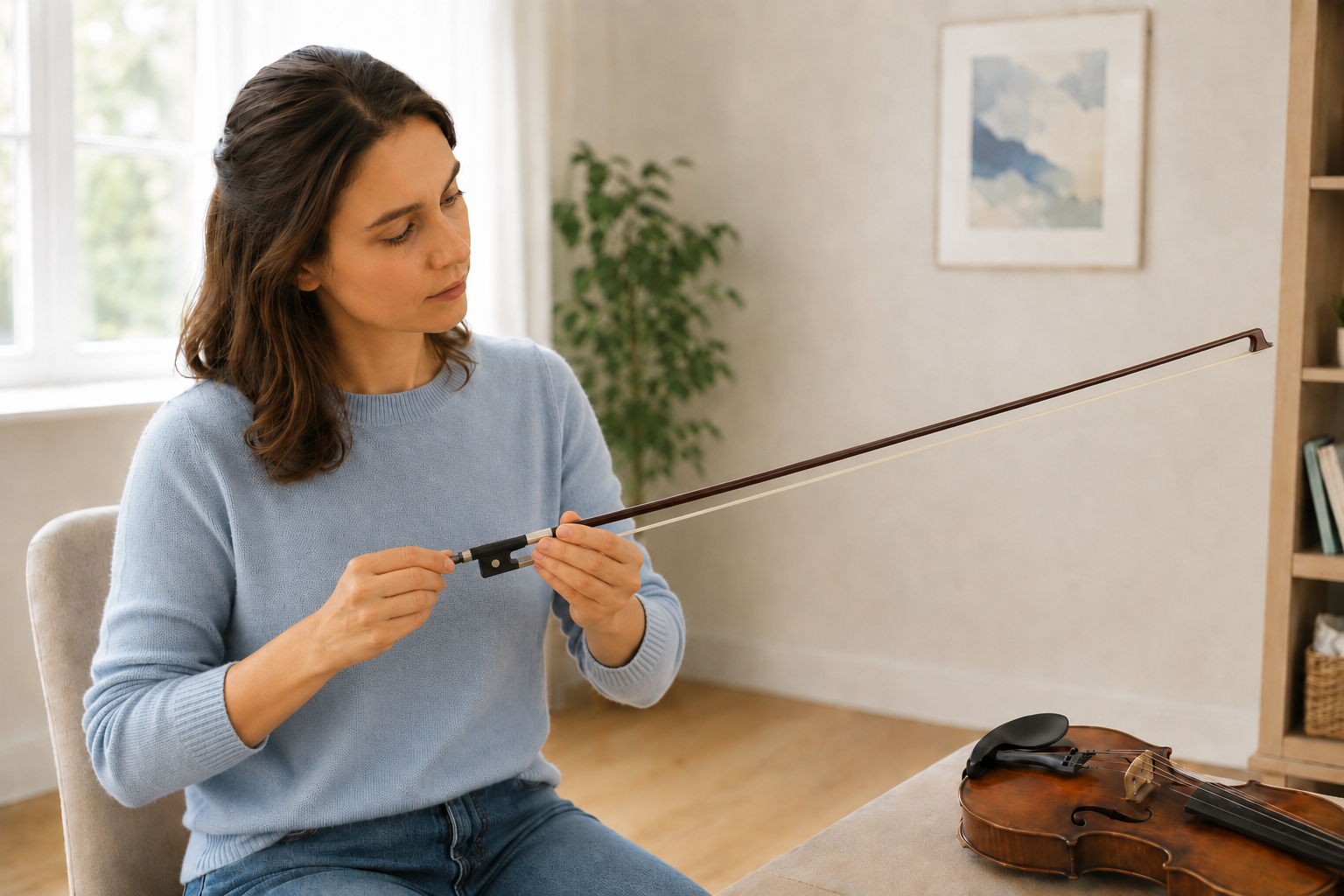
After a few turns, hold the bow sideways and look at the middle of the stick. Stop when there is a small gap between the hair and the stick, while the stick still keeps its gentle curve.
Then place the bow on the violin string and play a few slow notes.
If the bow feels weak, the hair touches the stick, or the sound does not respond well, tighten it slightly more.
If the bow feels stiff, bouncy, harsh, or hard to control, loosen it a little.
This is one of those violin skills that becomes easier with repetition. After a while, you will start to recognize the correct tension by sight and feel.
What Happens If the Bow Is Too Loose?
A bow that is too loose will not give you steady contact with the string.
The hair may sag toward the stick, especially near the middle of the bow. When you place the bow on the string, the hair may press into the stick or feel like it has no support.
This can make the violin harder to play. You may notice a weak sound, unclear notes, or a feeling that the bow is dragging instead of gliding.
A bow that is too loose can also make beginners press harder than they need to. Instead of fixing the sound, extra pressure usually creates more tension in the hand, wrist, arm, and shoulder.
If your bow feels like it is collapsing into the string, check the tension before assuming your technique is the problem.
What Happens If the Bow Is Too Tight?
A bow that is too tight can create a different set of problems.
The bow may feel stiff, jumpy, or harder to control. The sound can become harsh or forced because the bow is no longer flexing naturally against the string.
Too much tension can also put unnecessary stress on the bow. Over time, repeatedly overtightening a bow can affect the stick and the bow hair.
One common beginner mistake is tightening the bow until the stick looks straight. That is usually too tight. The curve of the bow is there for a reason. It helps the bow respond, grip the string, and move with some flexibility.
If your bow keeps bouncing or shaking, tension may not be the only cause, but it is one of the first things to check. You may also want to read Why Your Bow Keeps Bouncing on the Violin (And How to Fix It) and Why Your Violin Bow Shakes (And How to Fix It).
Should the Bow Hair Feel Tight?
The bow hair should feel firm enough to play, but it should not feel stretched as far as it can go.
Try not to judge bow tension by plucking or pulling on the hair with your fingers. That can get oils from your skin onto the hair, and it is not the best way to check tension.
It is better to look at the bow from the side and test it with a few slow notes.
If the bow gives you a clear tone without the hair touching the stick, you are probably close. If the stick has lost its curve, you have gone too far.
How Much Should You Turn the Bow Screw?
There is no exact number of turns that works for every bow.
Some bows tighten quickly. Others need more turns. Bow hair can also change slightly with humidity, temperature, age, and use.
The safest habit is to tighten gradually.
Turn the screw a little, check the gap, and stop when the bow looks ready to play. Avoid turning the screw hard at the end. If it feels stuck or difficult to turn, do not force it.
A bow screw should turn smoothly. If it grinds, slips, sticks, or does not seem to tighten the hair properly, the bow may need attention from a shop or luthier.
Do You Tighten the Bow Before or After Rosin?
In most cases, tighten the bow before you apply rosin.
Rosin works best when the bow hair is held at normal playing tension. If the hair is very loose, it can be harder to apply rosin evenly.
You do not need to rosin the bow every single time you play, though. Too much rosin can build up on the strings and make the sound scratchy or gritty.
If you are unsure whether rosin is part of the problem, read Best Violin Rosin for Adult Beginners (What Actually Matters) and How Often Should You Replace Violin Rosin (Signs, Tests & Timeline).
Should You Loosen the Bow After Playing?
Yes. You should loosen your violin bow after each practice session.
This is different from setting the bow tension before you play. Before playing, the bow needs enough tension to work properly. After playing, the bow should be loosened so the hair is no longer pulling tightly on the stick.
You do not need to loosen it until the hair is completely floppy. Just turn the screw counterclockwise enough that the hair relaxes and the stick is no longer under playing tension.
This protects the bow and helps it keep its shape over time.
For a deeper explanation, read Should You Loosen Your Violin Bow After Playing? (And What Happens If You Don’t).
Why Bow Tension Affects Your Sound
Bow tension affects how the bow contacts the string.
When the tension is close to correct, the bow can grip and release the string smoothly. That helps you create a clearer, steadier sound.
When the bow is too loose, it may feel unstable or weak.
When the bow is too tight, it may feel stiff and unforgiving.
Of course, bow tension is only one part of tone. Your sound is also affected by bow speed, bow pressure, contact point, rosin, strings, and how relaxed your arm feels.
Still, bow tension is a helpful first check because it is simple and easy to fix.
If your violin sounds scratchy even when the bow tension seems right, read Why Your Violin Sounds Scratchy (And How to Fix It).
Common Beginner Mistakes With Bow Tension
One common mistake is tightening the bow as far as it will go. This can make the bow feel stiff and can place unnecessary stress on the stick.
Another mistake is forgetting to tighten the bow at all. If the hair is still loose from storage, the bow will not respond properly.
Some beginners also confuse bow tension problems with rosin problems. If the bow slides around and does not grip the string, the bow may need rosin, but it may also be too loose. Check both before assuming something is wrong with the violin.
It is also easy to forget to loosen the bow after practice. This is a small habit, but it matters. When you put the violin away, loosen the bow before closing the case.
What If the Bow Still Does Not Feel Right?
Sometimes the problem is not your bow-tightening habit.
If the bow hair will not tighten enough even after several turns, the hair may be stretched out, the screw may not be working correctly, or the bow may need repair.
If the stick looks warped, the screw slips, or the hair is very uneven, it is best to have a violin shop or luthier look at it.
If the bow is inexpensive and the repair would cost more than the bow is worth, replacement may make more sense than repair. You can learn more in Violin Bow Hair: Types, When to Rehair, and When to Replace the Bow and Best Violin Bows for Adult Beginners and Intermediates (Smooth Tone & Control).
Final Thoughts
Bow tension is a small detail, but it can make a big difference in how your violin feels and sounds.
Before you play, tighten the bow just enough that the hair lifts away from the stick and gives you a small gap near the middle. The stick should still keep its natural inward curve. If the hair touches the stick while you play, the bow is probably too loose. If the stick looks straight or the bow feels stiff and jumpy, it is probably too tight.
After you practice, loosen the bow before putting it back in the case. You do not need to make the hair completely floppy, but you should release the playing tension so the bow is not stored under stress.
The goal is simple: tighten the bow enough to play comfortably, but not so much that you take away the bow’s natural flexibility. Once you get used to the look and feel, this becomes a quick habit before every practice session.
Leave a Reply