
Last Updated: February 2026
Your violin bow doesn’t wear out all at once.
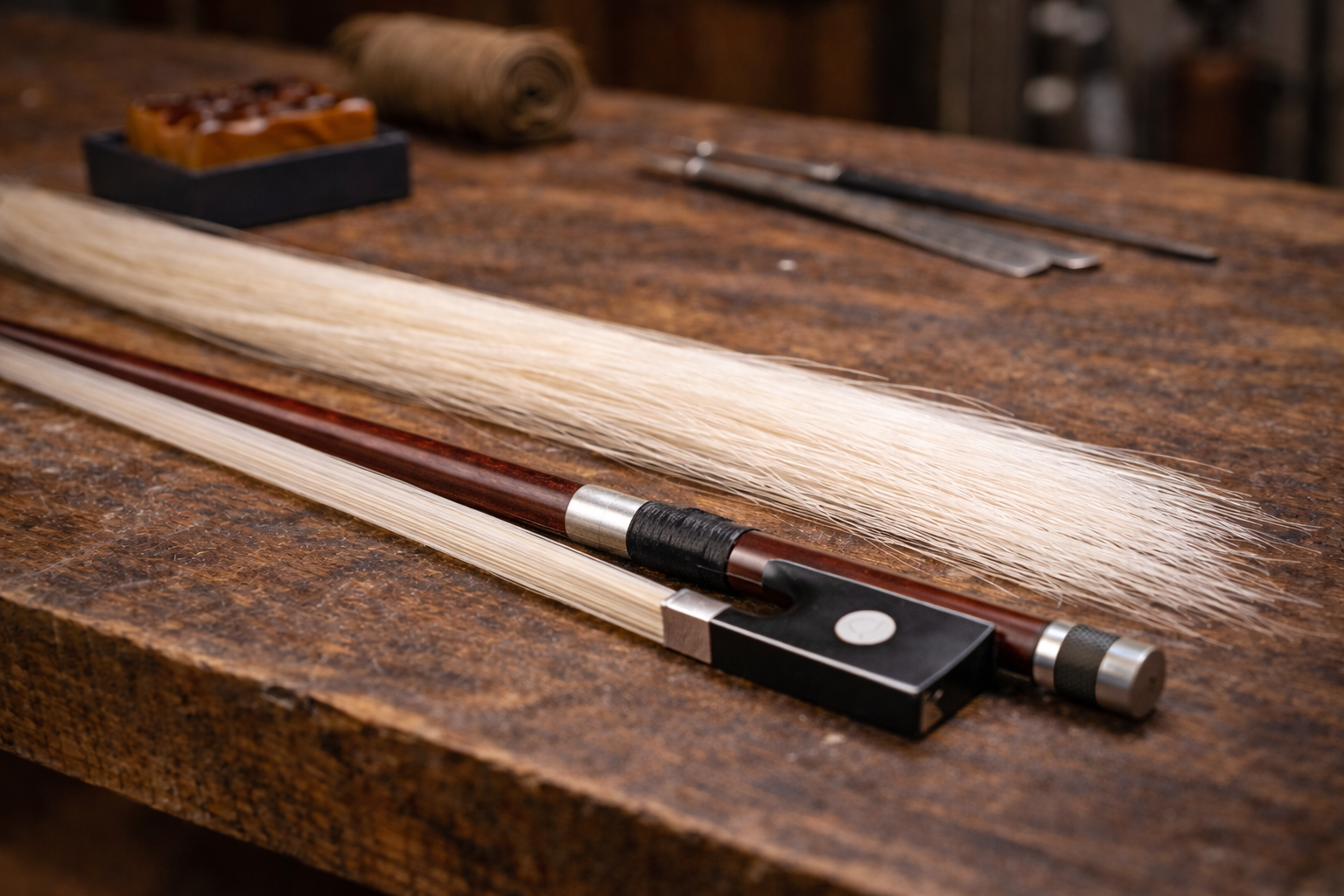
Most of the time, the bow hair is what slowly stops doing its job — often long before players realize it.
For adult beginners and intermediate players, worn bow hair is one of the most common causes of slipping, scratchy tone, and loss of control. This guide explains what bow hair is made of, how it wears out, when rehairing makes sense, and when replacing the entire bow is the smarter option.
What Violin Bow Hair Is Made Of (and Why It Wears Out)
Most violin bows are strung with natural horsehair, typically from cold-climate horses. This hair isn’t chosen for tradition — it’s chosen because of how it behaves under rosin.
Each strand of horsehair has tiny microscopic scales along its surface. When rosin is applied, it settles into those scales, creating friction against the string. That friction is what allows the bow to grip, start notes cleanly, and sustain tone.
Over time, several things happen:
- The scales wear smooth from repeated contact with strings
- Oil and sweat from the player’s hand migrate into the hair
- Dust and rosin buildup clog the surface
- Stretching causes uneven tension across the ribbon
Even if the bow stick itself is perfectly fine, worn hair can no longer hold rosin effectively. The result is a bow that feels slippery, inconsistent, or requires excess pressure to make sound.
This is normal wear — not poor technique.
Types of Violin Bow Hair (White, Black, and Blended)
White Bow Hair (Most Common for Violin)
White hair is the standard choice for violin bows. It provides balanced grip, predictable response, and good dynamic control.
Most adult players — beginners through advanced — are best served by white hair because it offers consistency without feeling overly aggressive.
Black Bow Hair (Less Common for Violin)
Black hair is thicker and naturally grippier. It’s more commonly used for bass bows and some folk styles.
For violinists, black hair can feel too grabby, less forgiving, and harder to control for subtle dynamics. It’s rarely recommended for classical violin playing unless a player has a very specific reason.
Salt-and-Pepper (Blended) Hair
Blended hair combines white and black strands. It’s uncommon for violin bows and doesn’t offer clear advantages for most adult learners.
For practical purposes, white hair is the right choice for nearly all violinists reading this guide.
Signs Your Bow Hair Is Worn Out (and Not Just Needing More Rosin)
Many players assume slipping or weak tone means they simply need more rosin. While rosin choice matters, it cannot restore worn hair.
Common signs of worn bow hair include:
- The bow slips even after applying fresh rosin
- You need noticeably more pressure to start notes
- The sound feels thin or unstable across strings
- Hair is breaking frequently along the ribbon
- The ribbon looks uneven or sparse in spots
If your bow suddenly feels worse, rosin choice can amplify the problem. A rosin that’s too hard or too soft for your environment can make worn hair feel even less responsive. This is explained in more detail in Best Violin Rosin for Adult Beginners (What Actually Matters).
When several of these signs appear together, the hair itself is almost always the issue.
How Often Adult Players Typically Need a Rehair (and Why)
There’s no fixed schedule for rehairing a bow. Bow hair wears out based on use, environment, and playing habits rather than calendar time.
Several factors influence how quickly hair degrades:
- Practice consistency — frequent playing wears hair faster
- Pressure habits — excessive pressure smooths the hair more quickly
- Environment — humidity and temperature changes affect hair tension
- Hand contact — touching the hair transfers oil that reduces grip
As a general guideline, casual adult players often need a rehair every 18–24 months, while regular players may need one closer to 12 months.
The most reliable indicator isn’t time — it’s whether the bow still responds the way it should.
Rehair or Replace the Bow? (A Practical Decision)
This decision is not about upgrading for better performance. It’s about whether maintenance makes sense for the bow you have.
Rehair the Bow If:
- The stick is straight and stable
- The frog tightens smoothly and evenly
- The bow feels balanced and comfortable in the hand
- The cost of rehairing is reasonable compared to the bow’s value
A well-made bow with worn hair almost always deserves a rehair.
Replace the Bow If:
- The bow was very inexpensive to begin with
- The stick feels weak, unresponsive, or unstable
- There are issues with the frog or screw mechanism
- Rehairing would cost close to the bow’s replacement price
In many entry-level bows, the stick itself limits control long before hair wear is the only issue. In those cases, replacing the entire bow is often the better investment.
If replacement makes more sense than rehairing, Best Violin Bows for Adult Beginners and Intermediates (Smooth Tone & Control) focuses on reliable, easy-to-control bows rather than performance upgrades.
Where to Get a Bow Rehaired (and What to Expect)
A proper bow rehair is performed by a trained technician or luthier and includes:
- Removing old hair
- Cleaning the frog and tip
- Installing new, evenly tensioned hair
- Aligning and finishing the ribbon correctly
Most violin shops that offer rentals also provide repair services, and many of those shops regularly perform bow rehairs. Even though rental programs are beginner-focused, the rehair work is often the same quality used for higher-end bows.
Your local violin shop is usually the best place to start. Extremely cheap mail-in services often cut corners that affect playability and longevity.
When the Problem Isn’t the Bow Hair
Sometimes a bow feels inconsistent not because the hair is worn out, but because contact point, pressure, or focus changes from day to day.
This is especially common for adult learners juggling limited practice time.
Practical Violinist Studio helps you practice with a clear, guided daily structure, making it easier to notice patterns in your sound over time — and tell the difference between an equipment issue and a practice inconsistency.
Learn more →
Summary
Bow hair is a consumable part of your setup. When it wears out, tone and control suffer — even if everything else is working properly.
Understanding when to rehair, when replacing the bow makes more sense, and when the issue lies elsewhere helps you make confident, informed decisions instead of guessing.
Leave a Reply