
Last Updated: November 2026
Violin cleaning products can get confusing quickly. Search online and you’ll find microfiber cloths, string cleaners, polish, oils, sprays, and complete cleaning kits that make it look like you need a cabinet full of products to take care of your violin.
You don’t.
For most players, a good cleaning cloth handles nearly all routine care. A few other products can be useful for stubborn rosin buildup or cleaning that a dry cloth alone can’t handle.
If you want the actual steps for cleaning your instrument, see How to Clean a Violin Safely. This guide is about the products themselves: which ones are worth buying, what each is useful for, and what I would leave out of your case.
What Most Violinists Actually Need
If you’re putting together a basic violin cleaning kit, start with a good cloth.
A soft microfiber cloth lets you wipe rosin dust, fingerprints, and perspiration from the violin and strings after playing without adding liquid cleaners to the instrument. Used regularly, that simple habit prevents most buildup before it becomes difficult to remove.
The other products in this guide are more specialized. A violin-specific cleaner can be useful in some situations, but it should be an occasional product rather than part of your everyday routine.
For most players, one or two good cleaning cloths are all you really need.
Best Violin Cleaning Cloths

Best overall cleaning cloth
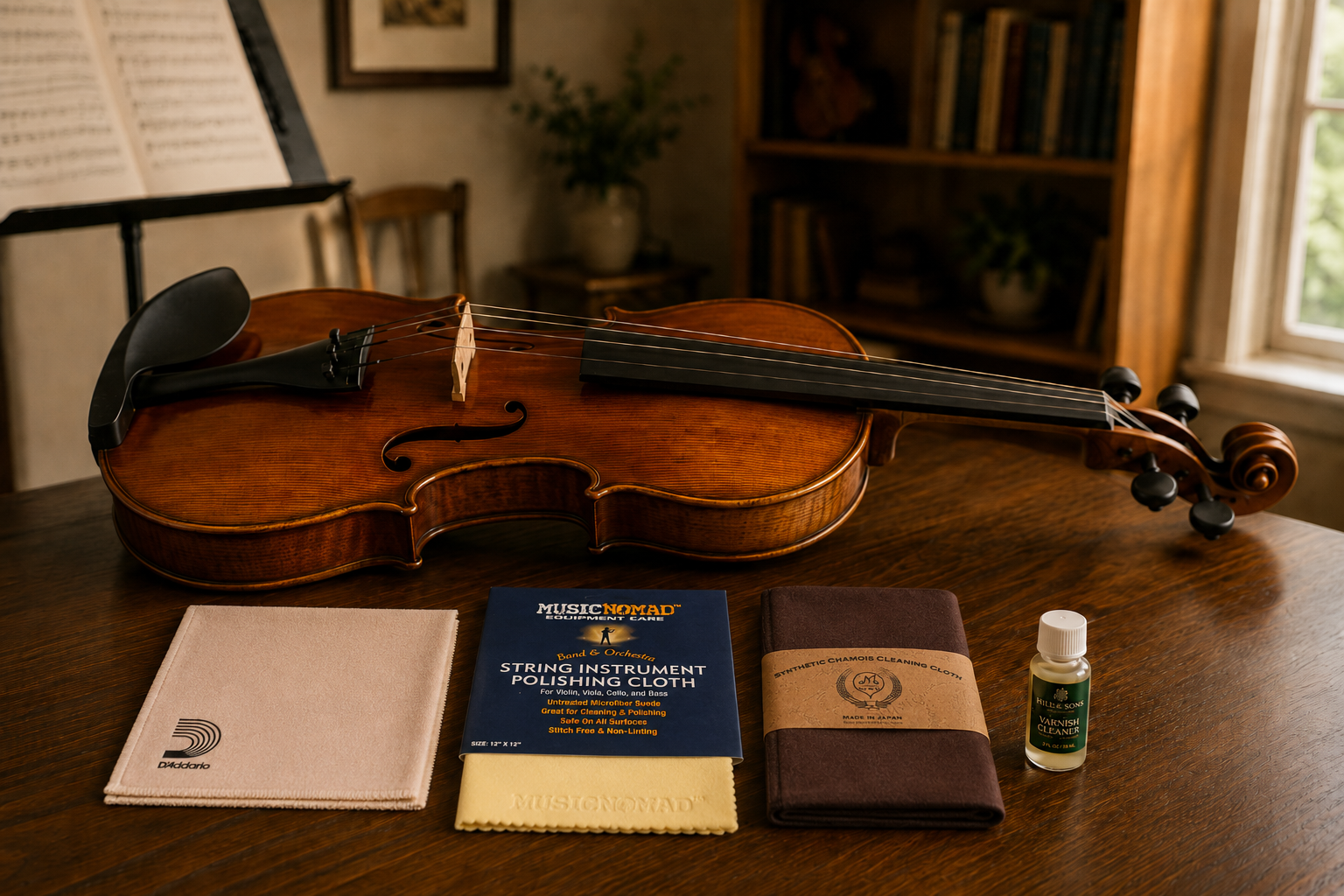
MusicNomad String Instrument Microfiber Polishing Cloth
The MusicNomad cloth is made specifically for violin, viola, cello, and bass. The soft, untreated microfiber picks up rosin dust, fingerprints, and oils without requiring a cleaning product, and the non-hemmed edge means there is no stitched border rubbing against the instrument.
If you want one simple cloth to keep in your case for your regular after-practice wipe-down, this is the one I would choose.
Good for: everyday cleaning, rosin dust, fingerprints, and routine after-practice care.

Best alternative or second cloth
D’Addario Orchestral Micro-Fiber Polishing Cloth
D’Addario’s Orchestral Micro-Fiber Polishing Cloth is another good option made for violin, viola, cello, and bass. It picks up rosin, dust, oils, and fingerprints without requiring a liquid cleaner and can be washed and reused.
This is also a good choice for a second cloth to keep in your case, allowing you to use one for rosin dust and the other for fingerprints and skin oils.
Good for: everyday cleaning or keeping a separate cloth for different cleaning tasks.

Best chamois-style cloth
MI&VI Synthetic Chamois Microfiber Instrument Cleaning and Polishing Cloth
The MI&VI cloth has a soft, chamois-like texture that feels different from a traditional microfiber polishing cloth. Designed for instruments including violin, viola, and cello, it works well for removing rosin dust and fingerprints after playing.
Good for: everyday cleaning and players who prefer a chamois-style cloth.
What If Rosin Won’t Come Off the Strings?
Most rosin should come off the strings with regular wiping. If it has hardened into a layer that a dry cloth will not remove, the strings may need a deeper cleaning.
I don’t think you need to buy a dedicated string cleaner just to have one in your case. There are not many violin-specific options I would recommend for routine use, and liquid cleaners require extra care because they must be kept away from the violin’s varnish.
If you are dealing with stubborn buildup, see How to Clean Violin Strings Without Damaging Your Instrument for the safer ways to handle it.
Do You Need a Violin Cleaner or Polish?
For routine care, probably not.
A good microfiber cloth should handle most of the cleaning your violin needs. The goal is to remove rosin dust, fingerprints, and perspiration regularly so they do not have a chance to build up.
A liquid cleaner may be useful occasionally if a dry cloth isn’t getting the violin clean, but it shouldn’t be part of your daily cleaning routine.
If you decide to use one, choose a product made specifically for violin-family instruments rather than furniture polish, guitar polish, or a general-purpose wood cleaner.

Best optional varnish cleaner
Hill & Sons Varnish Cleaner
Hill & Sons Varnish Cleaner is made specifically for traditional stringed instruments and is intended for occasional cleaning of the varnished surface.
This is the liquid cleaning product I would consider if a dry cloth is no longer doing enough and you want something made specifically for violin care rather than a general instrument cleaner.
For regular care, I would still stick with a microfiber cloth. If your violin is older, valuable, antique, or has damaged or unfamiliar varnish, it is safer to have a luthier handle deeper cleaning.
Good for: occasional cleaning of an appropriate violin when a dry cloth is not enough.
Skip it if: your violin stays clean with regular wiping or you are unsure about the type or condition of its varnish.
Products I Would Not Buy
The easiest way to waste money in this category is to buy a large “violin cleaning kit” because it appears to give you more for your money.
You may get polish, oil, wax, cleaner, cloths, brushes, and several little bottles for one low price. The problem is that you probably don’t need most of it.
I would rather buy one good violin cleaning cloth from a known company than a box containing six or eight products of questionable usefulness.
I would also skip:
- Furniture and household wood polish
- Guitar fretboard oils and conditioners
- General guitar cleaning sprays
- Silicone-based polishes
- Unbranded liquid violin cleaners
- Kits that do not clearly identify what is in each bottle
A product being safe for finished wood or guitars does not automatically make it appropriate for violin varnish.
For more detail on products and cleaning methods that can damage the instrument, see How to Clean a Violin Safely.
What I Would Buy for a Basic Violin Cleaning Kit
You don’t need to buy everything on this page. For most players, a simple cleaning setup works best.
If you just want the basics:
Start with one good cloth. The MusicNomad is my first choice, while the D’Addario and MI&VI cloths are also good options depending on the feel and style you prefer.
If you want a more complete setup:
Keep two cloths in your case. Use one for your regular dry wipe-down and keep the second separate for occasional cleaning with a liquid product.
If a dry cloth is no longer enough:
Hill & Sons Varnish Cleaner is the one liquid cleaning product on this list I would consider, but it is an occasional-use product rather than something every violinist needs.
For most adult players, I would start with one or two good cleaning cloths and stop there. Add the Hill cleaner only if you have a reason to use it. A small, simple cleaning kit is safer and more useful than a case full of bottles.
Why Two Cleaning Cloths Are Better Than One
If you’re ordering cloths anyway, there is a good argument for owning two.
Use one cloth for the strings and areas where rosin dust collects. Keep the second for removing fingerprints and skin oils from the rest of the violin. If you occasionally use a liquid cleaner, keep a separate cloth for that purpose.
Rosin eventually gets worked into a cleaning cloth. Having another clean cloth prevents you from spreading that rosin onto other parts of the violin.
Wash them periodically according to the manufacturer’s directions, and don’t use fabric softener or dryer sheets that can leave residue behind.
It’s an inexpensive addition to the case and more useful than most elaborate violin cleaning kits.
When Cleaning Products Aren’t the Answer
Sometimes the buildup on a violin is beyond what you should try to clean yourself.
If your violin has a thick layer of old rosin, dark grime that will not wipe away, sticky areas, damaged varnish, or anything that makes you think you need to scrub the surface, stop there.
A luthier can clean buildup without turning a small maintenance issue into damaged varnish.
The same applies if you don’t know much about the violin’s age or finish. There is no cleaner on this list that is worth experimenting with on a valuable instrument.
Your regular maintenance routine should prevent most instruments from ever getting to that point. Our Simple Violin Maintenance Checklist for Adult Players covers the other small care habits that are worth keeping up with.
Final Thoughts
If you’re shopping for violin cleaning products, I would spend the money on one or two quality cleaning cloths before buying any cleaners or polishes. The MusicNomad is my first choice, although all three cloths covered here are good options.
A quick wipe-down after each practice session takes less than a minute and can save you from having to deal with stubborn rosin and grime later. If you get into that habit, you may never need to buy a liquid violin cleaner.
Affiliate Disclosure: Some links in this article may be affiliate links. As an Amazon Associate and participant in other affiliate programs, we may earn from qualifying purchases at no additional cost to you.
Leave a Reply