
1678–1741
Antonio Vivaldi: An Interactive Timeline
Today, Antonio Vivaldi is best known for The Four Seasons. He was also a priest, a virtuoso violinist, a teacher of the Pietà’s accomplished musicians and a composer deeply involved in opera. Follow his life from a musical family in Venice to the theatres and courts of Europe, then on to his final journey to Vienna. Along the way, discover the people he worked with, the music they played and the records that preserve their stories.
Venice Beginnings 1678–1702
Music, family and the Church
Role / activity: Young violinist and clerical student
Setting: Venice: parish churches and St Mark’s
Antonio Vivaldi grew up in a Venice where music was part of everyday working life. His father, Giovanni Battista, earned his living as a violinist at St Mark’s, and the young Antonio appeared there as an additional player at Christmas 1696. Parish records also trace his training for the priesthood, which began long before his ordination. They offer tantalizing glimpses of a busy family and a developing musician, although no diary tells us exactly how he practiced or learned the violin. By the early 1700s, father and son were taking musical engagements together, and another Venetian institution was about to give Antonio a career of his own.
4 March 1678 — Antonio Lucio Vivaldi is born in Venice
Documented main claim: The birth and emergency baptism are established; this entry makes no claim about the precise circumstances of the birth.

Antonio Lucio Vivaldi was born in Venice on 4 March 1678, the son of Giovanni Battista Vivaldi and Camilla Calicchio. A midwife baptized him immediately after birth, and the parish recorded a subsequent church ceremony at San Giovanni in Bragora.
It was a busy household in a city where music was an everyday profession. The exact circumstances of Antonio's first hours are not recorded beyond the baptismal entry, but we know the names, the parish and the date with unusual precision for a seventeenth-century childhood.
Historical source: Michael Talbot · Treccani biographical study (open access)
June 1678 – death of older sister Gabriela Antonia — The sister Vivaldi never knew
Documented main claim: The parish-based research establishes Gabriela’s existence and death in June 1678; no precise day or personal response is established here.
Antonio had an older sister, Gabriela Antonia, born in 1676. She died in June 1678, when he was still an infant. Short biographies often begin the family story with Antonio, but the parish records preserve this earlier child and the loss that followed so soon after his birth.
Giovanni Battista and Camilla went on to raise several more children. Gabriela's brief life belongs in the family's story without trying to imagine how her parents spoke about her or how the loss affected an infant brother.
Historical source: Eleanor Selfridge-Field · Vivaldi’s Maternal Heritage, Studi vivaldiani 14, pp. 11–13
1680s–1690s — (Exact date unknown) More than a father-and-son musical household
Likely, but unconfirmed main claim: The family relationships and later copying work are documented; the decade is a broad narrative placement, not the date of one occurrence.
Antonio was one of several Vivaldi children, and music eventually became a family enterprise extending beyond the two violinists most people remember. His sister Cecilia married Giovanni Antonio Mauro, a professional music copyist who later worked within Antonio's circle.
That connection mattered when an opera company or an ensemble needed legible scores and individual parts on short notice. Mauro's later work gives us a glimpse of how family relationships and the practical business of producing music could overlap.
Historical source: Michael Talbot · Dizionario Biografico degli Italiani (2020)
23 April 1685 — His father joins the musicians of St Mark’s
Documented main claim: The father's appointment at St Mark's is dated; the suggestion that he taught Antonio is a scholarly inference.

On 23 April 1685, Giovanni Battista Vivaldi secured a place among the violinists of St Mark's Basilica. This was a prestigious employer in a city full of churches, theatres and working instrumentalists. For his seven-year-old son, it meant that one of Venice's important musical establishments was connected directly to the family.
Giovanni Battista is usually regarded as Antonio's first violin teacher. That is plausible, though no surviving lesson book lets us follow the instruction from one piece to the next.
Likely, but unconfirmed: Giovanni Battista Vivaldi was Antonio's first violin teacher.
A father-to-son apprenticeship is highly plausible and accepted by scholars, but no surviving record describes the earliest lessons.
Historical source: Church of the Pietà · Vivaldi biography (open access)
During Antonio’s childhood, 1680s — (Exact date unknown) Barbering and violin playing in one family
Likely, but unconfirmed main claim: The father’s occupations and St Mark’s appointment are documented. This broad childhood placement is contextual, not a dated incident.
Giovanni Battista's working life had another side: he was also associated with the barber's trade. The combination may seem unusual now, but families in seventeenth-century Venice could draw income from several kinds of skilled work.
A violinist employed at St Mark's was not automatically wealthy. With children to support and additional musical engagements to pursue, Giovanni Battista's household belonged to the city's working world rather than to an aristocratic court. Antonio's later career would likewise involve more than one source of income.
Historical source: Michael Talbot · Treccani, Vivaldi biography (2020)
1687 – a published account of Venice’s musical institutions — (Exact date unknown) Long before Vivaldi, Venice had outstanding women musicians
Documented main claim: Francesco Coli’s praise and its date are discussed in Selfridge-Field’s archival study. No meeting with the young Vivaldi is asserted.
When Francesco Coli described Venice's charitable institutions in the late 1680s, he singled out the musical accomplishments of the women at the Pietà. Antonio Vivaldi was still a boy, and the ensemble already had a reputation worth writing about.
Its singers and instrumentalists were trained within the institution, sometimes over many years, and played for audiences attending religious services. The women did not need Vivaldi to make them musicians. When he eventually arrived as a teacher, he would be joining a tradition they had already built.
Historical source: Eleanor Selfridge-Field · Music at the Pietà before Vivaldi, Early Music (1986)
1688 – an opera associated with his father — (Exact date unknown) Opera was part of his father’s musical world
Documented main claim: Talbot reports the 1688 opera and Giovanni Battista Rossi’s authorship. No evidence places Antonio at a rehearsal or performance.
The theatre was not a completely separate world from the Vivaldi family. In 1688, an opera titled La fedeltà sfortunata was staged in Venice with music attributed to Giovanni Battista Rossi, a name used by Antonio's father.
The attribution gives us a glimpse of Giovanni Battista's activity beyond the orchestra at St Mark's. We cannot place ten-year-old Antonio in the audience, but the production makes the family's connection with opera much less surprising when Antonio later entered the business himself.
Historical source: Michael Talbot · Treccani: Vivaldi’s family and early training
Late 1680s – Venice — The children behind Venice’s celebrated musical institution
Documented main claim: Kaley documents the Pietà’s charitable function and its extensive placement of children outside Venice; this is civic background, not a claim about Vivaldi’s childhood.
The Ospedale della Pietà began with a practical task: caring for children whose families could not provide for them. Many infants lived with wet nurses or foster families outside Venice; older residents might learn a trade. A smaller group of girls received the sustained musical training that attracted visitors and donations.
The institution was not an elite conservatory that happened to take in children. Its celebrated musicians lived within a charitable community sustained by gifts, legacies and civic support. Their musical achievements are more impressive when that wider reality is kept in view.
Historical source: Diana E. Kaley, The Church of the Pietà · International Fund for Monuments (1980)
22 July 1689 – appointment at the Mendicanti — His father takes a second teaching job across Venice
Documented main claim: The 1689 Mendicanti appointment is documented. The child Antonio’s participation in lessons there is not.
On 22 July 1689, Giovanni Battista Vivaldi added another appointment to his working schedule: maestro d'instrumenti at the Ospedale dei Mendicanti. Like the Pietà, it was a Venetian charitable institution with an established musical programme, but the two were separate organizations.
Antonio was eleven. The appointment does not show that he attended lessons there, but it does show how readily his father's professional life moved between church performance and instrumental teaching.
Historical source: Eleanor Selfridge-Field · Music at the Pietà before Vivaldi, Early Music (1986)
1690 – Venice — (Exact date unknown) A mutual-aid society brings the city’s musicians together
Documented main claim: Sardelli documents Giovanni Battista’s early membership in the Sovegno di Santa Cecilia in 1690. Antonio’s participation and contacts cannot be demonstrated.
Venetian musicians depended on colleagues for more than concerts. In 1690, Giovanni Battista Vivaldi joined the early membership of the Sovegno di Santa Cecilia, an association intended to provide mutual help within the profession. Giovanni Legrenzi and Francesco Partenio were among the musicians involved in its establishment.
The association helps explain how performers supported one another in a city without modern employment protections. It does not prove that Antonio went to meetings or studied with its members. It does show another side of the professional community around his family.
Historical source: Federico Maria Sardelli · The Early Works of Antonio Vivaldi, translated excerpt
Before 1690 – a traditional attribution examined — Was the young Vivaldi taught by Giovanni Legrenzi?
Likely, but unconfirmed main claim: Legrenzi’s position and death are established; direct composition or violin lessons from him to Antonio are not documented. The entry explicitly questions a traditional attribution.
Was Giovanni Legrenzi one of Vivaldi's teachers? His name appears in some biographies, and the connection is understandable: he was a leading composer at St Mark's while Giovanni Battista Vivaldi worked among its musicians.
Yet professional proximity is not evidence of lessons. Legrenzi died in 1690, when Antonio was twelve, and Federico Maria Sardelli treats the proposed pupil-teacher relationship as a possibility, not an established fact. The young violinist's musical education remains less well documented than his later performing and teaching career.
Historical source: Federico Maria Sardelli · discussion of the Vivaldi family’s musical circle
29 January 1691/92 – death of Gio. Francesco Temporini — A priest in the family leaves a complicated inheritance
Documented main claim: The death and family bequest records are documented. The suggested personal influence on Antonio’s priestly education is a scholarly possibility, not established fact.
The musical Vivaldis also had relatives in the Church. On Camilla Calicchio's side, Gio. Francesco Temporini was a priest attached to San Giovanni in Bragora, the family's parish. He died in January 1691/92, leaving a will that involved relatives, church property and earlier family bequests.
Eleanor Selfridge-Field has suggested that this connection might have mattered to Antonio's later clerical training. The will establishes a family relationship, but not a conversation or an agreement about his future. That distinction leaves room for the possibility without turning it into a family legend.
Historical source: Eleanor Selfridge-Field · Vivaldi’s Maternal Heritage, Studi vivaldiani 14, pp. 12–13
1693 — (Exact date unknown) A teenager begins the path to priesthood
Documented main claim: His clerical progression is attested; the precise tonsure month is inconsistently reported in secondary chronologies, so none is asserted here.
In 1693 the fifteen-year-old Antonio received the clerical tonsure, the first formal step on a path that would lead to priestly ordination ten years later. He was entering the secular clergy, whose members could still participate in the city's musical life.
For a young man already learning the violin, religious training did not necessarily mean abandoning performance. The Church offered a recognizable professional path, even if Antonio's private reasons for taking it have not survived.
Historical source: Michael Talbot · Dizionario Biografico degli Italiani (2020)
1693 onward – parish training documented in ordination registers — (Exact date unknown) Vivaldi’s priestly training took place in working churches
Documented main claim: The September 1693 tonsure and association with San Geminiano are recorded in the ordination register; later church affiliations also appear there. Specific lessons, attendance hours and violin practice routines are not documented.
The details of Antonio's clerical training are more concrete than the usual description of a boy 'entering the Church' suggests. The ordination register associates him with San Geminiano in 1693 and later with San Giovanni in Oleo. He trained under priests in working churches rather than following a course at a residential seminary.
That arrangement placed him within the ordinary life of Venetian parishes while his family continued its musical work. The registers give us institutions and stages of training, though not the day-to-day timetable of the young cleric.
Historical source: Karl Heller · Antonio Vivaldi: The Red Priest of Venice, chapter 3, p. 40
1693–1703 – years of clerical training — Why a young violinist entered the Church
Likely, but unconfirmed main claim: His clerical progression is documented. The individual reasons for the family’s choice are inferred from social conditions and cannot be stated as his private motives.
Why did Antonio choose the priesthood while developing as a violinist? It offered education, social standing and the prospect of a livelihood to someone without an inherited fortune. Venice also had room for clergy who worked as musicians, so the two pursuits need not have seemed incompatible.
What the records cannot settle is Antonio's personal motivation. A religious vocation, family expectations and practical opportunities are all possibilities, but no surviving statement by the young man ranks them for us. His later musical career shows how fully those worlds could overlap.
Historical source: Michael Talbot · Treccani, Vivaldi biography (2020)
Late seventeenth century – Venice — The Pietà Vivaldi knew was not today’s church
Documented main claim: The distinction between the earlier Pietà chapel and the present later building is documented; the description of daily activity is a general reconstruction, not a witnessed Vivaldi scene.

The Pietà church associated with Vivaldi today is not the chapel in which his early performances took place. The imposing later building was constructed after the institution had already developed its musical reputation. In Vivaldi's time, the chapel formed part of a working complex along the Riva degli Schiavoni, with rooms for the residents and the people who taught them.
Historic views help place that earlier setting on the Venetian waterfront. Remembering the building's history keeps us from imagining a 1703 performance inside the church that visitors see today.
Historical source: Diana E. Kaley, The Church of the Pietà · International Fund for Monuments (1980)
Christmas 1696 — (Exact date unknown) An early glimpse of Vivaldi performing
Documented main claim: A Christmas 1696 extra-violinist engagement is recorded; repertoire and audience reactions are not known.

At Christmas 1696, the eighteen-year-old Vivaldi served as an extra or substitute violinist in the musical establishment of St Mark's. It is one of the earliest records of Antonio performing as a musician in his own right.
The payment record names no repertoire, but it places him alongside working musicians at St Mark’s years before he published his famous concertos.
Historical source: Michael Talbot · Dizionario Biografico degli Italiani (2020)
Late 1690s – Venice — Another violinist in his father’s circle: Giorgio Gentili
Likely, but unconfirmed main claim: Gentili’s professional activity and proximity to the Vivaldi family are documented. Any direct teaching of Antonio remains a scholarly hypothesis.
Giorgio Gentili was a violinist and composer who worked in the professional circle surrounding St Mark's. His reputation as a performer appeared in Venetian writing about musicians, and he eventually published his own instrumental pieces.
Federico Maria Sardelli has proposed him as one possible influence on Antonio's early playing. The evidence supports acquaintance through the family's musical world, not a proven series of lessons. Gentili's career nevertheless gives a sense of the standards and opportunities available to a young Venetian violinist.
Historical source: Federico Maria Sardelli · The Early Works of Antonio Vivaldi
Around 1700 – the Venetian musical ospedali — Women were performing publicly in Venice before Vivaldi arrived
Documented main claim: Talbot describes the ospedali, the Pietà’s resident musicians, and its established choir and instrumental ensemble. The entry describes a longstanding situation, not a particular event dated to 1700.
Venice had several charitable ospedali whose resident women supplied music for worship. At the Pietà, the best performers received sustained training and some remained as musicians well into adulthood. Their concerts drew attention because listeners encountered singers and instrumentalists of considerable ability in an unusual institutional setting.
When Vivaldi arrived at the Pietà a few years later, he joined an established musical tradition. The women already had reputations, colleagues and responsibilities of their own.
Historical source: Michael Talbot · Treccani: the Pietà and its musicians
1701 – Pietà appointment — (Exact date unknown) A new musical director prepares the Pietà for Vivaldi
Documented main claim: Gasparini’s 1701 appointment is documented. The account explains institutional circumstances; it does not establish direct personal teaching between Gasparini and young Vivaldi.
In 1701 the Pietà hired Francesco Gasparini as maestro di coro, responsible for its vocal music. He brought experience from both church and opera, and the governors were expanding an already active programme in a city where charitable institutions competed for patrons' attention.
Gasparini's subsequent absences would leave a greater need for other composers to supply sacred pieces. Gasparini’s appointment shows the Pietà strengthening its musical staff shortly before Antonio arrived in September 1703, a young priest and violin teacher ready for his first long institutional post.
Historical source: Dizionario Biografico degli Italiani · Francesco Gasparini
1701 – Turin — (Exact date unknown) Father and son work together beyond Venice
Documented main claim: Sardelli identifies a documented 1701 journey to Turin by father and son. Concert repertoire and circumstances are not specified.
In 1701, two years before Antonio was ordained, he and Giovanni Battista were working together in Turin. The engagement is an early sign that the younger violinist's professional life was already taking him beyond Venice.
The surviving reference gives no programme or travel diary. Even so, the journey is significant: at twenty-three, Antonio was not simply preparing for a first formal job. He and his father were already pursuing musical work together in another city.
Historical source: Federico Maria Sardelli · documentation of the Vivaldis’ professional journeys
The Red Priest 1703–1710
A violin teacher at the Pietà
Role / activity: Priest, violin teacher and published composer
Setting: Ospedale della Pietà, Venice
The year 1703 changed Vivaldi’s working life. Ordained a priest in March, he joined the Ospedale della Pietà as a violin teacher in September. Its resident women and girls included accomplished singers and instrumentalists, and his duties soon extended well beyond basic lessons. He bought supplies, worked with players, and wrote music they could perform. His first published sonatas carried his name to readers outside Venice. The Pietà was also a demanding employer: in 1709 its governors declined to renew his appointment. The interruption did not last forever, but it reminded him that a musician’s livelihood depended on contracts and decisions made by other people.
23 March 1703 — Vivaldi is ordained a priest
Documented main claim: The ordination date is documented; the nickname should not be projected back onto 1703 as a documented title.
On 23 March 1703, Antonio Vivaldi was ordained a Catholic priest. His red hair eventually earned him the familiar nickname il Prete Rosso, the Red Priest, although the earliest surviving written use of that name is later.
Ordination did not end his musical career. In Venice a secular priest could work as a musician, and Vivaldi soon combined religious obligations with a demanding teaching position. His clerical status would also become relevant to disputes surrounding his later opera work.
Historical source: Church of the Pietà · Vivaldi biography (open access)
1703 – Pietà — A priestly obligation came with the new musical job
Documented main claim: The Mass duty and Vivaldi's relinquishment of it in 1706 are documented. His description of chest tightness and interrupted Masses comes from his 1737 letter. Asthma is a possible interpretation, not a confirmed diagnosis.
Alongside his work with the violin students, Vivaldi was assigned a Mass for the soul of a deceased benefactor. Such obligations formed part of the Pietà's religious life: gifts to the institution could carry continuing duties to remember the donor in worship.
In 1706, Vivaldi gave up this particular Mass assignment. In a letter written in 1737, he described a lifelong illness he called strettezza di petto, meaning 'tightness in the chest.' He said the condition had forced him to leave the altar on three occasions without completing Mass. Asthma has been suggested as an explanation, although his exact illness remains unknown. That is a more credible account than the later story that he abandoned Mass to write down a tune.
Historical source: Michael Talbot · Dizionario Biografico degli Italiani, Vivaldi
September 1703 — The Pietà hires a violin teacher
Documented main claim: The September appointment and general duties are documented; the individual routines of every pupil are not.
In September 1703, Vivaldi became maestro di violino at the Ospedale della Pietà. His appointment was to teach violin, not to take charge of the entire musical institution. Selected residents already played to a high standard, and the school employed other specialists alongside him.
For a young violinist trying to establish a career, it was an extraordinary workplace: an ensemble capable of tackling challenging music, a steady schedule of performances and an administration willing to invest in teaching. His formal employment would have interruptions, but his association with the Pietà lasted for decades.
Historical source: Michael Talbot · Dizionario Biografico degli Italiani (2020)
1703–1708 – Pietà — The Pietà was hiring wind teachers alongside its new violin master
Documented main claim: The booklet documents the oboe teachers and their years in the Pietà. It also shows the instrument was already present in Venice before Vivaldi’s appointment.
Vivaldi was not the only new specialist being brought into the Pietà. Employment records name Ignazio Rion as an oboe teacher in 1703, with Ludwig Erdmann appearing in the following years. The instrument was becoming increasingly useful in Venetian church and theatre music.
As these teachers developed the players' skills, the ensemble gained a wider range of sounds to draw upon. That matters when listening to Vivaldi's later concertos: some of their unusual instrumental combinations were made possible by a school steadily training players on more than one instrument.
Historical source: The Vivaldi Edition · Vivaldi and the oboe, historical booklet
Around 1703 – Pietà ensemble — The Pietà’s musicians ranged from teenagers to older adults
Documented main claim: The encyclopedia gives a range of ages and an occupational breakdown around Vivaldi’s arrival. It does not identify his individual pupils in that census.
The Pietà's performing group included seasoned adults as well as young learners. A scholarly account of its musicians around Vivaldi's arrival gives ages ranging from thirteen to seventy-one. Singers, organists, string players and theorbo players shared the same institution, though not necessarily the same level of experience.
For anyone picturing Vivaldi drilling a class of little girls, the age range is a useful correction. He entered a community where some women had spent many years developing and passing on their skills. We cannot identify the age of every person he taught, but the ensemble was plainly more than a children's class.
Historical source: New Catholic Encyclopedia Supplement 2011 · Antonio Vivaldi, Pietà personnel
1703–1709 – Pietà employment — A violin teacher also had to buy bows and strings
Documented main claim: Heller summarizes the documented teaching and purchasing duties and reimbursements; specific imagined purchases or repairs are deliberately excluded.
A good ensemble needed equipment that worked. The Pietà's accounts place purchases of string instruments, bows and strings among the practical responsibilities connected with Vivaldi's violin teaching. Expenses could be reimbursed, but someone still had to see that the players had what they needed.
For today's violinist, this is a particularly familiar part of the job. Behind the celebrated concertos stood instruments to maintain, strings to replace and administrative records to keep. The accounts are evidence of those duties without supplying an invented repair story for a particular rehearsal.
Historical source: Karl Heller · Antonio Vivaldi: The Red Priest of Venice, ch. 4
From 1703 onward — The Pietà was more than a beginner music school
Documented main claim: The historical event and main documented context are supported by the cited research.

The Pietà's selected players took part in regular religious performances and had to read, rehearse and coordinate demanding parts. Some were already highly accomplished before Vivaldi joined the staff.
That is why his teaching position was so fertile for composition. He could write music with particular players in mind, hear it rehearsed and adjust it for musicians accustomed to serious ensemble work. Their achievement deserves attention alongside his, especially when a concerto assigns the violinist a passage that is anything but elementary.
Historical source: Michael Talbot · Treccani, Vivaldi biography (2020)
17 August 1704 – salary resolution — A pay raise tells us how the Pietà valued its new teacher
Documented main claim: The governors’ August 1704 resolution raised the stated annual rate from sixty to one hundred ducats. Whether that increase applied retroactively is a scholarly interpretation.
The governors' resolution of 17 August 1704 is unusually encouraging about Vivaldi's first year. They increased his annual pay by forty ducats, bringing it to one hundred, and specifically praised the teaching that justified the expense.
A salary decision is a small but revealing piece of biography. It shows an employer making a favorable judgment while the young priest was still establishing himself. The same governors retained the power to reconsider the appointment, and five years later they would do just that.
Historical source: Giuseppe Gullo · Studi vivaldiani 22 (2022), discussion of Pietà salary records
17 August 1704 – Pietà salary increase — Vivaldi earns more by teaching an unfamiliar instrument
Documented main claim: The dated governors’ decision and 40-ducat increase are documented. The exact identity of the instrument called viola all’inglese is a matter of musicological interpretation.
In August 1704, the Pietà rewarded Vivaldi for taking on instruction beyond his original violin duties. The governors' decision refers to the viola all'inglese, an instrument whose exact identity is debated, and to the progress of his teaching.
The annual pay attached to his position rose from sixty to one hundred ducats. Whatever the instrument's precise construction, the payment shows that the school valued a teacher willing to extend the ensemble's range beyond ordinary violin playing.
Likely, but unconfirmed: The viola all’inglese taught at the Pietà was a member of the viol rather than modern violin family.
Scholars have proposed and revised identifications of this historical instrument term; the payment record establishes the duties without describing an instrument’s construction.
Historical source: Michael Talbot · Vivaldi and the English viol, reproduced liner notes
December 1705 – Teatro Sant’Angelo — A first foothold in the opera house
Documented main claim: Talbot states that Vivaldi contributed part of the music to a 1705 opera; Corago identifies a production around 12 December 1705 primarily with Girolamo Polani. Vivaldi should not be credited with the entire opera.
In late 1705 Vivaldi contributed music to Creso tolto a le fiamme at Venice's Teatro Sant'Angelo. He was not the sole composer of the production, but the assignment placed him inside an opera house years before his first complete stage work.
Theatre called for a different kind of collaboration from the Pietà. Music had to fit a libretto, the singers who were available and the demands of an existing production. This early contribution gave Vivaldi a foothold in an industry that would become one of the most complicated parts of his career.
Historical source: Michael Talbot · Treccani: Vivaldi’s early theatre work
1705 – collection published (Exact date unknown) — Suonate da camera a tre
English translation: Chamber sonatas for three parts
Op. 1 (including RV 63)
Documented main claim: Op. 1 was published in 1705; composition dates and initial performances of individual sonatas are not fixed.

In 1705 Vivaldi's first printed collection appeared in Venice: twelve chamber sonatas for two violins and continuo. The paired violins share and trade ideas, supported by a bass line, rather than placing one star soloist in front of an orchestra.
The last sonata, the Follia, RV 63, takes a familiar repeating bass pattern through a lively succession of variations. The final sonata, La Follia, is particularly lively; the listening selection presents that piece rather than the whole volume. Publication put Vivaldi's name and music into the hands of players who had never heard him perform in Venice.
Historical source: Michael Talbot · Dizionario Biografico degli Italiani (2020)
1705 – surviving edition of Op. 1, no. 12 (Exact date unknown) — Sonata a tre in re minore, «La Follia»
English translation: Trio Sonata in D minor, “La Folia”
RV 63; Op. 1, no. 12
Documented main claim: The surviving edition dates to 1705. Some scholars discuss an earlier edition; this entry does not assign a secure composition date.
A simple, repeating musical pattern can become an astonishing display of imagination. In the final sonata of Vivaldi’s Op. 1, two violins and continuo work through a sequence of variations on the old Folia pattern. One section moves solemnly; another races along with quick notes or a sharply changing rhythm. The bass holds the structure together while the upper players find fresh ways to answer each other.
The sonata was included in the Venetian edition dated 1705, though the possibility of an earlier printing has been discussed. It is a particularly inviting work for violin players to watch: the filmed performance lets us see how a small Baroque ensemble divides the musical work among its members.
Historical source: IMSLP · Trio Sonata in D minor, RV 63, Op. 1 no. 12
1706 – Vincenzo Coronelli’s guide to Venice — (Exact date unknown) A Venetian guide lists father and son among the city’s violinists
Documented main claim: Coronelli’s 1706 guide names Giovanni Battista and Antonio; it does not describe a specific joint concert.
Vincenzo Coronelli's 1706 guide to Venice named both Giovanni Battista Vivaldi and Antonio among the city's noteworthy violinists. The younger man was by then a priest and a teacher, but this contemporary recognition concerned his playing.
Long before his concertos made him famous abroad, Vivaldi was known in Venice as a working violinist. Coronelli's listing offers a firmer early witness than later stories about an astonishing child prodigy. It does not tell us which performances prompted the praise.
Historical source: Karl Heller · Antonio Vivaldi: The Red Priest of Venice, early-career discussion
1706 – published description of a Pietà musician — (Exact date unknown) Prudenza could sing and play more than one instrument
Documented main claim: The contemporary guidebook identifies Prudenza’s musical abilities. Her personal lessons with Vivaldi are not documented.
A 1706 guidebook to Venice singled out a Pietà musician named Prudenza, praising her ability to sing soprano and play both the violin and an instrument called the violoncello inglese. That is a rare glimpse of a named woman’s abilities during Vivaldi’s early years at the institution.
Musicians such as Prudenza were not simply anonymous players waiting for a composer to hand them music. Some were accomplished across several instruments and could help the ensemble meet unusual demands. Vivaldi was on the teaching staff by this time, but the surviving guidebook does not tell us whether he personally taught Prudenza or which pieces she performed.
Historical source: Michael Talbot · The Pietà’s instrumentalists and early viols
1706 — (Exact date unknown) Why Vivaldi stopped fulfilling a Mass obligation
Documented main claim: The end of a particular Mass obligation in 1706 is documented; a precise modern diagnosis is not.
By 1706 Vivaldi had given up the Mass obligation attached to his early Pietà appointment. The explanation in the records concerns recurring chest trouble; in later correspondence he also described difficulty breathing.
The popular story that he left Mass unfinished in order to write music is a different matter. No contemporary document verifies that episode. His difficulty with the obligation is real enough without either the comic scene or a confident modern diagnosis of the illness behind it.
Historical source: Michael Talbot · Dizionario Biografico degli Italiani (2020)
11 May 1706 – instrument-loan deed — Six viols arrive at the Pietà on loan
Documented main claim: The deed documents a loan of six viols. The precise relationship between those instruments and every occurrence of the term viola all’inglese remains debated.
On 11 May 1706, six viols from the collection of the late nobleman Alberto Gozzi were lent to the Pietà. They remained in the institution's care for almost twenty years. The loan came during the period when Vivaldi had been asked to teach an instrument called the viola all'inglese.
A school could enlarge its collection by borrowing as well as buying. These six instruments put another range of bowed-string sounds at the musicians' disposal. Historical names for viols are not always consistent, so the loan should not be mistaken for a list of six modern violas.
Historical source: Michael Talbot · Notes on Vivaldi and the English viol
Around 1707–1710 – manuscript associated with Pietà musicians — Four performers’ names survive on a remarkable chamber score
Likely, but unconfirmed main claim: The Sonata RV 779 manuscript names instrumental parts associated with the Pietà musicians. Some readings and the chronology remain uncertain; Pellegrina’s teaching is separately documented in scholarship. See also Karl Heller, Antonio Vivaldi: The Red Priest of Venice, chapter 4, p. 53.
Four women's names appear beside the instrumental parts of Vivaldi's Sonata RV 779. They appear to identify Prudenza on violin, Pellegrina on oboe, Lucietta on organ and Candida on salmoè, a type of chalumeau related to the early clarinet family. The combination tells us something about the exceptional instrumental abilities cultivated at the Pietà.
Pellegrina was more than a named performer. She also taught music at the institution, passing her skills on to other students. The score offers a rare connection between a surviving piece of music and the women who played it. Some of the names are difficult to read, and the manuscript does not establish an exact composition or first-performance date.
Historical source: The Vivaldi Edition · Alfredo Bernardini, notes on RV 779 and the Pietà musicians
July 1708 – serenata in Rovigo — A lost serenata honors a retiring official in Rovigo
Documented main claim: A 1708 printed libretto documents the occasion and work; the original score is lost.
In July 1708, Vivaldi supplied Le gare del dovere (RV 688), a serenata marking the end of Francesco Querini's term as podestà of Rovigo. We know the subject from a surviving printed libretto, which gives roles to figures such as Night, Time, the River Adige and the city itself. The music itself has been lost. Although the printed words survive, we can no longer hear what Vivaldi composed for this occasion.
This was a public occasion involving local government and musical celebration, five years before Vivaldi's first complete opera. It also shows that the composer was beginning to find work beyond Venice while still developing his reputation as a violinist and teacher.
Historical source: Clori · Italian Cantata Archive, Le gare del dovere (1708 libretto)
1703–1709 – first Pietà appointment — An acclaimed teacher still answered to the governors
Documented main claim: Both the 1704 favorable salary decision and the 1709 nonrenewal are documented; this entry draws the institutional connection without inventing his feelings.
The Pietà's musicians worked under governors who controlled appointments and the money attached to them. The documents from Vivaldi's first years include a favorable pay decision, but they also show how short the distance could be between praise and an employment vote.
These were not lifetime appointments. Administrators weighed cost and usefulness, and a highly skilled teacher could lose a post when the governors changed course. That institutional reality helps explain the interruption in Vivaldi's employment in 1709 without treating it automatically as a verdict on his musical ability.
Historical source: Karl Heller · Antonio Vivaldi: The Red Priest of Venice, ch. 4
Early publications, 1705–1709 — Patrons mattered before the concertos were famous
Documented main claim: The historical event and main documented context are supported by the cited research.
A printed book could carry Vivaldi's music into rooms he would never visit. His early publications named prestigious dedicatees, including Annibale Gambara and, later, Denmark's Frederik IV. A dedication was a way of introducing both the compositions and their author to someone with influence.
Such gestures were part of the business of music. They could raise a composer's standing, though they do not by themselves prove a payment or a lasting friendship. Even while teaching at the Pietà, Vivaldi was finding ways to reach patrons and buyers elsewhere.
Historical source: Michael Talbot · Treccani, Vivaldi biography (2020)
1709 – royal dedication and publication — (Exact date unknown) A book of violin sonatas reaches a visiting king
Documented main claim: The 1709 Op. 2 publication and dedication to King Frederik IV are documented. The description of Vivaldi’s motives is presented as context, not as a quotation of his intentions.
Op. 2 carried a dedication to Frederik IV, king of Denmark and Norway, who had visited Venice. Addressing a king in print gave Vivaldi a conspicuous introduction beyond the city's churches and concert audiences.
The sonatas do not try to overturn the chamber style of their day. Their mixture of lyrical violin writing, quicker passages and dances shows a musician fully at ease with an established form. The political importance of the dedicatee and the musical craft of the pieces belong to different sides of the same publication.
Sonate a violino e basso
By early 1709 – publication
English translation: Sonatas for violin and bass
Op. 2
Documented main claim: The collection was announced in 1708 and printed no later than early 1709.

Vivaldi's Op. 2 brought twelve sonatas for solo violin and continuo into print by early 1709. Their expressive slow passages and lively dance movements belong to the Italian chamber tradition in which Corelli was an important model.
The violin is given plenty to say, though it is a different kind of display from the large concertos that would soon make Vivaldi famous. Because the publication is dated more securely than the pieces' first composition, it is best understood as a milestone in his public career rather than a record of twelve new works written in one season.
Historical source: Los Angeles Philharmonic · Vivaldi Op. 2 violin sonatas
Historical source: Los Angeles Philharmonic · Vivaldi Op. 2 and Frederik IV
1709 – Prudenza’s marriage and dowry — (Exact date unknown) A musician leaves the Pietà with instruments of her own
Documented main claim: Talbot identifies the instruments among the dowry goods. No subsequent professional career or individual performances are established by the record.
When Prudenza married in 1709, the property recorded in her dowry included two violins, a viola all’inglese, a spinet and an angelica, a kind of lute. This was a working musician’s collection, not just a list of household furnishings. It suggests the practical value of instruments to a woman whose training had taken place within the Pietà.
Many members of the coro remained there for adult life; others married or entered religious communities. Prudenza’s recorded instruments offer a concrete example of how musical skill and material possessions could accompany someone beyond the institution. We do not know what music she continued to play after leaving.
Historical source: Michael Talbot · Instrument ownership and Prudenza’s dowry
February 1709 — The Pietà declines to renew his appointment
Documented main claim: The non-renewal is documented; the governors’ precise motivation is less securely established.
In February 1709 the Pietà's governors did not renew Vivaldi's teaching post. His first Pietà appointment lasted less than six years. The job was neither permanent nor secure. The institution regularly reviewed its musical staff and faced financial decisions of its own.
Michael Talbot considers economy a more likely explanation than any proven problem with Vivaldi's teaching or conduct. The documentary outcome is clear, but the private discussions behind the vote are not fully recoverable. The interruption lasted until his return in 1711.
Likely, but unconfirmed: Budget pressure was the main reason the Pietà did not renew Vivaldi.
Scholarly interpretation favors economy, but the surviving decision does not conclusively reveal each governor’s motive.
Historical source: Michael Talbot · Dizionario Biografico degli Italiani (2020)
6 July 1710 – Pietà regulations — What the Pietà expected from its chief vocal composer
Documented main claim: The 1710 Pietà resolution is documented. The duties described were for the maestro di coro, not an attribution of all those works to Vivaldi.
A 1710 resolution by the Pietà's governors lays out the workload expected of the maestro di coro: music for major feasts, regular motets and compositions for funerals, Holy Week and other occasions. The schedule shows why sacred music required an organized staff and a steady supply of new scores.
These were the duties of the chief vocal composer, not a personal checklist assigned to Vivaldi. The resolution shows how closely the institution managed the music it needed. When Vivaldi returned to the Pietà in 1711, those same demands would shape the opportunities open to him, even as his newly printed concertos were reaching Europe.
Historical source: Karl Heller · Antonio Vivaldi: The Red Priest of Venice, ch. 4
A Rising Reputation 1711–1717
Violin virtuosity meets the opera stage
Role / activity: Violin virtuoso, concert director and opera impresario
Setting: Venice: the Pietà and opera theatres
Around 1711 Vivaldi was reaching audiences he had never met. His concertos were being printed in Amsterdam, he and his father accepted engagements beyond Venice, and the Pietà would soon welcome him back. The published collection L’estro armonico helped make his name familiar to violinists across Europe, while visiting players such as Johann Georg Pisendel encountered him in person. At the same time, Vivaldi was entering the expensive, unpredictable world of opera. By 1717 he was balancing instrumental writing, theatre productions and the Pietà’s changing expectations. A new position at a princely court would soon offer a different kind of musical life.
1711 – Op. 3, no. 10 published (Exact date unknown) — Concerto per quattro violini in si minore
English translation: Concerto for Four Violins in B minor
RV 580; Op. 3, no. 10
Documented main claim: The published work and later Bach adaptation are established. Publication cannot by itself date its original composition.
Four solo violins take the stage in this B-minor concerto from Op. 3. They divide ideas among themselves, sometimes answering one after another and sometimes joining forces, while the cello and string ensemble help shape the musical argument.
Bach recognized the possibilities of this unusual design and arranged the concerto for four harpsichords as BWV 1065. A Voices of Music film captures the four soloists sharing the opening movement, giving a close view of the musical conversation.
Explore further: Compare Vivaldi’s original with Bach’s version: Hear Bach's four-harpsichord arrangement, BWV 1065 (Netherlands Bach Society, full filmed performance).
Historical source: Netherlands Bach Society · Bach’s arrangement of RV 580
1711 – published in Amsterdam (Exact date unknown) — L'estro armonico
English translation: The harmonic inspiration
Op. 3 (twelve concertos)
Documented main claim: The 1711 publication and international influence are attested; individual concerto composition dates may be earlier.

An Amsterdam edition published in 1711 made Vivaldi's music available to violinists far from Venice. L'estro armonico, Op. 3, contains twelve concertos that vary the number of solo violins and the way they play against the string ensemble.
Among them are the A-minor solo concerto RV 356, familiar to generations of students, the two-violin concerto RV 522 and the four-violin concerto RV 580. The complete recording lets you hear all twelve works in their published order. Johann Sebastian Bach studied this collection and arranged some of its music for keyboard. A book of printed parts had given Vivaldi's musical ideas a life well beyond his own performances.
Explore further: Bach would later study and rework some of these concertos. Follow his career in the Johann Sebastian Bach interactive timeline from Weimar to Leipzig.
Historical source: Michael Talbot · Dizionario Biografico degli Italiani (2020)
1711 – published as Op. 3, no. 6 (Exact date unknown) — Concerto per violino in la minore
English translation: Violin Concerto in A minor
RV 356; Op. 3, no. 6
Documented main claim: The 1711 publication and identification as RV 356 are secure. The original composition date is not known.
The A-minor Concerto RV 356 may sound familiar to adult violin students even if they do not recognize its number. The outer movements demand steady rhythm, clean attacks and agile playing, while the slow movement asks for a singing line without the excitement of sheer speed.
It appeared in L'estro armonico as Op. 3, No. 6, in 1711. A period-instrument performance by Voices of Music brings out the relationship between solo violin and ensemble, something easy to miss when learning the solo part alone.
Explore further: For a guided tour of how violin concertos developed, explore The Violinist’s Guide to Classical Music including its Vivaldi and Bach lessons.
Historical source: IMSLP · Violin Concerto RV 356, publication and score
1711 – publication of Op. 3, no. 8 (Exact date unknown) — Concerto per due violini in la minore
English translation: Concerto for Two Violins in A minor
RV 522; Op. 3, no. 8
Documented main claim: The 1711 publication and Bach’s organ transcription are documented. The concerto may have been composed earlier.
In RV 522, the eighth concerto of L'estro armonico, two solo violins alternately chase, answer and join one another. They are partners rather than a leader and an accompanist, and the larger ensemble takes part in the conversation.
Bach later reworked the concerto for organ as BWV 593, preserving its musical exchanges while translating them into a different instrument's possibilities. A filmed performance by Augusta McKay Lodge and Isabelle Seula Lee makes the interplay especially easy to follow. The 1711 publication date is secure, even though the first composition of the concerto may be earlier.
Explore further: Compare Vivaldi’s original with Bach’s version: Hear Bach's organ arrangement, BWV 593 (Netherlands Bach Society, full filmed performance).
Historical source: Netherlands Bach Society · BWV 593 and Vivaldi RV 522
February 1711 – Brescia — Father and son are invited to play away from Venice
Documented main claim: The Polish Music Library and Heller’s chronology report the Vivaldis performing at Santa Maria della Pace in February 1711. Records of each individual performance are limited.
In February 1711, Antonio and Giovanni Battista Vivaldi performed in Brescia, the city from which their family had come. For the younger violinist it was another engagement outside Venice, undertaken with the father who had been his closest professional connection since youth.
The visit also led into a different kind of work. The Oratorians of Santa Maria della Pace commissioned a Stabat Mater for 1712. A journey made as a performer could open a door for a composer, particularly where church musicians and local patrons already knew the family name.
Historical source: Polish Music Library · Father and son at Brescia, February 1711
27 September 1711 — Vivaldi returns to the Pietà
Documented main claim: Talbot confirms the 1711 reappointment. The more precise 27 September date is reported in Karl Heller’s published chronology, p. 316.
On 27 September 1711, the Pietà reappointed Vivaldi after a two-year interruption. He returned to musicians he knew, but to an employer that could still judge his work and vote on his future.
The position gave him a regular place to teach and work with an unusually versatile ensemble. It also placed him back inside the institution's schedules, finances and administrative decisions. Those practical arrangements would shape his career as much as the music itself.
Historical source: Michael Talbot · Treccani biographical study (open access)
Around 1712 – composed for celebrations in Padua — Concerto per violino in re maggiore, «Per la solennità della S. Lingua di S. Antonio in Padua»
English translation: Violin Concerto in D major for the Feast of St Anthony
RV 212
Likely, but unconfirmed main claim: The concerto’s dedication names St Anthony’s celebration in Padua. The composition and performance are placed around 1712; the surviving sources do not justify a precise day.
Vivaldi’s D-major Violin Concerto, RV 212, is associated with ceremonies honoring the relic of St Anthony’s tongue in Padua. Its title connects a virtuoso instrumental work with a particular religious celebration, not merely with a printer’s catalog. The solo violin has brilliant, athletic writing, including a striking cadenza that gives the player room for dazzling display.
A modern filmed performance offers a chance to watch a violinist navigate the final movement rather than simply hear the notes. The dedication links the concerto with the Padua celebration, although the surviving sources do not give us an exact concert program. The performance video features the final Allegro, including its dazzling solo writing.
Historical source: IMSLP · Violin Concerto in D major, RV 212, original dedication
1712 – commissioned in Brescia — Stabat Mater
English translation: The Mother Stood in Sorrow
RV 621
Likely, but unconfirmed main claim: The 1712 commission and scoring are supported by historical research; the frequently given 18 March performance date is probable rather than a fully reconstructed eyewitness program.

The Oratorians at Santa Maria della Pace in Brescia commissioned Vivaldi's Stabat Mater in 1712 for a religious observance honoring the Virgin Mary's sorrows. The piece is written for a low solo voice, strings and continuo, and much of its expression comes from restraint rather than virtuoso display.
The surviving music sets only part of the traditional poem, consistent with its intended liturgical use. A performance on 18 March is commonly associated with the work, though the commission and the year are more firmly established than the precise details of that service.
Historical source: American Bach Soloists · History and scoring of the Stabat Mater
19 July 1712 — A new violin for Anna Maria
Documented main claim: A dated Pietà expense record identifies the instrument purchase; the maker and repertoire played on that violin are not established.
A Pietà account records a payment on 19 July 1712 for a violin associated with Anna Maria. The entry gives us something tangible from the education of a musician who would become one of the institution's outstanding performers.
The account does not identify the maker, and it cannot tell us which concerto she first played on that instrument. Anna Maria's subsequent career as a performer and teacher, however, shows that the investment was made in a musician with a long future at the Pietà.
Explore further: Curious about the instruments these players used? Our History of the Violin Through Its Makers course introduces the makers and violin-making traditions of the period.
Historical source: Michael Talbot · Historical documentation of Anna Maria (open access)
Around 1713 – Bach’s organ transcription, BWV 593 — Bach encounters Vivaldi through printed music
Likely, but unconfirmed main claim: The relationship between Vivaldi’s RV 522 and Bach’s BWV 593 is documented. Around 1713 is the scholarly dating of the arrangement, not an exact day.
Vivaldi and Johann Sebastian Bach are not known to have met, but the printed concertos created an important connection. Around 1713, Bach arranged Vivaldi's two-violin Concerto RV 522 for organ as BWV 593 while working in Weimar.
A piece written around the interplay of two solo violins became a work for keyboards and organ manuals. Bach was engaging with the structure of an Italian concerto, not merely copying a popular tune. Their surviving music lets us hear that exchange across national boundaries even without a documented personal encounter.
Hear the music: Bach’s organ arrangement of Vivaldi RV 522, BWV 593
Explore further: For Bach’s side of this musical exchange, explore our Johann Sebastian Bach timeline including his Weimar years.
Historical source: Netherlands Bach Society · Organ Concerto BWV 593, after Vivaldi
Autumn 1713 — He takes on the business of a Venetian opera house
Documented main claim: His 1713 involvement in Teatro Sant’Angelo is documented; this entry describes normal production responsibilities without claiming particular undocumented incidents.
Later in 1713 Vivaldi and his father became involved in managing opera at Venice's Teatro Sant'Angelo. An impresario had to engage singers, secure texts and music, arrange rehearsals and persuade audiences to buy tickets. The risks were financial as well as artistic.
That experience helps explain the brisk, sometimes frustrated tone of Vivaldi's later business letters. Writing the music was only one part of putting an opera on stage, and he increasingly took responsibility for the rest.
Historical source: Michael Talbot · Dizionario Biografico degli Italiani (2020)
May 1713 – first production (exact day not securely established here) — Ottone in villa
English translation: Ottone at the villa
RV 729
Documented main claim: The University of Bologna’s Corago database records the first production at Teatro delle Garzerie, Vicenza, in May 1713. Its open record does not establish 17 May as an exact day.

In May 1713, Ottone in villa was staged in Vicenza, Vivaldi's first complete opera. He had supplied music to theatre productions before, but now the score was his own responsibility. The surviving autograph allows us to examine the work itself, not simply its title in a theatrical register.
Karl Heller's chronology gives 17 May for the premiere; some accounts identify only the month. For Vivaldi this was a substantial new undertaking, requiring a full score for singers, instrumentalists and a public theatre.
Historical source: Università di Bologna · Corago: Ottone in villa (May 1713)
May 1713 – Vicenza — Why did Vivaldi’s first complete opera open outside Venice?
Likely, but unconfirmed main claim: The May 1713 Vicenza opening is established. The motive of avoiding Venetian scrutiny is Talbot’s interpretation, not a documented statement by Vivaldi.
It is striking that Vivaldi's first complete opera opened in Vicenza rather than his home city of Venice. The production of Ottone in villa was linked to a theatre run by local patrons, giving the composer an opportunity to present a full score outside the crowded Venetian opera scene.
The choice of city reflects the networks through which Italian opera travelled. Singers, money, theatres and suitable dates mattered as much as a composer's reputation. The surviving evidence establishes the Vicenza production, but not a single decisive private reason for the choice of venue.
Historical source: Michael Talbot · Dizionario Biografico degli Italiani, Vivaldi
June 1713 – Vicenza — An oratorio follows his first opera
Documented main claim: Historical biography places a June 1713 oratorio at Santa Corona in Vicenza; no surviving score permits musical analysis.
Vivaldi did not leave Vicenza after the May production of Ottone in villa. In June, the city also heard his sacred dramatic work La vittoria navale at the church of Santa Corona. The program shows how quickly he was moving between opera and religious music, with the violinist’s reputation opening doors in both settings.
The music of this oratorio is not known to survive. The surviving evidence tells us when the oratorio was presented, but without its score the music itself is lost to us.
Historical source: Polish Music Library · Scholarly Vivaldi biography and 1713 Vicenza performance
1714 – documented oratorio; music lost — (Exact date unknown) An oratorio disappears from the record
Documented main claim: The historical event and main documented context are supported by the cited research.
The Pietà mounted an oratorio known as Moyses Deus Pharaonis in 1714. Vivaldi was increasingly supplying sacred vocal music after the departure of the institution's regular choir director, Francesco Gasparini. This work belongs to that broader responsibility.
The score has not survived, so we should resist describing musical passages no one can inspect. Its importance is documentary: it reminds us how incomplete the surviving picture of Vivaldi's career is. One celebrated work preserved by chance can loom larger in modern accounts than several pieces once heard by real audiences.
Historical source: Michael Talbot · Treccani, Vivaldi biography (2020)
About 1713–1717 – composition date approximate — Nisi Dominus
English translation: Unless the Lord Builds the House
RV 608
Likely, but unconfirmed main claim: Autograph and instrumentation are established; the 1713–1717 date is approximate, with no securely established first performance.

Vivaldi’s setting of Nisi Dominus, RV 608, turns a Latin psalm into a nine-movement work for solo alto and instruments. Its best-known movement, Cum dederit, slows the pace with an expressive, almost suspended vocal line. A viola d’amore adds another distinctive string color to the score.
The autograph survives in Turin, giving us direct contact with Vivaldi’s working music. Specialists generally place it around 1713–1717, but no securely dated premiere tells us exactly when it was first heard. The recording link begins a concert performance by Philippe Jaroussky and Ensemble Matheus; it is a modern interpretation rather than an attempt to reconstruct a named Pietà singer.
Historical source: IMSLP · Nisi Dominus, RV 608 (surviving score and catalogue)
Around 11 November 1714 – Venice premiere — Orlando finto pazzo
English translation: Orlando Pretending to Be Mad
RV 727
Likely, but unconfirmed main claim: A production at Sant’Angelo in November 1714 is established; Corago places the premiere around 11 November rather than asserting an exact day.
Vivaldi brought Orlando finto pazzo to Teatro Sant’Angelo during the autumn season of 1714. Its world is full of disguise, enchantment and shifting loyalties, taken from the Orlando tradition of Italian epic poetry. Writing the opera required more than producing attractive arias: singers, librettist, orchestra and stage managers all had parts to play.
The University of Bologna’s opera catalog places the premiere around 11 November, not on an absolutely secure day. The opera has a complicated relationship with the theatre’s other Orlando productions, so its reception should not be reduced to a single unsupported anecdote about public failure. The musical selection is an audio performance rather than a film of a staged production.
Historical source: Corago, University of Bologna · Orlando finto pazzo production
1715 – correspondence — (Exact date unknown) A Ferrarese family connection predates the famous later letters
Documented main claim: The journal notes an extant letter to Luigi Bentivoglio from 1715. It expressly cautions that the extent of Vivaldi’s early acquaintance with Guido is unknown.
Many of Vivaldi’s most revealing surviving letters concern difficult opera arrangements with Marchese Guido Bentivoglio in the 1730s. But the relationship between the composer and this noble family was older. Scholarship identifies a surviving 1715 letter from Vivaldi to Guido’s father, Marquis Luigi Bentivoglio. The later business correspondence was built on a pre-existing Ferrarese connection.
A letter documents contact, not necessarily friendship. We cannot tell from this early item that Guido and Vivaldi already knew one another closely; Guido was then very young. Those family connections would become important when Vivaldi needed help with opera arrangements many years later.
Historical source: Studi vivaldiani 22 (2022) · scholarly discussion of the Bentivoglio correspondence
By the mid-1710s – family manuscript work — A brother-in-law becomes one of his key copyists
Documented main claim: Talbot identifies Mauro as Vivaldi’s principal amanuensis from the middle of the 1710s. The date is approximate rather than an identified appointment day.
Vivaldi’s sister Cecilia married Giovanni Antonio Mauro, whose work as a music copyist became increasingly important to the composer during the 1710s. The sheets copied for singers, instrumentalists and patrons were necessary if Vivaldi’s prolific writing was to reach a rehearsal, an opera theatre or a foreign court.
Music histories naturally concentrate on the autograph, the page written by the composer. But surviving copies preserve a second kind of labor: neat, accurate parts made by other hands. Mauro’s connection to the family also shows how Vivaldi’s professional life continued to depend on trusted people around him.
Historical source: Michael Talbot · Treccani: Cecilia Vivaldi and copyist Giovanni Antonio Mauro
February–March 1715 — A visitor admires Vivaldi’s violin playing but questions his style
Documented main claim: The meetings and descriptions survive in Uffenbach’s diary; his judgment of the music is an opinion, not an objective verdict.
The German traveler Johann Friedrich Armand von Uffenbach heard Vivaldi perform in Venice during Carnival 1715. His diary describes a violinist whose quick and difficult playing left him amazed, though the same listener found the effect less pleasing than it was ingenious. This is a rare chance to hear a contemporary react with a mixture of admiration and criticism.
Uffenbach also dealt with Vivaldi over concertos and heard him play privately. The account shows a virtuoso who could impress potential patrons directly, not simply a composer represented by printed scores.
Historical source: Library of Congress · Uffenbach travel-diary account
About 1713–1717 – date approximate — Credo in mi minore
English translation: Credo in E minor
RV 591
Likely, but unconfirmed main claim: The autograph and identity of RV 591 are documented. Placement around 1713–1717 is scholarly dating, not a dated ceremony.

Vivaldi’s Credo in E minor, RV 591, sets the words of the Nicene Creed for four-part choir, strings and continuo. The surviving autograph in Turin gives us direct access to this sacred-music side of the composer’s work, where the choral writing is supported by energetic, precisely shaped instrumental lines.
Specialist editors place it broadly between 1713 and 1717, not on a known service date. In a recording sung by women’s voices, the autograph score can be followed on screen. The lively orchestral writing sets the solemn text in motion. The manuscript does not name the original singers or a first performance.
Historical source: Carus-Verlag · Credo in E minor, RV 591, dating and scoring
1710s – Pietà performances — (Exact date unknown) Sacred music at the Pietà sounded different from a normal church choir
Documented main claim: Selfridge-Field documents the women’s institutional ensembles and their history. No specific performer or first performance is asserted for this general context.
The Pietà’s reputation rested partly on an extraordinary musical arrangement: women and girls provided both the choral singing and the instrumental playing. The institution educated musicians who could meet demanding vocal and instrumental assignments, making its religious services a destination for visitors interested in fine music.
That fact should not be simplified into the claim that every performer was a child or that every surviving Vivaldi sacred work can be assigned to the Pietà. Some residents remained skilled musicians into adulthood, and Vivaldi also wrote for other patrons. Nevertheless, the institution’s female ensemble helps explain the sound world and musical opportunities surrounding much of his sacred output.
Historical source: Eleanor Selfridge-Field · Music at the Pietà before Vivaldi
Around 19 February 1715 – Venetian production — A Roman emperor appears on Vivaldi’s stage
Likely, but unconfirmed main claim: Corago identifies the February 1715 opera production but marks the exact premiere day as approximate.
In February 1715, Vivaldi’s Nerone fatto Cesare appeared at Teatro Sant’Angelo. Venice’s opera season demanded a steady supply of productions, often built around changing casts and familiar historical or legendary subjects. Vivaldi was working within a crowded business in which an opera could be mounted, altered and then disappear from regular use.
The score has not survived in a form that allows us to present a complete performance today. The production is known through theatrical documentation. The documented staging shows how active Vivaldi was in the opera business, even though we cannot hear the original score today.
Historical source: Corago, University of Bologna · Vivaldi opera performances
June 1715 – Pietà board decision — The Pietà rewards Vivaldi’s sacred-music work
Documented main claim: The 1715 governors’ vote and its listed categories of music are preserved through historical research; the identity of every listed piece is not known.
In June 1715 the governors of the Pietà voted Vivaldi a bonus for work filling a gap in the institution's sacred music. Their account mentions a substantial body of music, including a Mass, music for Vespers, an oratorio and many motets. The board also wanted him to continue improving the musical abilities of the girls and women in its ensemble.
It's unusually valuable to have an employer's assessment rather than only the composer’s own boasts or later compliments. The vote shows the board weighing both the supply of new scores and the practical development of the performers. Which individual surviving pieces correspond to every item in the list is another question, and not all of that music has come down to us.
Historical source: Los Angeles Philharmonic · Gloria program notes citing 1715 Pietà minutes
1716 — (Exact date unknown) A Dresden violinist studies with Vivaldi
Documented main claim: Pisendel’s 1716 contact and instruction are attested; a detailed transcript of individual lessons is not preserved.

During the visit of a Saxon party to Venice in 1716–1717, the Dresden violinist Johann Georg Pisendel encountered Vivaldi and studied his music. Pisendel was already an accomplished player, not a beginner seeking elementary instruction.
Their contact produced a remarkable surviving paper trail: sonatas, concerto copies, corrections and later performance annotations. Those pages make the relationship especially interesting to violinists today. We can see the music they worked with, even where we cannot reconstruct their conversations.
Historical source: Vivaldi Edition · Concertos for Pisendel, scholarly notes (PDF)
c. 1716 – Op. 5 publication — Another printed book widens the choices
Likely, but unconfirmed main claim: Scholarly sources place the Op. 5 print in this period; its exact issue date and individual composition dates should not be conflated.
In the same productive publishing period, Op. 5 offered four sonatas for violin with continuo and two trio sonatas. These are less famous than the concertos, yet they show that Vivaldi had not abandoned the intimate chamber-music forms in which his printed career began.
A violin concerto requires a larger group and the contrast between soloist and orchestra. A sonata can be played by only a few musicians, making musical conversation more exposed. The side-by-side existence of these publications is a useful corrective to a biography that treats Vivaldi as if he wrote only orchestral showpieces.
Hear the music: Violin and trio sonatas, Op. 5 (complete six-sonata recording)
Historical source: Michael Talbot · Treccani, Vivaldi biography (2020)
Probably 1713–1717 – exact date uncertain — Gloria
English translation: Gloria in D major
RV 589
Likely, but unconfirmed main claim: The work and its surviving music are established. Its precise composition and first-performance dates are uncertain.

Vivaldi's Gloria in D major, RV 589, is among the best-known sacred works associated with his years supplying music for the Pietà. It moves from a bright, festive opening into passages of quieter supplication and close exchanges between singers and orchestra. Violins are not simply accompaniment: their rhythms and phrases help shape the changing character of the text.
The surviving score supports the work's identity, but we cannot give it a securely documented first-performance day. Scholars usually place it in the period of his intensive sacred composition around 1713–1717. A filmed performance by Hervé Niquet and Le Concert Spirituel makes the exchange between singers and instrumentalists visible as well as audible.
Historical source: Nashville Symphony · Gloria RV 589 historical program notes
Late 1716 or early January 1717 – exact performance date debated — Juditha triumphans devicta Holofernis barbarie
English translation: Judith triumphant over the barbarism of Holofernes
RV 644
Likely, but unconfirmed main claim: The surviving autograph and Venetian war setting are established. The original performance is generally placed in late 1716, but scholarly research has proposed early January 1717; November 1716 is not verified as an exact first-performance date.
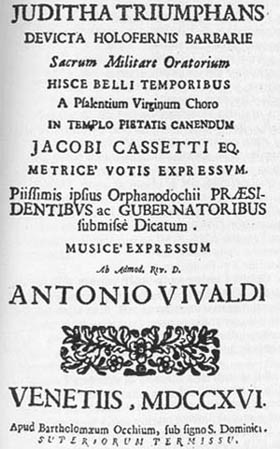
Vivaldi’s sacred oratorio Juditha triumphans tells the biblical story of Judith and Holofernes, while its language and imagery also reflect Venice’s war with the Ottoman Empire. It demanded a remarkable range of voices and instruments from the musicians of the Pietà, whose surviving autograph score is preserved in Turin.
Its first performance is less securely dated than many accounts suggest. It is traditionally placed in late 1716, often November. Musicologist Eleanor Selfridge-Field has argued that early January 1717 is also a plausible possibility, based in part on the movements of Venetian commander Johann Matthias von der Schulenburg. Neither proposed performance date should be presented as a settled fact.
Likely, but unconfirmed: The first performance of Juditha triumphans occurred in November 1716.
Eleanor Selfridge-Field finds a plausible alternative in early January 1717; the surviving dated references do not settle the first performance beyond doubt.
Historical source: Eleanor Selfridge-Field · Dating Juditha triumphans, pp. 207–221 (Cini PDF)
1716 – published in Amsterdam; composed earlier (Exact date unknown) — Concerto per violino in si bemolle maggiore
English translation: Violin Concerto in B-flat major
RV 383a; Op. 4, no. 1
Documented main claim: The collection was published in 1716; the concerto’s date of original composition is not established. The linked listening item is the first movement only.
The first concerto in Vivaldi’s La stravaganza, Op. 4, gives the solo violin an agile role against a responsive string ensemble. Shifts of mood, lively rhythmic turns and the contrast between the outer movements and the central Largo make it much more than a string of difficult passages. The writing is demanding, but its appeal lies as much in the musical exchanges as in the soloist’s agility.
The collection appeared in print in Amsterdam in 1716, but an announcement in the earlier Op. 3 suggests that at least some of the music existed before then. Rachel Podger and Arte dei Suonatori bring out the inventiveness of the opening movement in the listening selection.
Historical source: IMSLP · La stravaganza, Op. 4, historical publication and score
1716 – Op. 4 publication — (Exact date unknown) La stravaganza reaches violinists in print
Documented main claim: The historical event and main documented context are supported by the cited research.
Vivaldi's La stravaganza, Op. 4, circulated through Amsterdam publishing in 1716. Its twelve concertos were intended for a world in which music traveled as printed pages, passed from one violinist to another and was adapted to different performing situations. The solo writing could be brilliant, but the orchestral responses were just as important to the effect.
For a recreational player, these concertos are rewarding to hear alongside his better-known Four Seasons. They show how the violin could switch from singing melodies to quick passages, unusual gestures and conversations with a string ensemble. The publication year is firmer than the original composition dates of individual concertos.
Hear the music: La stravaganza, Op. 4 (complete twelve-concerto recording)
Historical source: Michael Talbot · Treccani, Vivaldi biography (2020)
1716–1717 – Venice and Dresden — Scores passed between two working violinists
Documented main claim: Original Dresden manuscript sources, dedications and copies support the relationship; particular undocumented lesson topics and conversations are not invented.

Pisendel's visit created opportunities for music to travel between Venice and Dresden. He acquired and copied Italian works, including Vivaldi concertos, which could then be played and studied by the skilled musicians of the Saxon court.
A hand-copied score was a practical object: it could be carried home, marked up and used in rehearsals. The surviving Dresden collection offers a record of this exchange that is more concrete than an anecdote about two virtuosos admiring one another.
Likely, but unconfirmed: The surviving annotated works reflect a substantial exchange of performance and compositional ideas between Vivaldi and Pisendel.
Autographs and annotations document professional contact, but their exact conversations and sequence of lessons are not preserved.
Historical source: Vivaldi Edition · Research on the concertos for Pisendel
19 January 1716 – Venice premiere — An opera about loyalty launches the 1716 Carnival season
Documented main claim: Corago identifies 19 January 1716 as the premiere. The original libretto survives; the entire original musical performance cannot be reconstructed.

Vivaldi’s La costanza trionfante degl’amori e degl’odii opened at Teatro San Moisè on 19 January 1716. Antonio Marchi’s drama placed rulers and lovers in a maze of concealed identities, rival claims and tests of faithfulness. The dated libretto shows us a working production: a theatre, a printed text, named roles and a season that had to attract paying audiences.
The opera later traveled under altered titles and in revised forms. That afterlife begins with this first Venetian production, whose title page survives even though its original stage sounds cannot be recovered complete. The pictured title page was printed for the original Venetian production.
Historical source: Corago, University of Bologna · La costanza trionfante, first production
29 March 1716 – governors’ vote — Seven votes were not enough to keep Vivaldi at the Pietà
Documented main claim: The 29 March 1716 board vote, seven of twelve in favor, and two-thirds rule are documented in Pietà minutes quoted by Heller. Neglect of duties because of outside activities is scholarly interpretation, not a stated motive in the surviving vote.
A vote at the Pietà in 1716 illustrates the uncertainty built into Vivaldi's employment. The governors did not automatically reward a successful musician with continued service: a proposal could receive substantial support and still fail under their rules.
The decision belongs to the administration's records, not to a documented public quarrel. Vivaldi's name remained associated with the institution's music, but his formal position depended on the outcome of votes rather than fame abroad.
Historical source: Karl Heller · Antonio Vivaldi: The Red Priest of Venice, chapter 4, p. 53
24 May 1716 — From violin teacher to maestro de’ concerti
Documented main claim: Talbot confirms the 1716 promotion to maestro de’ concerti. The exact date of 24 May comes from Karl Heller’s printed chronology, p. 316.
In 1716 Vivaldi acquired the title maestro de' concerti at the Pietà, emphasizing his responsibility for instrumental music rather than simply violin lessons. The change recognized the importance of supplying and directing music for an accomplished ensemble.
It was not the same role as maestro di coro, whose duties centered on sacred vocal music. That distinction explains why Vivaldi could carry considerable artistic responsibility without occupying every office in the institution.
Historical source: Michael Talbot · Treccani biographical study (open access)
27 October 1716 – Venice premiere — A queen, a disguise and a difficult theatrical puzzle
Documented main claim: The first production and 27 October date are listed in Corago; the drama is fictional, and no specific contemporary staging image is being claimed.

Vivaldi’s Arsilda, regina di Ponto reached Teatro Sant’Angelo on 27 October 1716. Domenico Lalli’s plot turns on a startling disguise: Lisea passes herself off as her brother Tamese, believed dead, while the real Tamese returns in another identity. The title page and cast list name the theatrical workers who had to make the changing identities intelligible to an audience.
The story was invented for the opera stage, not a factual account of an ancient kingdom. It shows Vivaldi working in a form where vocal casting, costumes, stage movement and a complicated text could matter as much as the orchestral writing. The original libretto, reproduced here, records the characters and their elaborate plot, though not the actors’ actual costumes or movements.
Historical source: Corago, University of Bologna · Arsilda, regina di Ponto, 1716 production
1716–1717 – Venice — A Dresden violinist’s score preserves Vivaldi’s corrections
Documented main claim: Vivaldi-Pisendel musical exchange is established; the surviving joint working manuscript is discussed in specialist scholarship. Spoken dialogue cannot be reconstructed.
Ink on a manuscript brings us unusually close to Vivaldi and the visiting Dresden violinist Johann Georg Pisendel. On a concerto score associated with Pisendel, corrections and additions have been identified as Vivaldi’s own.
The written changes show two working musicians in direct contact, exchanging ideas about music that would later travel north. We do not have their conversations, but we do have a page on which their work is visible.
Historical source: Michael Talbot · Vivaldi or Not Vivaldi? (scholarly study)
Early eighteenth-century copies; attribution reassessed later — A sonata credited to Vivaldi may belong to someone else
Likely, but unconfirmed main claim: Pisendel’s copy names Vivaldi, but Michael Talbot (2020) presents substantial evidence, including thematic borrowings and stylistic fingerprints, for attributing RV 34 to Diogenio Bigaglia. The existence of the inscription is certain; the corrected attribution is a strong scholarly assessment.
The violin sonata catalogued as RV 34 bears Vivaldi's name in a copy made by the Dresden violinist Johann Georg Pisendel. For many years, that inscription was treated as convincing evidence of authorship. Yet a familiar name on a manuscript is not always the composer's own.
Musicologist Michael Talbot has identified close musical parallels with works by Diogenio Bigaglia, a Venetian composer born the same year as Vivaldi. His comparison of themes, writing style and manuscript evidence makes a substantial case that RV 34 is really Bigaglia's work. The manuscript attribution is documented, but the modern reassignment remains a scholarly conclusion rather than a surviving signature by Bigaglia.
Historical source: Michael Talbot · Vivaldi or Not Vivaldi? The unreliable attribution of Sonata RV 34 (2020)
Around 1716–1717 – dedication to Johann Georg Pisendel — A sonata written for Pisendel bears a personal dedication
Likely, but unconfirmed main claim: The manuscript dedication to Pisendel is established; the precise composition date and any initial private performance remain uncertain.
Vivaldi's A-major Sonata RV 29 bears a dedication to Johann Georg Pisendel. Written for violin and continuo, it alternates expressive lines with quicker passages that give an accomplished player plenty of room for musical character.
A dedication on a manuscript is direct evidence of music intended for a particular colleague. It does not establish when or where they first played the sonata together, but the document places Pisendel firmly within Vivaldi's professional violin circle.
Hear the music: Violin Sonata in A major, RV 29 (complete)
Historical source: IMSLP · Sonata for Violin in A major, RV 29, Pisendel dedication
Around 1716–1717 – court visit; exact concerto date uncertain — An oboe concerto labeled “for Saxony”
Likely, but unconfirmed main claim: The “per Sassonia” inscription is documented. Assigning the concerto to a specific performance or individual Saxon oboist would be speculative.
Vivaldi’s autograph of an F-major oboe concerto, RV 455, bears the words “per Sassonia,” or “for Saxony.” The inscription links his music to the musicians of Dresden’s court orchestra, whose distinguished players visited Venice with the electoral prince in 1716–1717. One of the visiting musicians was oboist Johann Christian Richter.
This is a revealing contrast to the picture of Vivaldi as a composer concerned only with spectacular violin solos. His network included players who could carry demanding wind music back to a powerful court. The wording on the manuscript is real; the exact occasion, player and date for which RV 455 was first prepared remain less certain.
Hear the music: Oboe Concerto in F major, RV 455 (complete, cued within album)
Historical source: The Vivaldi Edition · Oboe concertos and the “per Sassonia” inscription
1717 – surviving operatic score — (Exact date unknown) An unusual bowed instrument enters a scene in Dario
Likely, but unconfirmed main claim: The article reproduces and discusses the autograph aria instrumentation. The proposed interpretation of viola all’inglese as a sympathetic-string instrument is musicological, not fully settled.
The autograph of L’incoronazione di Dario includes an aria with a part for viola all’inglese, an unusual bowed instrument also associated with the Pietà’s teaching records. That detail brings Vivaldi’s instrumental curiosity into the opera house: a color heard in the training of Venice’s young musicians could also serve a dramatic scene.
The name is not a tidy match for a modern viola. Researchers have connected it with the viol family and, in some interpretations, instruments fitted with sympathetic strings. Because the precise construction remains disputed, the surviving written part is more useful than any attempt to assign it one unquestioned modern equivalent.
Historical source: Viola da Gamba Society research on the viola all’inglese in Dario
1717 – commission request — (Exact date unknown) Bologna asks Vivaldi for sacred music
Likely, but unconfirmed main claim: Michael Talbot documents the proposed 1717 invitation to Vivaldi and the apparent lack of follow-through; the Treccani biography of Pietro Giuseppe Sandoni confirms that Sandoni supplied the 1717 Dixit Dominus and Magnificat. No specific surviving Vivaldi score can be securely linked to the proposal.
In 1717 the Accademia Filarmonica of Bologna considered asking Vivaldi to provide either a setting of Dixit Dominus or a setting of Magnificat for its celebrations. The invitation shows how far his reputation for sacred music had reached, beyond his work as a violinist and composer of concertos.
The proposal appears not to have resulted in a composition by Vivaldi for Bologna. The academy instead obtained settings of both texts from Pietro Giuseppe Sandoni. Vivaldi composed other settings of Dixit Dominus and Magnificat, but none can securely be identified as the work intended for this invitation.
Historical source: Michael Talbot · Treccani, Vivaldi biography (2020)
1716–1717 and subsequent Dresden use — Pisendel’s copies carry the marks of a working violinist
Documented main claim: Pisendel’s Vivaldi manuscripts and annotations are documented; particular ornaments are not automatically attributed to Vivaldi himself.
Pisendel continued working on the concertos he collected in Venice. His copies preserve ornaments, expressive markings and occasional revisions that tell us how a skilled violinist adapted a score for performance. Some were added in Venice, while other changes reflect later musical life in Dresden.
For violinists today, the manuscripts are a vivid reminder that eighteenth-century musicians did not necessarily treat every printed or handwritten note as untouchable. Not every mark can be claimed as a direct instruction from Vivaldi; several belong to Pisendel himself.
Historical source: Early Music Performer · Pisendel and Vivaldi manuscript annotations
1713–1717 – temporary sacred-music responsibilities — Supplying church music while a colleague is absent
Documented main claim: Gasparini’s absence and Vivaldi’s assumption of sacred composition duties are documented; this is a multi-year work pattern, not one dated performance.
When Francesco Gasparini was away from Venice, Vivaldi supplied sacred vocal music as well as instrumental works for the Pietà. That meant writing for singers, instrumentalists and religious occasions whose demands differed considerably from those of a violin concerto.
The surviving works demonstrate how broad his activity became. They should not all be assigned automatically to a particular week or to a permanent appointment as maestro di coro. The institution's staffing arrangements changed over time, and Vivaldi's contributions changed with them.
Historical source: Michael Talbot · Dizionario Biografico degli Italiani (2020)
1716–1717 setting; anecdote preserved later — The violinist who reportedly would not let the orchestra rush him
Main claim from a later recollection: Pisendel’s Venice visit and association with Vivaldi are established. The orchestra speeding up and Pisendel beating time are reported by later writer Johann Adam Hiller, not securely verified eyewitness testimony.
A story recorded later by Johann Adam Hiller places Pisendel in a Venetian performance of a Vivaldi concerto. According to the account, the orchestra began to rush a difficult passage and Pisendel held his tempo, marking the beat with his foot until the others settled down. The visiting Saxon prince supposedly found it amusing.
It is a delightful image of a violinist refusing to be hurried, but it comes from a later recollection. The encounter between Pisendel and Vivaldi is documented; this particular scene and the concerto involved cannot be independently confirmed.
Historical source: The Vivaldi Edition · Vivaldi and Pisendel, booklet discussion of Hiller’s anecdotes
23 January 1717 – Venice premiere — L’incoronazione di Dario
English translation: The Coronation of Darius
RV 719
Documented main claim: Corago dates the premiere and identifies the libretto. The Turin autograph score is listed in the manuscript description for RV 719.

L’incoronazione di Dario, or The Coronation of Darius, opened at Teatro Sant’Angelo on 23 January 1717. The Venetian libretto credits an older dramatic text by Adriano Morselli. Vivaldi supplied the music for a three-act opera that placed the Persian world on a stage designed for Carnival entertainment, with competing ambitions and theatrical reversals rather than an accurate history lesson.
Much of the handwritten score survives in Turin. It is a different kind of testimony from a printed libretto: on its pages we can examine Vivaldi’s instrumental decisions and the shape of the music that accompanied the characters. The two types of sources together tell a richer story than the title alone.
Historical source: Corago · Venetian premiere and libretto of L’incoronazione di Dario
16 October 1717 – Venice premiere — A royal marriage becomes a Venetian opera
Documented main claim: The venue and 16 October premiere are documented in Corago. Medieval characters in the plot are not evidence that the opera depicts their lives reliably.
On 16 October 1717 Vivaldi’s Tieteberga opened at Teatro San Moisè. The libretto draws its central figures from the history of the Frankish kingdoms, with a queen, her husband Lotario and a web of conflicting loyalties. The actual medieval past supplied names and a starting point; the relationships and staged speeches were shaped to satisfy eighteenth-century opera audiences.
Its production offers another glimpse of Vivaldi’s work outside the Pietà while the orchestra and sacred music there still demanded his attention. The original printed libretto survives, giving us the opening date and the dramatis personae. Much of the original music is lost, but the libretto documents another autumn spent supplying Venice’s stages. Within months Vivaldi would exchange his familiar Venetian world for a position at the Mantuan court.
Historical source: Corago, University of Bologna · Tieteberga, 16 October 1717
Mantua and Beyond 1718–1721
Court music and a growing opera career
Role / activity: Court music director and opera composer
Setting: Mantua, Venice and other Italian theatres
In 1718 Vivaldi moved from Venetian theatres and the Pietà into the service of Prince Philip of Hesse-Darmstadt, governor of Mantua. A court position offered regular duties and new patrons, but it also meant answering to the prince’s wishes. Opera still occupied him, while concertos and chamber music circulated among musicians and admirers. The stay brought friendships, frustrations and an expanding interest in audiences beyond Italy. By the early 1720s, he was again taking commissions in several cities, with Rome and the next great wave of printed concertos ahead.
Probably 1717–1718 – precise occasion and first performance uncertain — Serenata a tre
English translation: Serenata for three voices
RV 690
Likely, but unconfirmed main claim: The autograph dedication to a Marquis du Toureil is documented. Identification with Anne-Marc Goislard du Toureil and the probable 1717–1718 date come from subsequent scholarship; no certain first-performance date survives.
The surviving handwritten score of Vivaldi’s Serenata a tre, RV 690, names a French ‘Marquis du Toureil’. Scholars now identify him with Anne-Marc Goislard du Toureil, a music-loving nobleman who lived in Venice and became close to Vivaldi’s family. He even served as godfather to Vivaldi’s nephew Daniel in 1717.
In December 1718 du Toureil married Marina Berti in a private ceremony. The music may have been commissioned to celebrate that marriage, although neither its exact date nor its first performance is securely documented. Behind the pastoral drama of three singers is a colorful instrumental ensemble of strings, oboes, bassoon and horns, with a prominent violin solo in one aria. The score shows Vivaldi composing for a patron’s social world, not just for a public concert hall.
The listening link is to one filmed aria from the serenata, not the complete work.
Likely, but unconfirmed: The serenata was commissioned to celebrate Anne-Marc Goislard du Toureil’s marriage to Marina Berti.
The archival reconstruction identifies the French nobleman, and his December 1718 marriage fits the score’s dedication and story. The wedding connection is a reasoned hypothesis rather than a stated purpose in the surviving autograph.
Historical source: Cesare Fertonani, The Vivaldi Edition, Serenata a tre notes, pp. 13–14
1718 – Venice — (Exact date unknown) While Vivaldi worked away, the Pietà expanded its living quarters
Documented main claim: The relocation to additional quarters in 1718 is documented; no personal involvement by Vivaldi is inferred.
The Pietà was growing while Vivaldi’s musical life was changing. In 1718 the governors placed some foundling girls in additional rooms across the Rio di San Lorenzo. The institution was famous for its singers and instrumentalists, but living space and the care of its residents remained everyday concerns.
The expansion gives us a glimpse of the school as a working home, not simply a stage for concertgoers. The record says nothing about Vivaldi helping to plan the move, and the girls’ housing was managed whether he happened to be in Venice or elsewhere.
Historical source: Diana E. Kaley, The Church of the Pietà · International Fund for Monuments (1980)
15 February 1718 – Teatro San Moisè, Venice — Armida fills the stage just before the Mantua years
Documented main claim: The Venetian premiere on 15 February 1718 precedes Vivaldi’s Mantua service. This is not the separate Neapolitan opera Armida al campo by Sarro.
Armida al campo d'Egitto opened at Venice's Teatro San Moisè in February 1718, before Vivaldi's Mantuan court appointment. The story drew on the crusader romances associated with Torquato Tasso, and its singers included Antonia Margherita Merighi in the title role.
The libretto's cast list makes the production tangible: particular singers, with their own reputations, were taking on particular roles. Vivaldi was already deeply involved in opera before he began directing music for Prince Philip later that year.
Historical source: Corago, University of Bologna · Armida al campo d’Egitto, original cast and premiere
Spring 1718 – Mantua court appointment (precise date unknown) — Vivaldi enters court service in Mantua
Documented main claim: The Mantuan court appointment is documented; detailed day-to-day duties should not be reconstructed beyond the sources.
In 1718 Vivaldi entered the service of Prince Philip of Hesse-Darmstadt, the imperial governor at Mantua. The position brought a new patron and the responsibilities of a court music director, with both instrumental and vocal music to provide.
It was a change from the Pietà's charitable institution, but not a withdrawal from opera or from Venice. Vivaldi continued taking engagements in several cities. His career was becoming less a succession of single jobs than a network of patrons, theatres and musicians with different demands.
Historical source: Michael Talbot · Dizionario Biografico degli Italiani (2020)
Summer 1718 – Florence (precise performance day unknown) — A Florence opera expands his reach
Documented main claim: The 1718 Florence production is historically attested; the opera is incompletely preserved.
Florence heard Vivaldi's Scanderbeg at the Teatro della Pergola in 1718. An opera engagement in this important theatrical city took him beyond the venues where Venetian audiences already knew his work.
The complete music has not survived, so the libretto and other performance records carry more of the history than any recording can. They establish an expanding career in which each new theatre required its own singers, arrangements and audience.
Historical source: Michael Talbot · Dizionario Biografico degli Italiani (2020)
28 December 1718 – Mantua premiere — Teuzzone
RV 736
Documented main claim: Corago dates the first performance 28 December 1718; the Carnival 1719 designation on the original libretto explains why some catalogs list 1719.

On 28 December 1718, Mantua’s Teatro Arciducale presented Vivaldi’s Teuzzone, with a libretto by Apostolo Zeno. The story involved a struggle for power in an imagined ancient Chinese setting, shaped for the tastes of an Italian court audience.
The score also preserves evidence of borrowing and reworking, including material taken from earlier stage pieces. That sort of revision was normal professional practice, not necessarily a confession of running out of ideas. Some catalogs label the opera 1719 because it belonged to the Carnival season of that year; the University of Bologna’s performance database gives the opening date in December 1718. A filmed aria featuring Christopher Lowrey and Voices of Music brings one moment from the opera to life.
Historical source: Corago, University of Bologna · Teuzzone original libretto
During the Mantua appointment, 1718–1720 — Court patronage brings opportunity and limits
Likely, but unconfirmed main claim: Court service and its broad constraints are supported; this is a thematic placement in the middle of a multi-year appointment.
A court appointment offered prestige and regular access to musicians, but it also meant answering to a prince's preferences. At Mantua, Vivaldi could write for a particular household while continuing to pursue opera projects elsewhere.
Michael Talbot describes these years as productive without suggesting that the arrangement satisfied every one of Vivaldi's ambitions. The surviving work points to both opportunity and limitation. It does not require an invented confrontation between composer and patron.
Historical source: Michael Talbot · Dizionario Biografico degli Italiani (2020)
Mantua court years, 1718–1720 — Music for a court room, not a public theatre
Documented main claim: Vivaldi’s Mantua appointment and production of chamber cantatas are supported by scholarship. Individual performance occasions and dates are frequently unknown.
Not every Mantuan performance needed scenery or a large orchestra. Chamber cantatas placed a singer with a small instrumental group in a setting suited to court rooms and invited listeners. The attention could fall on a few lines of text, a well-shaped phrase or the exchange between voice and accompaniment.
These smaller works belong beside the better-known operas and concertos in Vivaldi's Mantuan career. The surviving manuscripts rarely identify a specific evening or audience, so it is the type of work, rather than an invented private recital, that matters here.
Historical source: Chamber Music Society of Lincoln Center · Vivaldi’s Mantua years
1718–1720 – Mantua residence — Private vocal music belonged to Mantua’s court life
Documented main claim: The Mantua appointment and emphasis on cantatas and instrumental works are documented; individual private performances are not reconstructed.
The chamber cantata was useful to a court music director because it could be adapted to the singers and instrumentalists available. Vivaldi's surviving repertory includes pieces of this kind from the years around his Mantuan service, with voices supported by relatively modest forces.
These works show the composer's command of intimate vocal writing alongside his taste for larger spectacle. Their connection with court life is plausible and important, but individual manuscript sources do not give us the precise room, audience or date of every performance.
Historical source: Chamber Music Society of Lincoln Center · Antonio Vivaldi biography
Late 1710s – Op. 6 in print — Six violin concertos circulate beyond the court
Likely, but unconfirmed main claim: The six-concerto publication is established; scholarly chronologies differ in assigning its exact issue year.
During the late 1710s, printed collections continued to carry Vivaldi's violin writing beyond the places where he played and worked. His Op. 6 consisted of six concertos. Music published in Amsterdam could be bought and studied by players who would never travel to Venice or Mantua.
The original date of each concerto is not preserved by the printed volume. Bibliographies also differ slightly in dating the issue of Op. 6, so it is better to treat this as a development spanning the end of the decade than to make one publication year stand for every performance and composition.
Hear the music: Six Violin Concertos, Op. 6 (complete recording)
Historical source: Michael Talbot · Treccani, Vivaldi biography (2020)
1719 – cantata connected with Bishop Guidi di Bagno’s appointment — (Exact date unknown) Vivaldi supplies music for Mantua’s new bishop
Documented main claim: The cantata and 1719 occasion are supported by scholarly notes. The exact date of composition and first performance is not established.
A court composer could be asked to respond quickly to ceremonial news. In 1719, Vivaldi prepared the cantata O mie porpore più belle, RV 685, in connection with the appointment of Count Antonio Guidi di Bagno as Bishop of Mantua. Its text alludes to the bishop’s purple vestments, and the music moves through a brisk opening aria, a short recitative and a concluding aria.
The scoring gives the voice an instrumental partner: two violins, viola and bass in the first section, with a solo violin and bass taking particular importance later. This was not music written for anonymous posterity. It belonged to a specific social occasion, reflecting how Vivaldi’s practical work could shift between religious subjects, court etiquette and instrumental invention.
Hear the music: O mie porpore più belle, RV 685 (complete cantata)
Historical source: The Vivaldi Edition · Cantatas for contralto, historical notes on RV 685
Carnival 1719 – Mantua — Tito Manlio
English translation: Titus Manlius
RV 738
Documented main claim: The 1719 performance is documented and the cancelled marriage is established in research. The sensational claim that the entire opera was written in five days should not be adopted uncritically.

Tito Manlio was prepared at Mantua during arrangements for Prince Philip of Hesse-Darmstadt's intended marriage to Eleonora Gonzaga. The marriage did not take place, but the opera was nevertheless staged during Carnival 1719.
Its autograph is full of evidence of work in progress. Passages were altered, and people besides Vivaldi helped prepare material for performance. The story of a wedding celebration that never happened is memorable, but the score's revisions tell us more about how an opera was actually made.
Historical source: Ricordi · Alessandro Borin’s critical introduction to Tito Manlio
15 May 1719 – Hamburg staging — Vivaldi’s opera reaches Hamburg under a German title
Documented main claim: Corago documents the Hamburg staging as a related version of the 1716 Venetian opera. Vivaldi’s personal presence in Hamburg is not claimed.

A drama first heard as La costanza trionfante in Venice resurfaced at Hamburg’s Theater am Gänsemarkt in May 1719, this time under a long German title ending with Tigranes, King of Armenia. The surviving Hamburg title page is especially striking: its elaborate German lettering announces music connected to a story born in the Italian opera world.
Vivaldi did not need to travel to Hamburg for his music to reach its stage. Performers and organizers adapted the Venetian material for a German audience. The printed German libretto is a tangible trace of that journey. It helps us follow Vivaldi’s reputation beyond the places where his own passport or salary records locate him.
Historical source: Corago, University of Bologna · Artabano/Tigranes, Hamburg performance, 1719
After leaving Mantua, c. 1720 — A court title follows Vivaldi back to Venice
Likely, but unconfirmed main claim: Continued use of the title and occasional musical ties are supported. Continuing financial terms are not fully established.
Vivaldi's regular Mantuan appointment ended, but he did not simply discard the court connection. He continued using a title associated with Prince Philip and remained available for music connected with the household.
Such titles could be valuable when approaching a new patron or theatre. They spoke of professional standing even when the musician was physically elsewhere. They should not be taken as proof of an uninterrupted Mantuan salary after his return to Venice.
Historical source: Michael Talbot · Treccani, Vivaldi biography (2020)
1720 – printed dedication — (Exact date unknown) An opera for a diplomat serving the Russian tsar
Documented main claim: The named dedicatee and his Russian court title are printed on the 1720 libretto. The nature of his financial support and attendance are not established.
Count Savva Vladislavich's name appears prominently in the dedication to La verità in cimento. A diplomat in the orbit of the Russian tsar, he represented the sort of foreign connection that could lend prestige to a Venetian opera production.
A printed dedication is a public gesture, not a receipt. It shows that the producer wished to honor this patron, but cannot establish what he paid, whether he chose the plot or even which performance he attended.
Historical source: Corago, University of Bologna · original 1720 libretto dedication
1720 — (Exact date unknown) Back in Venice, with Mantuan connections intact
Documented main claim: The dated event is established in the cited historical chronology; details in the narrative have their own evidentiary limits.
Vivaldi returned to Venice in 1720. Leaving the regular Mantuan position did not cut him off from Prince Philip: he retained a title and continued to supply music when opportunities arose. This flexibility allowed him to combine work for patrons with the broader market for opera and instrumental scores.
He could now rely on connections in more than one city instead of depending on a single salaried position.
Historical source: Michael Talbot · Dizionario Biografico degli Italiani (2020)
Late 1710s–c. 1720 – Op. 7 attribution problem — Not everything published as Vivaldi was his
Likely, but unconfirmed main claim: Op. 7 was published under Vivaldi’s name, but the degree of his personal involvement is uncertain, and modern catalogues question the authenticity of some concertos. Attribution questions should be considered individually; the complete recording represents the printed collection, not proof of Vivaldi’s authorship of every work.

Around 1720, Amsterdam publisher Estienne Roger issued twelve concertos under Vivaldi's name as Op. 7. Such printed collections could spread a composer's reputation far beyond the cities where he worked, but this one does not appear to have been assembled under Vivaldi's close supervision. The publisher had considerable freedom to choose what went into print.
The problem was not only control of publication. Some of the music, especially the two oboe concertos in the collection, is considered doubtful or spurious by modern scholars. Op. 7 therefore tells two stories at once: Vivaldi's name had commercial value, and his name on a title page was not a guarantee that he had written every note.
Hear the music: Op. 7 as published (complete recording; disputed attributions)
Historical source: Michael Talbot · Vivaldi biography and Op. 7 publication history
1720 – satire published — (Exact date unknown) Opera business becomes the target of satire
Documented main claim: The publication is documented; the degree and meaning of personal targeting of Vivaldi are interpretive.

Benedetto Marcello published Il teatro alla moda in 1720, making fun of the conventions, vanity and commercial routines of the opera world. Vivaldi has long been identified as one of its prominent targets. The work reminds us that Venetian opera could be an arena of rivalry and ridicule as well as artistic achievement.
A satire is not a neutral biography of the person it mocks. We should not read its jokes as proven accusations about Vivaldi's character or behavior. Its value here is showing the social temperature of the business he had entered.
Likely, but unconfirmed: The satire was aimed specifically and principally at Vivaldi.
Scholars see prominent allusions to him, but a general satirical text should not be treated as a factual deposition against him.
Historical source: Michael Talbot · Dizionario Biografico degli Italiani (2020)
Around 1718–1720 – stylistic context — The descriptive concerto was taking shape beyond Venice
Likely, but unconfirmed main claim: The association of named concertos with the Mantua period follows scholarship; it does not establish exact composition dates for each title.
Some of Vivaldi’s concertos carry titles suggesting a mood or scene. Musicologists connect several of these pictorially named works with the period around his Mantua residence. Titles such as Il piacere (Pleasure), Il sospetto (Suspicion) and La caccia (The Hunt) show that the idea was not confined to the four concertos that would later become The Four Seasons.
Such titles can sharpen a listener’s imagination without supplying a scene-by-scene script. The dates of individual pieces remain uncertain, but this kind of musical imagination was already developing well before The Four Seasons appeared in print.
Historical source: Chamber Music Society of Lincoln Center · Antonio Vivaldi biography
Autumn 1720 – different libretto issues — The printed words of an opera could change during its run
Documented main claim: Corago explicitly distinguishes the reprint by substituted arias and textual cuts. The artistic or commercial reasons for those changes are not documented here.
Two editions of the 1720 libretto for La verità in cimento are not identical. A later printing recorded by Corago substitutes some arias and shortens parts of the text.
That is a valuable glimpse of opera as a working performance rather than a permanently fixed book. The changes are visible in print, even though their immediate causes are not. The source does not allow us to decide whether a singer's request, a change in pacing or some other stage need prompted each revision.
Historical source: Corago, University of Bologna · revised 1720 La verità in cimento libretto
7 January 1720 – Teatro della Pace, Rome — A Roman Tito Manlio shares music among three composers
Documented main claim: The Roman performance and multiple composers are documented; this is distinct from Vivaldi’s 1719 Mantua Tito Manlio.
Rome heard a Tito Manlio in January 1720, but it was not a straightforward repeat of Vivaldi's Mantuan opera. The production brought together music associated with Gaetano Boni, Giovanni Giorgi and Vivaldi, according to the Corago catalogue.
Italian opera often adapted a familiar story to fit a new cast and theatre. The Roman version is an especially clear reason to give the city and date when discussing an opera: the title alone cannot tell us which music the audience heard.
Historical source: Corago, University of Bologna · Tito Manlio, Roman collaborative production of 1720
26 April 1720 – violin purchased — The Pietà buys Anna Maria another violin
Documented main claim: A second violin purchase for Anna Maria is documented. The record identifies maker Nicolò Selles. The reason for replacement and Vivaldi’s direct involvement are not documented.
On 26 April 1720, the Pietà bought Anna Maria a violin from the Venetian maker Nicolò Selles. Another instrument had been obtained for her in 1712; this later purchase shows that her work as a violinist continued to justify investment.
The purchase record does not explain what happened to the older instrument or name the person who chose the new one. It does give a maker and date, a rare tangible detail in the career of a musician whose reputation is otherwise carried mostly by written praise and surviving scores.
Explore further: Anna Maria’s new violin came from a Venetian maker during a remarkable period of Italian violin making. Our History of the Violin Through Its Makers course explores the craftsmen and instruments that helped shape the violin’s history.
Historical source: Michael Talbot · Anna Maria’s violin purchase (NovAntiqua)
26 October 1720 – Venice — La verità in cimento
English translation: The Truth Put to the Test
RV 739
Documented main claim: The original printed libretto and the 26 October 1720 production date are documented in Corago. The specific rehearsal process and any changes during the run are not fully recoverable.

On 26 October 1720, La verità in cimento opened at Venice's Teatro Sant'Angelo. Its plot turned on family secrets and mistaken identities, and its libretto carried a dedication to Count Savva Vladislavich, a diplomat connected with the Russian court.
Vivaldi was again producing opera in Venice after his Mantuan service. The printed text documents the occasion, while the score preserves the music. As a revised libretto from the same season shows, the words performed in an opera house were not necessarily fixed for every night. The listening selection offers a glimpse of the surviving operatic score.
Historical source: Università di Bologna · Corago: 1720 original opera libretto
26 October 1720 — Venice premiere — La verità in cimento
English translation: The Truth Put to the Test
RV 739
Documented main claim: Corago dates the premiere to 26 October 1720 and identifies the surviving original libretto. No unverified first-performance cast or aria sequence is asserted.
La verità in cimento, loosely The Truth Put to the Test, opened at Teatro Sant’Angelo on 26 October 1720. Its libretto involved Giovanni Palazzi’s earlier text and work by Domenico Lalli. The elaborate plot depends on family identity, deception and the struggle to disentangle the truth, familiar material for an audience that expected emotional reversals and brilliant singing.
The printed libretto establishes where and when the opera was staged, while the surviving score brings its music into view. By 1720 Vivaldi’s working life joined the court connections he had made at Mantua with continuing activity in Venetian opera. A particular production can be documented without assuming that every aria stayed unchanged throughout the run.
Historical source: Corago, University of Bologna · La verità in cimento, original 1720 libretto
By 1720–1721 – tutoring privileges — Anna Maria is trusted to teach others
Likely, but unconfirmed main claim: The broader tutoring role is established. Published research differs on the administrative date: Talbot lists 23 August 1720, while Pech identifies 14 February 1721.
By 1720–1721, Anna Maria was acquiring responsibilities beyond her own performances. Scholarship places her entry into a privileged group in August 1720, while another account dates formal permission to teach fee-paying boarders to February 1721.
Those distinctions need not be collapsed into one event. What matters for the musical history is that Anna Maria became someone from whom other women learned. The Pietà's expertise was passed down by its resident performers as well as by visiting professional teachers.
Historical source: Kay Pech · Women and the Violin, p. 7
1721 – Venice — (Exact date unknown) Vivaldi’s brother Francesco is temporarily banished from Venice
Documented main claim: Heller reports Francesco Gaetano Vivaldi’s temporary banishment for insulting a nobleman in 1721 and his later printing work. No surviving personal response by Antonio is established here.
Not everyone in Vivaldi’s large family became a musician. His younger brother Francesco Gaetano earned his living as a barber and wigmaker. In 1721 he was temporarily banished from Venice after insulting a nobleman. The punishment is a glimpse of how unequal the city’s social world could be: words exchanged with a person of rank might have consequences beyond an ordinary quarrel.
The family event fell during years when Antonio was moving between court service, Venice and opera commissions. The record tells us what happened to Francesco, not how Antonio reacted or whether the brothers discussed the affair. Francesco later worked for a time as a printer, another reminder that the Vivaldi household was made up of people with their own livelihoods and difficulties.
Historical source: Karl Heller · Antonio Vivaldi: The Red Priest of Venice, chapter 3, pp. 39–40
26 August 1721 – Milan premiere — A Vivaldi opera brings a remarkable cast to Milan
Documented main claim: Corago’s libretto-based record documents the date, theatre, roles and named singers. It does not establish all surviving musical materials.
On 26 August 1721, Vivaldi’s pastoral drama La Silvia opened in Milan. The printed libretto identifies the singers and their characters, including Margherita Gualandi as Silvia and Anna Maria Strada del Pò as Nerina. These were working professionals with careers and patrons of their own, and the opera brought them together within a story of disguised identities, love and classical mythology.
The record is especially valuable because it tells us who actually appeared on stage, not only who supplied the music. For Vivaldi, Milan represented another opportunity to work beyond Venice and Mantua. The libretto survives even though the music is not preserved as a complete score. Milan was one more stop in a career increasingly sustained by commissions across Italy. Rome and new arrangements with the Pietà soon followed.
Historical source: Corago, University of Bologna · La Silvia, 26 August 1721, cast and theatre
The Four Seasons 1722–1728
Concertos, opera and powerful patrons
Role / activity: Violinist, composer and opera impresario
Setting: Venice, Rome and northern Italy
By the early 1720s Vivaldi was moving between Venice, Rome and other Italian musical centers. His operas brought him into contact with singers, patrons and theatre managers, while the Pietà continued to draw on his instrumental music. In 1725 an Amsterdam publisher issued Il cimento dell’armonia e dell’inventione, containing The Four Seasons. The famous four concertos were only part of the collection, and only part of these busy years. He also wrote for remarkable individual performers, including Anna Maria, and maintained links to European courts. An imperial encounter in 1728 hinted at the opportunities he would pursue farther north.
9 January 1722 – Milan performance — A sacred work is performed in Milan
Documented main claim: The original printed Milan libretto records the 9 January 1722 presentation at the Casa Professa of San Fedele. No complete surviving music or personal direction by Vivaldi is asserted.
A printed libretto records a performance of L’adorazione delli tre Re Magi al Bambino Gesù at the Casa Professa of San Fedele in Milan on 9 January 1722. The surviving text places Vivaldi in the city’s sacred-music world, well beyond the Venetian Pietà and its celebrated ensemble.
The printed text establishes the occasion, but the music has not survived. We cannot hear its arias or tell whether Vivaldi personally directed the performance.
Historical source: Biblioteca Nazionale Braidense · 1722 printed libretto, L’adorazione delli tre Re Magi
1723 – Rome — (Exact date unknown) A Roman artist sketches Vivaldi as he appeared
Documented main claim: Ghezzi’s dated caricature is a surviving contemporary work; the entry does not infer a psychological portrait from it.

Pier Leone Ghezzi drew a caricature of Vivaldi in Rome in 1723. Unlike later idealized images, the drawing is a contemporary response to a person the artist could see. It provides an intriguing visual companion to the records of Vivaldi's Roman theatrical work.
A caricature exaggerates features by design. It should not be treated like a photographic likeness or used to invent conclusions about the subject's personality. Together with the engraved portrait that appeared in 1725, it offers one of the rare surviving images made during Vivaldi's lifetime.
Historical source: Michael Talbot · Dizionario Biografico degli Italiani (2020)
1722–1723 – Venice — Anna Girò was building a career before becoming Vivaldi’s regular singer
Documented main claim: The residence, debut and later Vivaldi collaboration are documented in Talbot’s biography. An acquaintance in Mantua is explicitly identified as possible, not certain.
Anna Tessieri, who performed under the name Anna Girò, began establishing herself as a professional singer in Venice during the early 1720s. She was active before becoming one of Vivaldi's most frequent operatic collaborators.
Like other singers of her day, she built a career through engagements, managers and performances, not simply through association with one composer. An earlier acquaintance with Vivaldi is possible, but their collaboration is better documented from the mid-1720s onward.
Historical source: Michael Talbot · Dizionario Biografico degli Italiani, Vivaldi and Anna Girò
Carnival 1723 – Roman production (Exact date unknown) — Ercole sul Termodonte
English translation: Hercules on the Thermodon
RV 710
Documented main claim: The 1723 Roman production is documented; this date is a performance anchor.
During the Roman Carnival of 1723, Vivaldi was in the city to supervise Ercole sul Termodonte at the Teatro Capranica. Rome offered a different theatre environment, with its own patrons, staging practices and audiences. Vivaldi was already known for instrumental music, but this engagement shows the importance he attached to opera.
His travel and the production are documented. They do not establish that every part of the music was first composed in the month of its premiere, nor that we know exactly what every spectator thought of it.
The listening link is to a filmed excerpt from the opera, not a complete performance.
Historical source: Università di Bologna · Corago: Ercole sul Termodonte, 23 January 1723
2 July 1723 — Two concertos a month: a new arrangement with the Pietà
Documented main claim: The 1723–1729 obligation to send two concertos each month and supervise rehearsals while in Venice is supported by Paul Everett. The exact 2 July 1723 administrative date is also given in Karl Heller’s published chronology, p. 316.
In July 1723 Vivaldi reached a new arrangement with the Pietà. He would provide two concertos each month and supervise rehearsals when he was in Venice. The terms recognized the reality of a composer who spent substantial time traveling and working for other patrons.
Two concertos a month was a considerable undertaking. Someone had to prepare the music, copy parts and get the ensemble ready to play, even when Vivaldi himself was away. The contract gives a rare, practical measure of the institution's appetite for new instrumental pieces.
Historical source: Paul Everett · Chamber Music Society of Lincoln Center (open access)
Carnival 1724 – Rome (Exact date unknown) — Giustino
English translation: Justin
RV 717
Documented main claim: The University of Bologna’s Corago database identifies the Roman Capranica premiere in Carnival 1724, without supplying an exact opening day.

For Carnival 1724, the Teatro Capranica in Rome staged Vivaldi’s Giustino. The libretto takes its action from an imagined Byzantine court full of rivalries and sudden reversals. Surviving descriptions of the scenes include gardens, an army camp, a storm and a shipwreck. This was music made for the theatre, not a sequence of concert arias presented without a story.
The production belongs to a period when Vivaldi repeatedly traveled beyond Venice to supervise opera. Success depended on local patrons, an available company and a theatre’s resources, as much as on the composer’s reputation.
Historical source: Università di Bologna · Corago: Giustino, Carnival 1724
Probably 1720s – composition year not established — Concerto per tre violini in fa maggiore
English translation: Concerto for Three Violins in F major
RV 551
Likely, but unconfirmed main claim: RV 551 is documented for three solo violins. IMSLP gives an approximate composition range of 1720–24 or later; 1724 is an editorial placement, not an exact date.
Vivaldi’s Concerto in F major, RV 551, gives the starring role to three solo violins rather than one. They imitate one another, join briefly as a small ensemble, then step forward independently while the strings provide a frame. The shifting combinations make it possible to hear three distinct musical personalities within one concerto.
The score survives, including in Dresden, where violinist Johann Georg Pisendel copied a version. Dating is less firm: a broad estimate places it in or after the early 1720s. No surviving program identifies its premiere or original soloists, and its date remains approximate.
American Bach Soloists perform all three movements in a filmed concert.
Historical source: IMSLP · Concerto for Three Violins in F major, RV 551
Roman visits, c. 1723–1724; recollected in letter of 23 Nov 1737 — Vivaldi later said he played for the pope
Likely, but unconfirmed main claim: Vivaldi’s 1737 assertion that he played twice for the pope is documented in a letter. The performances themselves, their dates and repertory are not independently established here.
When Vivaldi faced objections to his opera work in Ferrara in 1737, he reminded his patron that he had performed in Rome and, he said, had played twice for the pope in private apartments. The statement comes from Vivaldi himself, in a letter written while he was trying to protect his professional standing.
That makes the letter valuable testimony, but not an independently verified court diary. Scholars connect the claim with Vivaldi’s Roman activity in the early 1720s; the surviving statement does not provide the two performance dates or the music played. The distinction matters because the claim tells us as much about how Vivaldi defended his public respectability as it does about his connections with influential listeners.
Historical source: Vivaldi Venice · Success in Rome and in Europe; account based on Vivaldi’s later statement
1725 – French press notice — (Exact date unknown) A French journal praises the Venetian composer
Documented main claim: The historical event and main documented context are supported by the cited research.
In 1725 the Mercure de France described Vivaldi in particularly admiring terms. His name was being discussed beyond Italy, in a country with its own strong instrumental traditions and musical tastes. This matters because it shows reputation moving through print, not only through the travel of performers or the sale of scores.
The response was not universal: tastes differed from city to city, and later observers could be much less enthusiastic. Still, the attention helps explain why a composer working from Venice would seek opportunities with French patrons and audiences as well as Italian ones.
Historical source: Michael Talbot · Treccani, Vivaldi biography (2020)
1725 – a visitor describes the Pietà’s concerts — (Exact date unknown) A visitor could hear the Pietà’s virtuosos without seeing them
Documented main claim: A 1725 German description confirms the practice of instrumental concerts after singing; no individual work or soloist is identified for that visit.
A German visitor in 1725 described hearing the Pietà's musicians from galleries partly screened by grilles and dark gauze. Singers and instrumentalists could be heard with great clarity while remaining partly hidden from the audience below.
It must have made the changes of instrument especially intriguing to hear. The screens belonged to contemporary expectations about the women's public visibility, not to a modern concert-hall arrangement. The visitor describes the institution's practice, although no particular Vivaldi concerto can be assigned to that day.
Historical source: Michael Talbot · Hyperion, Concerti con molti istromenti, historical booklet
1725 – published as Op. 8, no. 5 (Exact date unknown) — La tempesta di mare
English translation: The Storm at Sea
RV 253; Op. 8, no. 5
Documented main claim: The 1725 publication is documented; the original composition and first-performance dates are not established by the publication.
The Four Seasons were only the opening four concertos of Vivaldi’s Op. 8. The fifth, La tempesta di mare, brings another restless musical picture: fast-moving violin figures and forceful orchestral responses evoke a rough sea. Its title invites the listener to hear the drama in the gestures of the players, without requiring the music to describe a literal sequence of events.
The concerto appeared in the Amsterdam publication of 1725, alongside the more famous seasonal pieces. That gives us a secure date for the printed work, not necessarily for its first composition. Violinist Giuliano Carmignola and the Venice Baroque Orchestra capture its restless energy.
Historical source: IMSLP · Il cimento dell’armonia e dell’inventione, Op. 8
1725 – published in Op. 8, no. 6 (Exact date unknown) — Concerto in do maggiore, «Il piacere»
English translation: Violin Concerto in C major, “Pleasure”
RV 180; Op. 8, no. 6
Documented main claim: The published 1725 Op. 8 placement and RV number are documented; no exact composition or premiere date is asserted.
The sixth concerto in Vivaldi’s Op. 8 is Il piacere, or Pleasure, in C major, RV 180. The title hints at enjoyment, but there is no surviving program to translate each musical phrase into a specific incident. Instead, its animated violin passages and contrasting quieter moments show Vivaldi using the same concerto language that made the first four works in the collection so memorable.
Printed in 1725, it may have been composed earlier. Listening to this less familiar concerto helps place The Four Seasons within the much larger collection Vivaldi offered to readers.
The first movement makes a vivid introduction to this concerto's changing moods.
Historical source: IMSLP · Violin Concerto RV 180 “Il piacere,” Op. 8 no. 6
1725 – published in Op. 8, no. 10 (Exact date unknown) — Concerto per violino in si bemolle maggiore, «La caccia»
English translation: Violin Concerto in B-flat major, “The Hunt”
RV 362; Op. 8, no. 10
Documented main claim: The 1725 printing and identification of RV 362 are documented. A specific original composition year or first performance is not established.
The Four Seasons occupy the first four positions in Vivaldi’s Op. 8, but the same 1725 publication includes other concertos with evocative titles. The B-flat major La caccia, or The Hunt, appears as number ten. Its brisk violin figures and repeated orchestral gestures suggest the bustle and excitement of the hunt, without requiring words to explain every note.
This piece is useful for understanding a broader habit in Vivaldi’s music: a concerto could be a compelling instrumental argument and also invite the imagination. The publication date is secure; its original composition date is not. Giuliano Carmignola performs the concerto with the Venice Baroque Orchestra.
Historical source: IMSLP · Violin Concerto in B-flat major “La caccia,” RV 362
Before or around 1725 – early partbooks — The Four Seasons also survived outside the famous printed edition
Likely, but unconfirmed main claim: The Manchester partbooks belong to the Ottoboni provenance and have been dated to around 1726. Some musical readings appear older than the 1725 print; that is distinct from claiming that the physical manuscripts themselves necessarily predate publication.
Manuscript performing parts for The Four Seasons survive at Manchester's Henry Watson Music Library. The partbooks came from the collection of Cardinal Pietro Ottoboni and preserve readings that differ from Vivaldi's 1725 Amsterdam publication.
The parts were probably copied around 1726, but some of their readings appear to reflect an earlier state of the music. That matters because eighteenth-century players did not all use identical copies: music passed from hand to hand, and a revised printed edition did not erase earlier versions. The Manchester parts help us understand how the concertos developed, though they cannot identify what was played at every early performance.
Historical source: Manchester City Council · Henry Watson Music Library, Italian music manuscripts
1725 – publication, not composition date (Exact date unknown) — Le quattro stagioni
English translation: The Four Seasons
Op. 8, nos. 1–4; RV 269, 315, 293, 297
Documented main claim: The 1725 Op. 8 publication is documented; exact composition, first performance, and poem authorship are not.

In 1725, the Amsterdam publisher Le Cène issued Il cimento dell'armonia e dell'inventione, Op. 8. Its opening four violin concertos were Spring, Summer, Autumn and Winter.
Bird calls, storms, dancing, oppressive heat and shivering cold emerge through the interaction of solo violin and strings. These are carefully structured concertos, not just musical sound effects. The accompanying poems and cues invite listeners to recognize particular scenes. The publication is securely dated; the original composition and first performance of each concerto may be earlier, and the authorship of the poems remains uncertain.
Likely, but unconfirmed: Vivaldi composed all four concertos in 1725.
The date belongs to the printed edition; earlier versions or performances are possible, and no exact original composition dates are established.
Historical source: Chamber Music Society of Lincoln Center · Four Seasons notes and works
1725 – publication of Op. 8 with descriptive poems — (Exact date unknown) The Four Seasons came with words on the page
Documented main claim: The 1725 printed collection includes descriptive materials. Attribution of the accompanying sonnets to Vivaldi personally remains uncertain.

The printed parts of The Four Seasons include short descriptive cues that point to details in accompanying sonnets. A violin figure can depict birdsong; restless repeated notes can evoke a summer storm; softer writing suggests someone resting or shivering.
For a violinist, the words make the page more vivid. Passages that look like an exercise in bow control suddenly have a dramatic purpose. These instructions belong to the historical edition, not to a modern programme note. The poems' author has not been conclusively identified.
Historical source: Chamber Music Society of Lincoln Center · The Four Seasons, sonnets and publication
1725 – dedication of Op. 8 — (Exact date unknown) The Four Seasons had a patron as well as an audience
Documented main claim: The 1725 print and dedication to Count Wenzel von Morzin are established. The dedication does not establish composition dates or premiere venues for the four seasonal concertos.
The famous four concertos appeared in a collection dedicated to Count Wenzel von Morzin, a Bohemian nobleman. Vivaldi's printed dedication describes a connection with the count's musical service, placing this music within a network of patrons that reached far beyond Venice.
That professional relationship does not tell us precisely when The Four Seasons were first written or heard. It does show that Vivaldi was addressing a specific patron as well as the wider public who would buy the printed music.
Historical source: Michael Talbot · Treccani: Op. 8 dedication and Morzin patronage
12 September 1725 – Venice — Serenata (known as La Gloria e Imeneo)
English translation: Glory and Hymen: a wedding serenata
RV 687
Documented main claim: The date and French embassy celebration are documented by correspondence and contemporary reporting. The modern short title is derived from the characters; the score’s original title page is lost.

To mark the marriage of Louis XV of France and Maria Leszczyńska, the French ambassador in Venice arranged celebrations on 12 September 1725. Vivaldi supplied a short serenata now known as La Gloria e Imeneo. The event was both entertainment and diplomacy, with a Venetian composer furnishing music for a foreign court’s celebration.
The surviving score contains music for two allegorical singers and string accompaniment. Its original title page is lost, so even the familiar modern title is not an entirely secure original label. A contemporary account of the festivities describes a remarkable gathering of gondolas outside the French embassy.
Historical source: Cesare Fertonani · Vivaldi Edition, French royal wedding serenata
Probably 1726 – French diplomatic celebrations — La Senna festeggiante
English translation: The Celebrating Seine
RV 693
Likely, but unconfirmed main claim: Manuscript paper and textual relationships support 1726; a performance on or near the French king’s name-day is a reasoned historical proposal, not an unambiguous dated program.

Vivaldi’s La Senna festeggiante was written for festivities connected with the French ambassador in Venice. Its allegorical figures include the River Seine, the Golden Age and Virtue. The music occasionally adopts French-style rhythms and gestures, a deliberate compliment to its audience.
The surviving manuscript is especially revealing: much of it was copied by Giovanni Battista Vivaldi, Antonio’s father, with additions in the composer’s own hand. The year 1726 is well supported by the paper and musical relationships to other scores. The precise date of the first performance is less certain, though a celebration in late August is plausible.
Likely, but unconfirmed: The serenata was performed for the French king’s name-day celebrations in August 1726.
Talbot argues for that occasion from diplomatic customs and manuscript dating, but no definitive first-performance document survives.
Historical source: Michael Talbot · Accademia Chigiana, La Senna festeggiante research notes
1726 – Quantz visits Venice — (Exact date unknown) A visiting musician encounters the Pietà’s virtuosos
Documented main claim: The visit and retrospective testimony are supported; neither identifies a documented personal meeting with Vivaldi in this event.
The German flautist and composer Johann Joachim Quantz visited Venice in 1726 and later wrote about the music he heard during his Italian travels. He regarded the city’s charitable institutions as notable places for sacred music and remembered the standard of instrumental performance.
For Vivaldi, this was a professional environment in which a violinist could be judged against formidable performers, including women whose careers were largely confined to the institution. Quantz’s recollections were written afterward, however, and should not be mistaken for a dated transcription of a conversation with Vivaldi or an identified performance of one particular concerto.
Historical source: Johann Joachim Quantz · 1726 Venice visit (biographical summary)
About 1726–1727 – surviving manuscript — Anna Maria’s personal book preserves thirty-one violin concertos
Likely, but unconfirmed main claim: The Anna Maria partbook and approximate date are documented. The number and attributions are those stated in the cited scholarly booklet.
A bound manuscript bearing Anna Maria's name preserves the solo violin parts of thirty-one concertos, at least twenty-four of them associated with Vivaldi in a specialist study. It places an individual performer at the centre of the musical evidence rather than leaving the soloist anonymous.
The collection is dated approximately 1726–1727. Some of the pieces are unknown from other sources, making the book an important witness to music prepared for the Pietà's leading violinists. It does not establish when Anna Maria played each concerto, but its pages reveal the demanding repertory available to her.
Historical source: The Vivaldi Edition · Concertos for Anna Maria (booklet)
1726 and after — The singer who became a trusted collaborator
Documented main claim: Girò’s participation and later collaboration are documented; romantic allegations are not verified.
By 1726 Anna Girò was appearing in Vivaldi's operatic productions, including Dorilla in Tempe. He would come to rely on her voice in several later works, and her sister Paolina was part of the practical arrangements surrounding the singer's travels.
Their long professional association also attracted gossip. Contemporary rumors do not establish a romantic relationship, and they are less informative about her actual work than the records of her stage roles and Vivaldi's insistence on engaging her for particular productions.
Historical source: Michael Talbot · Dizionario Biografico degli Italiani (2020)
About 1726–1727 – manuscript collection — Twelve violin sonatas leave an unexpected trail to Manchester
Likely, but unconfirmed main claim: The library documents the twelve sonatas and modern discovery. The about-1726–27 copying date is established in specialist reference literature, not from a dated autograph composition statement.
Manchester also preserves a collection of twelve Vivaldi violin sonatas associated with Cardinal Ottoboni. The manuscripts were probably copied around 1726–1727, though some of the music may be older. They contain material missing or incomplete in other surviving versions.
The collection passed through later ownership and eventually reached the Henry Watson Music Library, where its significance was recognized after acquisition in 1965. For violinists it is an exciting kind of survival: intimate chamber music rescued not by a famous first performance but by the persistence of an old bundle of manuscripts.
Historical source: Manchester City Council · Henry Watson Music Library, Newman Flower Collection
13 October 1726 – documented singer’s contract — An opera singer’s contract puts a date on the business
Documented main claim: The 13 October 1726 contract with Lucrezia Baldini is documented; the fee and private terms are not reconstructed here.
On 13 October 1726 Vivaldi entered into a contract with the singer Lucrezia Baldini. Her name later appeared among the cast of Farnace, alongside Anna Girò and other professional singers. Such agreements were part of an impresario’s work: an opera season depended on hiring the right voices and negotiating terms long before the curtain rose.
The surviving contract gives a firmer date than many stories about Vivaldi’s daily theatrical activity. It also brings Baldini into view as a working artist with whom he made an agreement, rather than a nameless voice in the orchestra. The contract should not be stretched into a claim about her private life, or about the precise musical pieces she rehearsed with Vivaldi that autumn.
Historical source: Michael Talbot · Vivaldi’s Manchester Sonatas, Proceedings of the Royal Musical Association, note 39
9 November 1726 – first performance — Dorilla in Tempe opens at Sant’Angelo
Documented main claim: The historical event and main documented context are supported by the cited research.

On 9 November 1726 the Teatro Sant'Angelo presented Vivaldi's Dorilla in Tempe. A surviving printed libretto gives the theatre, date and characters. The setting mixed pastoral scenery and mythological events with the machinery of a commercial opera season. Anna Girò sang Eudamia, making this production an early documented connection between her stage career and Vivaldi's operas.
An opera house brought together librettists, singers, instrumentalists, costume makers and paying audiences. We know considerably more about the printed production than about the private rehearsals, but the documentation is enough to show Vivaldi participating in a sophisticated theatrical business.
Historical source: University of Bologna · Corago, Dorilla in Tempe
Pietà years; exact composition and performance date unknown (Exact date unknown) — Concerto per la Santissima Assontione di Maria Vergine in do maggiore
English translation: Violin Concerto in C major for the Assumption of the Virgin Mary
RV 581
Likely, but unconfirmed main claim: The association with the Assumption and the double-orchestra scoring are documented; exact year and original performance are not. The listening video begins at the first movement of RV 581 within a complete published recording.
Vivaldi’s C-major concerto RV 581 bears a title connecting it with the Assumption of the Virgin Mary. Its scoring for solo violin and two string ensembles, or due cori, creates opportunities for the music to pass between separate groups. Sources place the concerto within the repertory associated with Anna Maria and the Pietà’s extraordinary players.
The title associates the music with a feast day, but no surviving concert program establishes its first performance. We cannot say which year’s Assumption service first featured the piece. Anna Maria’s partbook connects the concerto with the Pietà’s repertory, but neither the year of composition nor its first performance is established.
Concerto Italiano, directed by Rinaldo Alessandrini, performs all three movements.
Historical source: Vivaldi Edition · Concertos for Anna Maria, RV 581 and 582
Around 1726–1727 – preserved in her partbook — Concerto per violino in do maggiore (versione di Anna Maria)
English translation: Violin Concerto in C major, Anna Maria version
RV 179a
Likely, but unconfirmed main claim: RV 179a is a documented variant in Anna Maria’s manuscript; specific reasons for its revisions remain unverified.
Anna Maria's repertory preserves a version of the concerto catalogued RV 179a, related to RV 179 but with a different final movement. Its surviving solo line does not make a complete orchestral score.
This is music in motion, changing as copies and performance versions circulated. We cannot assign every alteration to a particular person. The slow movement can be heard in a performance by Théotime Langlois de Swarte with Les Ombres. This is an excerpt, not a complete performance of the concerto.
Historical source: IMSLP · Anna Maria’s Partbook, manuscript inventory
Anna Maria’s 1720s repertory – exact year unknown — (Exact date unknown) A violin concerto asks for differently tuned instruments
Likely, but unconfirmed main claim: RV 343 belongs to Anna Maria’s documented repertory and specifies scordatura in its score. The year is an editorial placement, not a known first performance.
RV 343 goes unusually far in its instructions to violinists. Vivaldi asks the soloist and the first and second violin sections to tune A–E–A–E instead of the usual G–D–A–E. The change, called scordatura, alters the open strings available and makes certain notes resonate in a different way.
The concerto survives in an autograph and is linked with Anna Maria's Pietà repertory. Unlike the scordatura concerto in the printed La cetra, this piece involves several violin parts being retuned, not just the soloist. Its exact first performance remains unknown.
Hear the music: Violin Concerto in A major, RV 343 (complete recording)
Historical source: IMSLP · Violin Concerto in A major, RV 343, original scordatura directions
1727 – printed in La cetra, no. 6 (Exact date unknown) — Concerto per violino in la maggiore, La cetra, n. 6
English translation: Violin Concerto in A major, Op. 9 No. 6
RV 348; Op. 9, no. 6
Documented main claim: Op. 9 no. 6 is identified as RV 348, with solo violin scordatura in the original part. The original composition year is unknown.
For the sixth concerto of La cetra, Op. 9, Vivaldi asks the solo violinist to retune the strings to A–E–A–E. The new open-string pattern changes the way the instrument resonates and creates possibilities that would not feel the same under standard tuning.
This is one of Vivaldi's clearest examples of making the physical setup of a violin part of the composition. The printed concerto is RV 348, distinct from RV 343, where additional violins also use scordatura. The listening link opens this concerto within a complete recording of Op. 9.
Historical source: IMSLP · La cetra, Op. 9 (1727), no. 6, RV 348 and scordatura notation
Anna Maria’s partbook, around 1726–1727 — Concerto per violino in si bemolle maggiore, «Il cornetto da posta»
English translation: Violin Concerto in B-flat major, “The Posthorn”
RV 363
Likely, but unconfirmed main claim: The concerto appears in Anna Maria’s partbook and survives in Dresden. Its precise composition and first-performance dates remain unknown.
RV 363 is a B-flat major violin concerto known as Il cornetto da posta, or The Posthorn. Its title appears in a Dresden manuscript, and the solo violin part is also preserved among the repertory associated with Anna Maria at the Pietà. The music suggests lively signaling gestures on the violin; Vivaldi did not score an actual posthorn as the solo instrument.
Its precise composition date and first performance are unrecorded. The surviving sources nevertheless connect an imaginative title with demanding music for a real violin player. Roberto Baraldi plays the complete three-movement concerto with Accademia I Filarmonici, directed by Alberto Martini.
Historical source: IMSLP · Anna Maria’s Partbook, including RV 363
1727 – printed in La cetra, no. 1 (Exact date unknown) — Concerto per violino in do maggiore
English translation: Violin Concerto in C major
RV 181a; Op. 9, no. 1
Documented main claim: The 1727 publication records RV 181a as Op. 9 No. 1. No claim is made for a dated first performance or composition date.
Before audiences heard anything else in Vivaldi’s Op. 9, they encountered the C-major concerto now catalogued as RV 181a. It opens La cetra, the twelve-concerto collection dedicated to Emperor Charles VI. The prominent solo violin and surrounding strings show the composer presenting his instrumental art in an established and immediately understandable format, rather than relying only on unusual titles or theatrical scenes.
Its place as number one is firmly documented by the 1727 printed edition. Its position in the printed book tells us how Vivaldi wanted to present the collection, not when he first wrote or performed this particular concerto.
Historical source: IMSLP · La cetra, Op. 9, printed concerto list
1727 – Amsterdam publication (Exact date unknown) — La cetra
English translation: The Lyre
Op. 9 (twelve concertos)
Documented main claim: The printed collection dates to 1727, and scholarship distinguishes it from the partly overlapping manuscript La cetra presented to the emperor in 1728.

Vivaldi's La cetra, Op. 9, was published in Amsterdam in 1727. The twelve concertos are for violin or two violins with strings and continuo, despite the title's reference to the ancient lyre.
The dedication addressed Emperor Charles VI, making the volume part of Vivaldi's pursuit of influential patrons. The publication contains a variety of approaches, including a concerto requiring alternate violin tuning. It should not be confused with the separate manuscript set that he presented to the emperor the following year.
Historical source: IMSLP · Original publication details for La cetra, Op. 9
Date uncertain – placed in the mature concerto years — Concerto per violino e violoncello in si bemolle maggiore
English translation: Concerto for Violin and Cello in B-flat major
RV 547
Likely, but unconfirmed main claim: RV 547 is scored for solo violin and cello; an exact composition year is not documented. The Curtis Institute video is a modern full three-movement performance, not evidence of its premiere.
In Vivaldi’s B-flat major concerto RV 547, a violin and cello share the solo duties. The combination gives the higher and lower string registers equal opportunities to lead, answer and contrast one another. The cello does more than support the bass line: it takes the lead alongside the violin.
The Chamber Music Society of Lincoln Center highlights RV 547 as an example of Vivaldi’s mature style. There is no securely documented premiere or precise composition year, so its position near the late 1720s is editorial rather than a hard historical date. The complete three-movement filmed performance features violinist Annelle Gregory and cellist Thomas Mesa with Sphinx Virtuosi, presented by the Curtis Institute of Music.
Historical source: Chamber Music Society of Lincoln Center · Antonio Vivaldi biography
Late 1720s – approximate placement — Concerto per viola d’amore in re minore
English translation: Viola d’amore Concerto in D minor
RV 393
Likely, but unconfirmed main claim: The unusual capitalization is found in Vivaldi’s autograph titles; its association with Anna Maria is a scholarly interpretation, not a proven personal dedication.
In the title of a viola d'amore concerto, RV 393, the letters AM stand out in the way Vivaldi wrote the instrument's name. A similar spelling appears with RV 397. Scholars have wondered whether this is an allusion to Anna Maria, the Pietà violinist who also played the viola d'amore.
The letters are real; their intended meaning is not settled. What is certain is that Vivaldi's music for the instrument belongs to the same adventurous string culture in which performers could master far more than the ordinary violin.
Historical source: Karl Heller · Antonio Vivaldi: The Red Priest of Venice, ch. 6: AMore inscription
1727 – printed in La cetra, no. 9 (Exact date unknown) — Concerto per due violini in si bemolle maggiore
English translation: Concerto for Two Violins in B-flat major
RV 530; Op. 9, no. 9
Documented main claim: IMSLP identifies the work as the ninth concerto of Op. 9, first published in 1727, and gives the instrumentation and three movements.
Most concertos in Vivaldi’s La cetra showcase a single violin. Number nine, in B-flat major, instead places two solo violins before the strings and continuo. In its three movements the players share the spotlight, making solo and orchestral exchanges part of a broader conversation. The two soloists trade phrases and share musical ideas, offering a different kind of drama from a single-violin concerto.
La cetra appeared in Amsterdam in 1727 with a dedication to Emperor Charles VI. That publication date does not establish the concerto’s original composition year or the identity of its first performers. It does show the kind of double-violin writing Vivaldi chose to include in a prestigious printed collection.
Historical source: IMSLP · Concerto for Two Violins in B-flat major, RV 530
1726–1727 manuscript, examined in modern scholarship — What survives when only the solo violin part is left?
Documented main claim: Only solo violin parts survive in the partbook. Some works survive completely elsewhere, while others are incomplete and require editorial reconstruction.
Anna Maria's partbook presents a problem for anyone who wants to perform all the music it contains: in many cases only the solo violin line survives in this collection. Some concertos can be matched with other copies; for others, missing accompaniment must be reconstructed.
A modern performance can still be convincing, but an editor's newly supplied strings and bass are not newly discovered notes by Vivaldi. The difference is worth understanding, particularly when a recording sounds complete even though the historical source is not.
Historical source: The Vivaldi Edition · Concertos for Anna Maria (booklet)
25 January 1727 – Florence premiere — Ipermestra brings Vivaldi back to Florence
Documented main claim: The historical event and main documented context are supported by the cited research.
The Teatro della Pergola in Florence presented Ipermestra on 25 January 1727. The university's opera database preserves a specific event record with the venue, the cast and the printed libretto. This is the kind of documentation that lets us place Vivaldi's work in a real theatre season rather than guessing from a score's style.
For singers and players, a new production meant learning roles and preparing parts for the available company. We shouldn't assume that the surviving materials reproduce every detail of opening night, but they help us understand how far Vivaldi's theatrical connections extended beyond Venice.
Historical source: University of Bologna · Corago, Ipermestra performance
10 February 1727 – Venice premiere — Farnace
RV 711
Documented main claim: The original Venice premiere is documented by opera records; surviving scores and later productions may represent different versions.
Vivaldi’s Farnace premiered at Teatro Sant’Angelo on 10 February 1727. It tells the story of a ruler and family caught in warfare, loyalty and terrible decisions. Vivaldi’s music gives the characters moments of anger, grief and tenderness, with the orchestra closely involved in the drama.
The opera proved adaptable. Contemporary records trace later performances and revised versions in places including Prague, Pavia and Mantua. That history reminds us that a Baroque opera was rarely a fixed object performed forever in one definitive form. In the aria Gelido in ogni vena, Vivaldi draws on the icy orchestral music of Winter from The Four Seasons. Countertenor Christopher Lowrey sings this powerful scene with Voices of Music; the selection comes from Farnace, not a standalone performance of Winter.
Historical source: Teatro La Fenice · Farnace historical production notes
27 September 1727 – petition to the Venetian government — Behind the music, the Pietà faced a serious crisis of space
Documented main claim: The 27 September 1727 petition and its concern over overcrowding are documented in the institutional history; no individual testimony is invented.
In 1727, the Pietà's governors appealed for permission to enlarge their buildings. Historical research describes severe crowding and unhealthy conditions, including heavy infant mortality among children in the institution's care.
That petition belongs alongside the accounts of magnificent music. The same organization had to house and support vulnerable residents, many of whom were not members of the celebrated ensemble. Its architectural and financial problems were urgent realities, not background scenery for Vivaldi's career.
Historical source: Diana E. Kaley, The Church of the Pietà · International Fund for Monuments (1980)
15 November 1727 – Teatro Sant’Angelo premiere — Orlando (Orlando furioso)
English translation: Orlando, the Furious Knight
RV 728
Documented main claim: Corago identifies the 15 November 1727 original performance. The linked selection is one modern aria excerpt, not the complete production.

In November 1727 Vivaldi’s Orlando was staged at Teatro Sant’Angelo. The story follows a great knight whose love and jealousy threaten his reason, drawn from the imaginative universe of Ariosto’s Orlando furioso. It was a familiar kind of subject for Venetian operagoers, but the music had to give the characters a living presence through their individual arias and dramatic encounters.
Vivaldi had already been involved in earlier Orlando productions, so the 1727 staging needs its own date and identity rather than being merged into them. The original printed libretto survives and is reproduced beside the entry. The aria Sol da te, mio dolce amore can be heard in a filmed performance by BREZZA. It is one scene from the opera rather than the entire work.
Historical source: Corago, University of Bologna · Orlando, 15 November 1727
1720s – publishing and manuscript practice — (Exact date unknown) The hardest concertos were not necessarily the ones put in print
Documented main claim: The contrast between published concertos and music prepared for Anna Maria is a specialist interpretation grounded in manuscript comparisons; no individual work’s marketing intention is assumed.
The works Vivaldi sent to print were not always the most technically demanding ones he wrote. Some concertos circulated privately for accomplished performers and patrons, leaving their traces in manuscript collections rather than in the familiar numbered editions.
That difference matters to a violinist exploring his catalogue. A published opus gives one view of the composer; the surviving autograph and copied parts reveal experiments, difficult passages and unusual scoring that a commercial volume might never have contained.
Historical source: The Vivaldi Edition · Concertos for Anna Maria (booklet)
1727–1728 – print and manuscript — Two different collections share the title La cetra
Documented main claim: The two collections and their different contents are established; this entry does not equate the original composition dates of their individual concertos.
Two collections called La cetra survive from Vivaldi's dealings with Emperor Charles VI. One was printed in Amsterdam in 1727 as Op. 9; the other was a manuscript presentation set given during the 1728 imperial meeting. They share a title but not identical musical contents.
The distinction is useful when following the sources. A printed edition was meant to circulate to buyers; a handsome manuscript could be a personal gift to a patron. Neither should be mistaken for a simple duplicate of the other.
Historical source: Michael Talbot · Treccani, Vivaldi biography (2020)
6 May 1728 — Vivaldi loses his mother
Documented main claim: The 6 May 1728 date appears in Heller’s chronology; no private response by Vivaldi is documented.
Camilla Calicchio, Vivaldi's mother, died on 6 May 1728. The date belongs to the family story occurring amid an especially busy period of travel, theatre and publication. Biographies focused mainly on concertos can easily leave the Vivaldi household out of view.
There is no need to invent a private response to the loss. The documentary fact is meaningful enough, particularly because his father's death would follow in the next decade and alter a long-standing musical partnership.
Historical source: Karl Heller · Antonio Vivaldi: The Red Priest of Venice, online chronology (1728)
September 1728 — A meeting with Emperor Charles VI
Documented main claim: The encounter and manuscript presentation are documented; this entry distinguishes the manuscript collection from the 1727 printed La cetra.

In September 1728, Vivaldi met Emperor Charles VI at Lipizza near Trieste. He presented a manuscript collection of concertos bearing the title La cetra. The encounter put the composer personally before a ruler to whom he had already addressed a printed dedication.
For a working musician, such a meeting could be both an artistic presentation and a search for patronage. The manuscript gift was a different collection from the printed Op. 9. The imperial contact also helped point Vivaldi’s ambitions toward Central Europe, where he and his father would travel the following year.
Historical source: Michael Talbot · Dizionario Biografico degli Italiani (2020)
Changing Fortunes 1729–1739
Opera troubles and family losses
Role / activity: Composer, opera impresario and Pietà concert director
Setting: Venice and Italian opera stages; Ferrara negotiations
The late 1720s took Vivaldi and his father toward Central Europe, and the following decade brought commissions, theatrical risks and increasingly difficult negotiations. He continued writing for opera singers and for the Pietà’s skilled instrumentalists. He returned to the Pietà as maestro de’ concerti in 1735, only to lose the formal appointment again in 1738. His longtime musical partner and father died in 1736. Disputes over opera in Ferrara, changes in public taste and the constant need to find patrons made these demanding years, even as new scores continued to appear. By the end of the decade Vivaldi was looking beyond Venice once more.
Between 1729 and 1730 – exact conviction date uncertain — A second brother faces a serious Venetian court penalty
Likely, but unconfirmed main claim: Heller documents a three-year banishment of Giuseppe/Iseppo for injuring a grocer’s errand boy, but dates it only to sometime between 1729 and 1730. The conviction day and details of the altercation are not established.
Another of Antonio’s younger brothers, Giuseppe Gaetano, also known as Iseppo, became involved in a criminal case. After injuring a grocer’s errand boy, he was sentenced to three years of exile from Venice sometime in 1729 or 1730. The incident had little to do with concertos or the stage, but it belonged to the family world around a composer whose professional reputation was well established by then.
We cannot reconstruct the confrontation, the boy’s injuries or the private consequences for the Vivaldi household from this brief surviving account. Nor should the sentence be confused with a charge against Antonio himself. What it does reveal is that the family’s experience of Venetian life included legal trouble as well as musical success, and that different brothers followed very different paths.
Historical source: Karl Heller · Antonio Vivaldi: The Red Priest of Venice, chapter 3, pp. 39–40
Autumn 1729 onward — Father and son travel toward Central Europe
Documented main claim: The father’s leave and Central European travel are documented; exact itineraries require qualification.
In 1729 Giovanni Battista Vivaldi obtained leave from his post at St Mark's to travel with Antonio beyond Italy. Father and son were still working together long after the younger musician had established an international reputation.
The journey took them into the Habsburg world, where court contacts and opera ventures offered possibilities unavailable in Venice. Its stops cannot all be traced day by day. What is striking is the continued partnership: Giovanni Battista remained an active figure in Antonio's professional life, not merely the teacher of his childhood.
Historical source: Michael Talbot · Dizionario Biografico degli Italiani (2020)
1729 – published in Op. 10, no. 3 (Exact date unknown) — Concerto per flauto traversiere in re maggiore, «Il gardellino»
English translation: Flute Concerto in D major, “The Goldfinch”
Common title: Il gardellino
RV 428; Op. 10, no. 3
Documented main claim: The source identifies RV 428 as Op. 10 No. 3, first published in 1729, and notes related RV 90. No exact original composition date is asserted.
The D-major Flute Concerto Il gardellino, or The Goldfinch, is the third work in Vivaldi’s Op. 10, printed in Amsterdam in 1729. The solo flute’s light, agile phrases evoke a small bird, set against a string accompaniment rather than against the sounds of an actual outdoor scene. Its three movements balance bright display with a lyrical middle section.
Although the solo instrument is not the violin, the concerto reveals how Vivaldi adapted his skill at shaping instrumental characters for a fashionable new market. The concerto appeared in print in 1729, though Vivaldi may have written it earlier. An earlier chamber-concerto version related to RV 428 also survives.
Historical source: IMSLP · Flute Concerto in D major Il gardellino, RV 428
1729 – published as Op. 10, no. 2 (Exact date unknown) — La notte
English translation: The Night: Flute Concerto in G minor
RV 439; Op. 10, no. 2
Documented main claim: RV 439 appears as Op. 10 no. 2 in 1729. The filmed Bremer Barockorchester performance presents all six movements on recorder rather than the originally published transverse flute.
Among the flute concertos printed in Vivaldi’s Op. 10 is La notte, The Night, RV 439. Rather than settling into a simple fast-slow-fast plan, it moves through several contrasting sections, including passages marked for sleep and troubled dreams. The solo line becomes part of a succession of scenes, with the accompanying strings changing the atmosphere around it.
The changing scenes show how imaginative his writing could be beyond the violin. The 1729 publication is secure, though the music has links with earlier versions and should not be assigned a newly invented composition day. The filmed Bremer Barockorchester performance presents all six movements with Dorothee Oberlinger on recorder. The printed version calls for transverse flute, making the recorder a modern performance choice.
Historical source: IMSLP · Six Flute Concertos, Op. 10, including La notte RV 439
1729 – published in Amsterdam (Exact date unknown) — Sei concerti a flauto traverso
English translation: Six Concertos for Transverse Flute
Op. 10 (including RV 428 and RV 433)
Documented main claim: The 1729 publication of a flute-only concerto collection is supported. Individual composition dates and prior versions vary.

Around 1729, Vivaldi's Op. 10 brought a collection of concertos for transverse flute into print. These pieces reflect the growing appetite for the flute among professional and amateur musicians, while reworking material that in some cases had already circulated in other forms.
A violin virtuoso did not have to write only for the violin. In this collection Vivaldi transferred his gift for quick contrasts and vivid musical pictures into a different instrument's voice.
Historical source: Michael Talbot · Treccani: Op. 10 and the transverse flute
1729 – Amsterdam — (Exact date unknown) Three printed books, but none with a dedication
Documented main claim: Talbot states that Op. 10–12 were issued in Amsterdam at the publisher’s expense and carried no dedications. Earnings and degree of editorial control are not specified.
Vivaldi’s Op. 10, Op. 11 and Op. 12 appeared from Michel-Charles Le Cène in Amsterdam in 1729. Together they presented eighteen concertos. Unlike major earlier collections designed around a named patron, these books were issued at the publisher’s expense, according to their title pages, and carry no personal dedications.
That small bibliographic difference says something about how a composer’s reputation could function. A volume no longer needed to be presented as a gift to a particular prince to find a market. It does not tell us how much Vivaldi earned from each book, or whether he personally approved every detail of engraving. It does show a change in the way his name appeared in print.
Historical source: Michael Talbot · Dizionario Biografico degli Italiani, publications of 1729
1729 – first documented occurrence identified — (Exact date unknown) When does “the Red Priest” appear in the records?
Documented main claim: The nickname appears in records concerning Giuseppe Vivaldi in 1729. This is the earliest documentary occurrence identified in Talbot’s study, not proof that it was coined in that year.
Vivaldi's nickname il Prete Rosso, the Red Priest, is familiar today. Yet the earliest written occurrence identified by Michael Talbot belongs to records around his brother Giuseppe's legal troubles in 1729, long after Antonio's ordination.
That is the earliest surviving appearance, not necessarily the day the name was invented. It might have been spoken for years before anyone happened to write it down. The distinction keeps a colorful biographical detail attached to what the documents actually show.
Historical source: Michael Talbot · Treccani biography, family and nickname
Autumn 1730 – Teatro Sporck, Prague — Argippo brings Italian opera to Prague
Documented main claim: The Prague production and its printed libretto are documented. The original score is lost; the surviving Argippo pasticcio (RV Anh. 137) is a later composite source that must not be equated with Vivaldi’s original 1730 work. The attribution and dating of individual numbers have a separate documentary history.
In autumn 1730, Vivaldi's Argippo reached Prague's Teatro Sporck. Its bilingual Italian–German libretto helped a Central European audience follow the action, and the cast brought together performers such as Giovanni Dreyer, Antonio Denzio and Anna Cosimi. Their careers carried Italian opera far beyond Venice.
The original 1730 score is lost. Music connected with Argippo survives in a later, substantially revised pasticcio, with arias by Vivaldi and other composers, including Hasse, Porpora and Vinci. A performance of an aria from this later version gives us some of the opera's afterlife, but it cannot reproduce exactly what Prague heard in 1730.
Hear the music: Se lento ancora il fulmine (aria from the later Argippo pasticcio)
Historical source: Corago · Prague Argippo (1730), and Vivaldi Edition · later pasticcio
Late 1720s–early 1730s – date approximate — Concerto per flauto in re minore, «Il Gran Mogol»
English translation: Flute Concerto in D minor, “The Great Mogul”
Common title: Il Gran Mogol
RV 431a
Likely, but unconfirmed main claim: RV 431a is a D-minor flute concerto in a surviving British manuscript. Its link with the projected four geographical concertos is discussed by specialist scholarship; a date around 1730 is an editorial placement.
Vivaldi’s D-minor flute concerto Il Gran Mogol, or The Great Mogul (RV 431a), is associated with a projected set of four works bearing geographical titles: France, England, Spain and India. These titles reflect the appetite of European audiences for imagined distant places, not a documented attempt to reproduce Indian music.
Il Gran Mogol survives in a British manuscript source, while the three projected companion concertos have not been identified. Its discovery allowed musicians to hear a score long absent from the familiar published Vivaldi collections. Its exact composition date and first performance remain uncertain, so the position around 1730 is approximate.
Historical source: Reinhard Strohm · Vivaldi Edition, Argippo and the “Grand Mogul” concertos
Around 1730 – shift away from new printed collections — Why sell a single concerto instead of another printed book?
Likely, but unconfirmed main claim: The broad shift in publishing and reported manuscript sales is documented in biography. “About 1730” describes a trend rather than one dated decision.
By about 1730, Vivaldi no longer regularly prepared new collections of his music for print. The change did not mean he had stopped composing. He found it worthwhile to sell manuscript concertos directly to patrons and musicians, and he reportedly claimed that one such sale could bring in a guinea. This was another way for music to travel, one that did not require a publisher to sell hundreds of copies.
A printed collection could advertise a composer’s name across Europe, while an individual manuscript might satisfy one patron or one group of performers. Both methods mattered during Vivaldi’s career. The surviving evidence tells us about his business choices; it does not make every manuscript sale or its price recoverable.
Historical source: Chamber Music Society of Lincoln Center · Vivaldi’s later publication and manuscript sales
15 May 1730 – Pöllnitz’s account — A visitor calls Anna Maria Italy’s leading violinist
Documented main claim: The dated visitor’s judgment is attested. It is contemporary praise, not an objective national ranking of violinists.
In May 1730, Karl Ludwig von Pöllnitz praised Anna Maria's violin playing in terms that placed her among Italy's finest musicians. He had encountered a highly accomplished adult performer, not the child pupil of the simplified Pietà legend.
It is one visitor's enthusiastic judgment, not a ranking compiled from every violinist in Italy. But his words are valuable testimony to the reputation Anna Maria had earned through years of public playing and teaching.
Historical source: Michael Talbot · Pöllnitz’s 1730 testimony (NovAntiqua)
10 June 1730 – letter from Venice — A letter asks a distant prince to remember him
Documented main claim: Heller prints an English translation of Vivaldi’s letter dated Venice, 10 June 1730. The proposed Mecklenburg-Strelitz identification of its recipient is not certain.
A letter dated 10 June 1730 shows Vivaldi maintaining contact with an aristocratic patron beyond Venice. He wrote respectfully about their earlier meeting, asked for further commissions and mentioned a shared interest in the flute. This is a glimpse of an artist who had to keep professional relationships alive after traveling elsewhere.
The likely recipient has been proposed as a prince of Mecklenburg-Strelitz, but Heller presents the identification as probable rather than certain. The letter itself establishes Vivaldi's request; it does not tell us that a new commission followed.
Likely, but unconfirmed: The addressee was Prince Carl Ludwig Frederick of Mecklenburg-Strelitz.
The identification is proposed in scholarship, but the original letter’s recipient is not unambiguously named.
Historical source: Karl Heller · Selected letters: Vivaldi’s letter from Venice, 10 June 1730
Around the Central European journeys, 1729–1731 — A Central European sound enters Vivaldi’s imagination
Likely, but unconfirmed main claim: The Conca musical reference is supported in Talbot’s biography; Vivaldi’s precise encounter with a particular rural performance cannot be reconstructed.
During his contacts with Bohemian musical culture, Vivaldi encountered sounds unlike those of a Venetian theatre or church. Michael Talbot points to a string concerto known as Conca that imitates the conch-shell horn used in rural rain-making customs. The detail reminds us that Vivaldi's descriptive imagination was not confined to spring birds and winter storms.
Travel could expose a working musician to local instruments and sounds that never appeared in a conventional orchestra. The precise circumstances in which Vivaldi first heard such a sound are not preserved, so we should not invent a picturesque scene of him standing in a village square.
Historical source: Michael Talbot · Treccani, Vivaldi biography (2020)
May 1731 – return to Venice — After Vienna and Prague, father and son return home
Documented main claim: Talbot places the departure in late 1729 and return in May 1731. Details of day-to-day travel and specific shared performances remain limited.
Antonio and Giovanni Battista returned to Venice in May 1731 after an extended period away that included the musical worlds of Vienna and Prague. This was far more than a short excursion to play a concert.
Antonio was now in his fifties and his father was an elderly musician. The return marks the end of a long shared journey, but not the end of their working relationship. Between the two cities, they had been pursuing the kind of theatre and patronage contacts on which an itinerant composer's income could depend.
Historical source: Michael Talbot · Treccani: Central European journey, 1729–1731
January 1732 – Teatro Sporck, Prague — A familiar opera finds new life in Prague as Doriclea
Documented main claim: The Prague Carnival production is documented; the exact day and Vivaldi’s presence at the theatre are not established.

The printed title page for Doriclea announces an Italian drama for Count Franz Anton von Sporck’s theatre in Prague during Carnival 1732. The work is connected with Vivaldi’s earlier La costanza trionfante, first performed in Venice in 1716. The different name and revised presentation show how easily a successful operatic subject could circulate and change when it reached a new city.
The Prague libretto names the venue, patron and season, but no record places Vivaldi personally at the performances. The title page reproduced here comes from the original production.
Historical source: Corago, University of Bologna · Doriclea, Prague 1732
6 January 1732 – theatre opening — A new Verona theatre opens with Vivaldi’s music
Documented main claim: The historical event and main documented context are supported by the cited research.

When Verona’s Teatro Filarmonico opened on 6 January 1732, it made a statement about the city as much as about music. Designed by Francesco Bibiena, the new theatre announced itself with Vivaldi’s La fida ninfa, on a libretto by the Veronese scholar Scipione Maffei.
The printed libretto names the performers who brought the opening-night characters to life. Its cast list and description of the occasion provide a rare view of the practical people and ambitions behind a celebrated opera premiere.
Historical source: University of Bologna · Corago, La fida ninfa
6 January 1732 – Verona premiere — La fida ninfa
English translation: The Faithful Nymph
RV 714
Documented main claim: The date, singers and production are documented in opera records. The linked 2026 recording is an excerpt from a modern performance.

For the opening of Verona’s new Teatro Filarmonico on 6 January 1732, Vivaldi set Scipione Maffei’s La fida ninfa, an opera full of separations, mistaken identities and strained loyalties. The score required a major cast, dancers and orchestral color capable of filling the city’s new stage.
Among its memorable moments is Alma oppressa, an aria that gives the singer room for intense coloratura. Éléonore Pancrazi performs Alma oppressa with Le Stagioni, offering a vivid example of the opera's vocal writing.
Historical source: Corago, University of Bologna · La fida ninfa, first production, cast and ballet
Early–mid 1730s – family and opera work — A nephew tries his fortunes in the theatre
Likely, but unconfirmed main claim: Talbot documents Pietro Mauro’s failed theatrical venture and later work as copyist; this broad episode is placed approximately in the 1730s and should not be given a precise invented year.
Pietro Mauro, a nephew of Vivaldi through his sister Cecilia, attempted to establish himself as a tenor and as the head of a small opera company. The venture did not prosper. The surviving biographical record also associates the episode with a scandal that affected the family’s reputation, although the precise sequence and everyone’s private motives are difficult to recover.
Pietro later worked as a music copyist. His experience offers another view of a musician’s family: not every relative became a celebrated performer, and earning a living from opera could be precarious even when one had useful connections.
Historical source: Michael Talbot · Treccani: Vivaldi’s nephew Pietro Mauro
12 March 1733 – letter reported in scholarship — A visitor judged eight Pietà violinists remarkably accomplished
Documented main claim: The group’s reputation is supported by contemporary reports. The exact comparison is presented as an observer’s opinion, not independently measured fact.
A report associated with the musician G. A. Riccieri and dated 12 March 1733 praises a group of eight violinists at the Pietà, comparing their playing favorably with that of professional men. The account is worth attention because it describes an ensemble of accomplished women rather than placing all the credit on Anna Maria alone.
It is a visitor’s enthusiastic judgment, but it captures the impression these musicians made on people who heard them. Its real value is to show that several violinists reached a level visitors considered outstanding. Vivaldi’s reputation as a teacher belongs alongside the collective discipline and work of the women who played the music.
Historical source: Kay Pech · Women and the Violin, citing Riccieri’s letter of 12 March 1733
19 April 1733 — Vivaldi formally separates his affairs from his father’s
Documented main claim: The legal emancipation document is dated 19 April 1733. Its existence does not prove estrangement from Giovanni Battista or supply Vivaldi’s personal motive.
On 19 April 1733, Vivaldi obtained legal emancipation from his father, Giovanni Battista, at the age of fifty-five. It sounds startlingly late to modern ears, but the document records a change in family legal affairs, not a story of adolescent independence.
The two men had worked together for decades, including their recent travels to Central Europe. Nothing in the surviving record establishes a quarrel as the reason for emancipation. It is best read as an important legal step within a long family partnership whose private financial motives are not fully known.
Historical source: Giuseppe Gullo · Studi Vivaldiani 22 (2022), p. 23 n. 31, legal emancipation
14 November 1733 – Venice premiere — An Aztec ruler takes the stage in Venice
Documented main claim: Corago documents the date and theatre production. The historical setting of the libretto is an imaginative operatic treatment, not a documentary biography of the ruler.

On 14 November 1733, Teatro Sant’Angelo presented Vivaldi’s Motezuma, a drama set against the Spanish conquest of Mexico. Its plot was shaped for Venetian operatic tastes, not written as a trustworthy account of the historical emperor or the people he ruled.
The original theatrical documentation places the production firmly in Vivaldi’s busy later career. Part of the music was rediscovered centuries afterward, allowing modern musicians to revisit a work long thought lost. That later discovery is interesting, but it should not be confused with what Venetian audiences knew in 1733. The surviving libretto is especially useful evidence for the theatrical event itself.
Historical source: Corago, University of Bologna · Motezuma production
26 January 1734 – revised production — Dorilla returns to the stage in a changed form
Documented main claim: The historical event and main documented context are supported by the cited research.
Vivaldi's Dorilla in Tempe returned to the Teatro Sant'Angelo in 1734 in a revised, mixed version. The university opera record lists the revival separately from its 1726 premiere. That distinction is useful: eighteenth-century operas were living theatrical properties, often reshaped to fit new performers and the expectations of another season.
A modern recording usually presents one chosen version of the score, but a visitor to the theatre in a different year might have heard altered arias or other changes. This is part of the practical world in which Vivaldi worked, not proof that the original opera had somehow been unfinished.
Historical source: University of Bologna · Corago, Dorilla revival record
17 February 1734 – Venice premiere — L’Olimpiade
English translation: The Olympiad
RV 725
Documented main claim: The 1734 libretto and documented performance establish the original Venetian production. Later performances and recordings may use different performing editions.

Vivaldi’s L’Olimpiade was first performed at Teatro Sant’Angelo on 17 February 1734. The story follows a circle of lovers and rivals entangled in an ancient Greek athletic contest. Its text came from Pietro Metastasio, whose poetry inspired operas by many composers, so the audience was encountering Vivaldi’s musical treatment of a familiar dramatic world.
One aria compares human feelings to vessels tossed about by rough seas. It is a vivid example of the orchestra helping a singer portray unrest. Cecilia Bartoli sings Siam navi all’onde algenti with Il Giardino Armonico, a single aria from the opera rather than a complete staging.
Historical source: Corago, University of Bologna · L’Olimpiade 1734 premiere
Carnival season, 1735 – Verona (Exact date unknown) — Il Bajazet (Il Tamerlano)
English translation: Bajazet (Tamerlane)
RV 703
Documented main claim: The work and mixed authorship are documented. Individual arias borrowed from other composers must not be represented as newly composed by Vivaldi.
For the Verona Carnival season of 1735, Vivaldi assembled Il Bajazet, also known as Il Tamerlano. It was a pasticcio: a dramatic work combining music he wrote with arias drawn from other composers. This was a recognized operatic practice, not an embarrassing secret. A theatre could offer the kinds of vocal display audiences expected while bringing different musical styles into one evening.
One famous aria in the opera, Sposa, son disprezzata, was originally composed by Geminiano Giacomelli, not by Vivaldi. That is worth pointing out because recordings often put Vivaldi’s name alone on the selection. A filmed performance of the borrowed aria reveals how a singer's showpiece could travel between composers and productions.
Historical source: Teatro La Fenice · Il Bajazet, the 1735 Verona pasticcio
1735–1738 – renewed appointment — The Pietà still wanted music for many kinds of instruments
Documented main claim: The 1735 appointment and duties for varied instrumental repertory are documented; undocumented counts or rehearsal details are not invented.
When Vivaldi was again employed as maestro de’ concerti in the mid-1730s, the Pietà’s musical needs went well beyond violin solos. Contemporary records summarized by scholars describe duties involving concertos for varied instruments, teaching and rehearsals. The institution’s orchestra had developed a reputation for instrumental variety, and it needed music to match.
The Pietà still needed instrumental music even as Vivaldi’s operatic difficulties attracted attention elsewhere. The same musician could manage theatre business and still provide challenging music for the women of the Pietà. An appointment tells us the expectations, not exactly how many individual rehearsals he led.
Historical source: Ellen Rosand · Vivaldi’s Stage, research on Pietà and court concertos
During the 1730s — (Exact date unknown) The opera audience’s taste was changing
Likely, but unconfirmed main claim: The practice of incorporating other composers’ arias is documented; the record’s mid-decade placement is representative rather than an exact event date.
By the 1730s, operas in Venice increasingly reflected fashions associated with younger composers, including the Neapolitan school. Vivaldi sometimes incorporated arias by other musicians into stage productions. That was part of a flexible theatrical culture in which a successful season could matter more than the modern ideal of a completely self-contained score.
The practice is worth understanding without calling it laziness or theft by default. Singers, audiences and managers all helped determine what went on stage. For Vivaldi, keeping his operas attractive meant responding to a market that no longer sounded exactly as it had when he first became famous.
Historical source: Michael Talbot · Treccani, Vivaldi biography (2020)
18 May 1735 – Venice production — La Griselda
English translation: Griselda
RV 718
Documented main claim: The opera and date are documented; Goldoni’s later reported dialogue is retrospective.

In 1735 Vivaldi collaborated with the young playwright Carlo Goldoni, who revised an earlier libretto for La Griselda. The opera was staged at Teatro San Samuele in Venice on 18 May. Such work was practical and collaborative: an old story could be reshaped for a new company, and singers needed material suited to their capabilities.
Goldoni later told the story of his encounter with Vivaldi in memoirs, but those recollections were written after the event. They are useful testimony, not a word-for-word record of their conversations.
Historical source: Fondazione Giorgio Cini · La Griselda, RV 718 critical edition
5 August 1735 — Another return to the Pietà
Documented main claim: The 1735 Pietà return is corroborated by Talbot; the 5 August date is given in Karl Heller’s published chronology, p. 318.
On 5 August 1735, Vivaldi was appointed once more as maestro de' concerti at the Pietà. The post brought him back into formal service with an ensemble whose abilities and musicians he knew intimately.
His career now extended across several cities and opera houses, so the governors expected an arrangement suited to someone who did not spend every month in Venice. The appointment would last only until 1738, another sign that the Pietà's employment decisions were never the equivalent of a permanent guarantee.
Historical source: Michael Talbot · Treccani biographical study (open access)
Around 1736 – anonymous Venetian satire — A poem lists the instruments Anna Maria could play
Documented main claim: The satire dating around 1736 lists Anna Maria’s instruments; literary praise is not a verified record of each performance.
A Venetian satirical poem written around 1736 praises Anna Maria's range of instruments, naming violin, viola d'amore, cello, mandolin, harpsichord, lute and theorbo. The verse is not an examination certificate, but other sources likewise show that her abilities extended beyond the violin.
For modern players, that breadth is striking. A performer in the Pietà could move among instruments in ways that seem extraordinary today. The poem cannot tell us how frequently she played each one, but it reflects her reputation for versatility.
Historical source: Kay Pech · Women and the Violin, discussion of the c.1736 Pietà satire
3 November 1736 – Venetian letter — Six sequins, unpaid copyists and the realities of opera
Documented main claim: Vivaldi’s letter of 3 November 1736 to Guido Bentivoglio discusses the six-sequin fee and copying expenses. Its contents document Vivaldi’s own negotiations and frustrations, not independent confirmation of other participants’ motives.
On 3 November 1736, Vivaldi wrote to Marchese Guido Bentivoglio about opera arrangements for Ferrara. He discussed adapting two operas for six sequins apiece, a sum he said scarcely covered the expense of having the parts copied. Deadlines, singer demands and changes to a production could quickly turn a promising engagement into a financial worry.
Vivaldi's surviving correspondence shows him negotiating practical details as well as making music: procuring scores, arranging copyists and rehearsals, and trying to keep expenses from falling on him. His letters give us an unusually direct view of a working opera composer. They also present his own side of the negotiations, rather than an impartial account of everyone involved.
Historical source: Vivaldi–Bentivoglio correspondence · 3 November 1736; Karl Heller, appendix
17 January 1736 – Florence premiere — A princess of Scotland reaches the Florence opera stage
Documented main claim: The 17 January Florence premiere is documented. The Scottish setting is a fictionalized literary subject, not a historical portrait.
On 17 January 1736 Vivaldi’s Ginevra, principessa di Scozia opened at Florence’s Teatro della Pergola. Antonio Salvi’s drama drew on the adventures of Ginevra from the literary tradition of Ariosto, reshaping an imagined Scottish court for an Italian opera audience. A printed libretto survives, preserving the theatre, date and characters even where the original stage production cannot be reconstructed in full.
Vivaldi had reached his late fifties, but the invitation to supply music for Florence shows that he was still active outside Venice. Opera was not a sideline that he abandoned after The Four Seasons. It remained a substantial part of his working life, demanding travel arrangements, singers and a theater able to mount the new production.
Historical source: Corago, University of Bologna · Ginevra principessa di Scozia, Florence 1736
14 May 1736 — The death of Giovanni Battista Vivaldi
Documented main claim: Talbot records Giovanni Battista’s death in 1736; the precise 14 May date is given in Karl Heller’s published chronology, p. 318.
Giovanni Battista Vivaldi died on 14 May 1736. For more than half a century he had worked as a violinist, and he remained closely connected to Antonio's activities long after his son became internationally known. His death removed a figure who had been present from the earliest musical records to travels and professional dealings in adulthood.
No account survives of Antonio’s response, but the death ended a musical partnership that had connected his early training with his mature career.
Historical source: Michael Talbot · Treccani biographical study (open access)
By 1737 – correspondence and public reputation — (Exact date unknown) Two sisters travel within Vivaldi’s professional circle
Documented main claim: The sisters’ association and Vivaldi’s comments are documented. Claims of a romantic or sexual relationship are not established.
Anna Girò's half-sister Paolina travelled with her and appears in the accounts of Vivaldi's professional circle. Vivaldi raised Paolina's presence when answering criticism about the propriety of his association with the singer.
Their movements make sense within a theatrical world where women singers travelled for work and where reputation mattered. The correspondence shows both a close collaboration and concern about appearances. It does not establish the romantic relationship sometimes asserted in later biographies.
Historical source: Michael Talbot · Treccani, Vivaldi biography (2020)
16 November 1737 – letter to Guido Bentivoglio — Vivaldi insists his opera needs Anna Girò
Documented main claim: The biographical study cites Vivaldi’s letter praising Girò. Talbot explicitly states that rumors of a sexual relationship are unproved.
Writing to Guido Bentivoglio in November 1737, Vivaldi argued that his planned opera needed Anna Girò because a singer of comparable ability would be difficult to find. With the Ferrara production in trouble, this was a practical statement about the cast he believed he could rely on.
Girò had performed in Vivaldi's works for years and had engagements of her own. The letter demonstrates his high regard for her as a colleague. It does not transform rumors about their private relationship into established fact.
Historical source: Michael Talbot · Dizionario Biografico degli Italiani, 16 November 1737 letter
May fair, 1737 – Verona; exact opening day not fixed — Anna Girò sings in Vivaldi’s Roman tragedy at Verona
Documented main claim: The May 1737 fair production and named cast/design staff are documented. Published sources differ on an exact premiere day.
Vivaldi’s Catone in Utica reached Verona’s Teatro dell’Accademia Filarmonica during the May fair of 1737. Pietro Metastasio’s drama puts the Roman republican Cato and Julius Caesar into conflict, but it was also an opportunity for familiar Venetian performers. The documented cast names Anna Girò as Marzia, while the production record credits the stage designer Francesco Galli Bibiena and a separate choreographer for the dances.
The opera involved more hands than the composer’s: singers, designers, dancers and theater administrators worked together to make ancient history into an evening’s entertainment. The production belongs to Verona’s May fair; the exact opening day is uncertain.
Historical source: Corago, University of Bologna · Catone in Utica, Verona 1737 cast and staging
30 August 1737 – appointment as maestra di coro — Anna Maria becomes a leader of the Pietà’s musicians
Documented main claim: The 1737 promotion is documented in research on Anna Maria; specific daily administrative actions are not recorded here.
On 30 August 1737, Anna Maria was promoted to maestra di coro at the Pietà. After years as an outstanding instrumentalist and teacher, she now had an important role in guiding the musical community itself.
The promotion changed her obligations, including the expectation that she would appear as a featured violin soloist. It is an important milestone because it gives one of the institution's women a place in the story as a musical leader, not simply as a recipient of Vivaldi's teaching.
Historical source: Kay Pech · Women and the Violin, p. 7
1737 disputes; restriction affects 1738 season — Ferrara’s opera plans run into church opposition
Documented main claim: The letters reveal disputes beginning in 1737. Talbot distinguishes these from Ruffo’s 1738 prohibition on Vivaldi’s personal direction in Ferrara; the event must not describe the 1738 ban as a settled 1737 action.
Vivaldi's Ferrara plans became entangled in the practical frustrations of theatre in 1737: disagreements about repertoire, expenses for copying, and the selection of singers. His letters to the nobleman Guido Bentivoglio reveal that trouble was developing before the proposed season could proceed smoothly.
The more serious obstacle came from Cardinal Tommaso Ruffo, whose objections to a priest's involvement in opera affected Vivaldi's ability to direct the 1738 season in person. The correspondence brings together religious authority and the day-to-day costs of running a theatre.
Historical source: Michael Talbot · Treccani biographical study (open access)
16 November 1737 – personal letter — Vivaldi explains the difficulty of traveling and saying Mass
Documented main claim: Vivaldi’s 16 November 1737 letter is a first-person source for the chest complaint; specific modern diagnoses remain scholarly hypotheses.
In a letter to his Ferrara contact Guido Bentivoglio, Vivaldi described a long-standing tightness in his chest and explained how it affected his ability to fulfill some priestly duties and travel without assistance. The complaint was part of his answer to criticism of his life as a priest who worked in opera.
The letter deserves to be read as Vivaldi’s own account, not as a modern medical chart. It tells us that he experienced a problem and regarded it as serious. Calling it a particular disease, or claiming that we know exactly how he felt in every performance, would go further than the surviving testimony allows.
Likely, but unconfirmed: Vivaldi had a chronic respiratory illness of a particular modern diagnostic type.
The letter describes symptoms, not the results of any diagnostic procedure; retrospective identification as asthma or bronchitis is interpretive.
Historical source: Michael Talbot · Treccani: 1737 letter and its physical complaints
Late December 1737 – Venice premiere — Anna Girò takes the stage in L’oracolo in Messenia
Likely, but unconfirmed main claim: Corago identifies 28 December 1737; Strohm’s separate reference cited by Corago gives 30 December. The late-December season and original cast are secure.
For the Carnival season beginning in late 1737, Teatro Sant’Angelo presented Vivaldi’s L’oracolo in Messenia. The surviving cast list places Anna Girò in the role of Merope, alongside a company of singers with careers extending beyond Vivaldi’s theatre. The plot came from an older drama by Apostolo Zeno, drawing its characters into a story of usurpation and family identity.
This opera had an unusual later chapter: material associated with it was planned for presentation in Vienna after Vivaldi’s death. The Venetian premiere is placed in late December 1737; sources differ between 28 and 30 December. The later Viennese plans belong to the opera’s complicated history after Vivaldi’s death.
Historical source: Corago, University of Bologna · L’oracolo in Messenia, Venetian cast
1738 – commission from Amsterdam — A Dutch theatre anniversary brings another commission
Documented main claim: Talbot reports the 1738 commission for the Schouwburg centenary. The record does not assert a particular surviving RV catalogue number for the requested concerto.
A commission in 1738 asked Vivaldi for a large concerto to mark the hundredth anniversary of Amsterdam’s Schouwburg theatre. Even while his opera plans in Ferrara were encountering trouble, musicians and institutions abroad continued to seek his work.
The anniversary is a useful corrective to a simple story of steady decline. Public tastes were shifting and some ventures failed, but demand did not disappear all at once. Vivaldi continued to move between the risks of theatre management and the comparatively straightforward sale or commission of new music.
Historical source: Michael Talbot · Treccani: Amsterdam Schouwburg centenary
27 January 1738 – Teatro Sant’Angelo, Venice — Rosmira is assembled for the Venetian opera stage
Documented main claim: Corago documents the production date and theatre; the account of the opera’s compilation follows specialist work on Vivaldi’s late pasticcios.

On 27 January 1738, Vivaldi’s Rosmira was staged at Teatro Sant’Angelo in Venice. Opera in this period was a collaborative and adaptable business. Rosmira was assembled using music from several sources, and surviving librettos identify Anna Girò in the title role. Vivaldi’s job included selecting, adapting and coordinating music for the singers available that season.
The episode belongs to the same late career in which he was dealing with the difficulties of Ferrara. It shows that trouble in one city did not mean all theatrical activity had ceased. A published performance record establishes the production, not every detail of the rehearsal process or the reactions of the audience.
Historical source: IMSLP · Rosmira, RV 731 (1738 production, libretto and original cast)
March 1738 — The Pietà again declines to confirm his post
Documented main claim: Talbot describes the end of Vivaldi’s renewed Pietà appointment in 1738; the precise March decision is documented in Karl Heller’s printed chronology, p. 318.
In March 1738 the Pietà's governors declined to renew Vivaldi's appointment as maestro de' concerti. The decision ended his latest formal period on the staff, not his ability to compose or his links with the institution.
He continued making music for sale and pursuing operatic work. The Pietà itself would soon pay him for sacred compositions, a reminder that a former employee could remain a valued supplier even when no longer drawing a regular salary.
Historical source: Michael Talbot · Treccani biographical study (open access)
Late December 1738 – Carnival 1739 Ferrara season — A badly received opera ends a Ferrara plan
Documented main claim: The Ferrara Siroe opened in late December 1738 for Carnival 1739; the cancellation of Farnace followed. Sources label the theatrical season 1739 even though the opening occurred in 1738. The exact response and business discussions are documented retrospectively.
After the earlier disputes that had blocked his work in Ferrara, Vivaldi hoped for better results from a new Carnival season. Siroe, re di Persia opened there in late December 1738, at the beginning of the season known as Carnival 1739. The response was poor enough that plans for a subsequent Farnace production were abandoned.
The setback followed disputes over contracts, religious restrictions and who would oversee the performances. Vivaldi had been struggling to make the Ferrara venture work for several seasons, with financial and artistic disappointments piling up.
Historical source: Michael Talbot, Treccani · Ferrara productions and cancellations, 1737–1739
1739 – associated with the Pietà sale (Exact date unknown) — Nisi Dominus in la maggiore
English translation: Nisi Dominus in A major
RV 803
Likely, but unconfirmed main claim: The 1739 purchase, rediscovery in 2003 and erroneous Galuppi attribution are documented; the copyist’s intent is Talbot’s scholarly inference.
Vivaldi’s Nisi Dominus in A major, RV 803, is associated with the psalm settings bought by the Pietà in 1739. It uses three solo voices, five obbligato instruments and strings, a lavish combination for sacred music.
For many years the Dresden manuscript bore another composer’s name. Michael Talbot recognized the music as Vivaldi’s in 2003, returning a major late work to his known catalogue. The attribution history tells us how easily a musical identity could be lost when scores passed from city to city and from one copyist to another.
Historical source: Michael Talbot · Recovering Vivaldi’s Lost Psalm, Eighteenth-Century Music (2004)
1739 – documented music purchase — (Exact date unknown) Five psalm settings are sold to the Pietà
Documented main claim: Michael Talbot documents the 1739 sale of five psalms. The purchase date is not treated as the guaranteed composition date for each work.
The Pietà bought five psalm settings from Vivaldi in 1739. The record documents a transaction for church music at a time when his formal appointment had ended and much of his public activity was concerned with opera.
A purchase date is not necessarily a composition date. The group also has an unexpected later history: one psalm survived under another composer's name and was only recognized as Vivaldi's centuries afterward.
Historical source: Michael Talbot · Recovering Vivaldi’s Lost Psalm, Eighteenth-Century Music (2004)
Around 1739 – revised version, RV 611 — Magnificat
English translation: Magnificat in G minor (revised version)
RV 611
Likely, but unconfirmed main claim: RV 611 is a surviving revision with five performers named on the manuscript. The revision is dated approximately 1739; no exact completion or first-performance day is known.
Vivaldi returned to his Magnificat in G minor late in his career, replacing some earlier music with a sequence of solo passages. In the surviving manuscript of the version cataloged as RV 611, he wrote the names of five Pietà musicians by their parts: Apollonia, Maria, Chiaretta, Ambrosina and Albetta. We can identify the actual voices for whom those moments were prepared, rather than guessing which anonymous students performed them.
The revision is especially revealing because a composer long known for violin fireworks was still shaping demanding music around particular singers. Some passages ask for a more elaborate solo line than earlier versions. Scholars place this revision around 1739, not on an exact recorded rehearsal date. A modern performance of RV 611 gives these passages a voice, although the original Pietà singers can no longer be heard.
Historical source: Philharmonie de Paris · Magnificat de Vivaldi, RV 611 version and named singers
1739 composition; mid-1750s manuscript history — Music could travel under a different composer’s name
Likely, but unconfirmed main claim: The Dresden manuscript attributions and identifications are documented; deliberate intent remains a scholarly conclusion.
Some of Vivaldi’s sacred works followed a surprising route into German collections. In the 1750s, the Venetian copyist Iseppo Baldan circulated copies that attributed music now identified as Vivaldi’s to Baldassarre Galuppi. The works include Beatus vir, RV 795, and material connected with Nisi Dominus, RV 803.
The copying and attributions are part of the documents’ history, rather than events from Vivaldi’s own lifetime. Scholar Michael Talbot has argued that some changes were intentional, although the inscriptions themselves cannot tell us what Baldan hoped to achieve.
Historical source: Michael Talbot · Recovering Vivaldi’s Lost Psalm, Eighteenth-Century Music (2004)
Late 1730s – stylistic context; individual work dates uncertain — Vivaldi’s late concertos do not sound like copies of his early hits
Likely, but unconfirmed main claim: The stylistic overview covers music of the late 1730s and perhaps 1740. The chapter placement is approximate and does not assert individual concerto composition years.
Vivaldi’s later violin concertos reveal a composer still experimenting. The solo writing can be exceptionally intricate, but the surrounding textures sometimes become lighter and the melodic phrases more graceful. Musicologists connect these changes to the spreading galant style, which was influencing the tastes of listeners and opera audiences during the 1730s.
It would be misleading to give all of these concertos a composition date of 1740. Some manuscripts associated with Vivaldi’s final years preserve works that may have been written earlier. Whatever the precise dates of the individual scores, Vivaldi’s later concertos show a musician still finding new ways to handle melody, rhythm and instrumental dialogue.
Historical source: Cesare Fertonani · The Vivaldi Edition, late violin concertos “Per il castello”
From 1739 – renewed music sales to the Pietà — Work continues after a formal appointment ends
Documented main claim: Talbot reports sacred works purchased beginning in 1739 during an interim between maestros di coro; individual titles and purchase dates are not specified here.
After Vivaldi left the Pietà's staff in 1738, its governors still needed new music for worship. They were willing to purchase sacred pieces from him during a period of change in the institution's vocal leadership.
The distinction between salaried employment and a paid commission matters here. Vivaldi could work with the Pietà without holding a permanent office, drawing on his long knowledge of its singers and instrumentalists.
Historical source: Michael Talbot · Treccani: Pietà purchases after 1738
August 1739 – Venice — A visitor questions Vivaldi’s standing in Venice
Documented main claim: The meeting and comment are attested in contemporary travel testimony; popularity was not objectively measured.
The French traveller Charles de Brosses met Vivaldi in Venice in 1739 and left an observation that can surprise modern readers: he thought the composer was less highly regarded there than his reputation elsewhere might suggest.
It is an interesting contemporary voice, but one person's impression is not a measure of the city's entire opinion. Contracts, performances and music sales show that Vivaldi was still professionally active. De Brosses tells us about a moment of changing taste, not an agreed verdict on a career.
Historical source: Michael Talbot · Treccani biographical study (open access)
7 November 1739 – Venice premiere — Feraspe: a final Venetian opera with an original libretto
Documented main claim: Corago confirms the premiere, venue, season and libretto. The music is lost, so this is a historical production entry rather than a playable composition.

On 7 November 1739 the Teatro Sant’Angelo staged Vivaldi’s Feraspe, an opera built around a Persian royal family and court intrigue. The libretto names the theater, season and dedication to Marquis Ferdinando Monti. Its scene descriptions include a harbor, palace rooms and a ceremonial throne, reminders that a new opera depended on scenery as well as voices and orchestra.
Vivaldi was still mounting operas within two years of his death. No complete score of Feraspe survives, but its libretto preserves the stage world he created. The next spring would bring one last spectacular concert at the Pietà, followed by Vivaldi’s departure from Venice.
Historical source: Corago, University of Bologna · Feraspe, 7 November 1739
The Final Journey 1740–1741
Last concerts and the road to Vienna
Role / activity: Composer seeking new patrons
Setting: Venice and Vienna
In March 1740 Vivaldi’s music sounded at the Pietà for a visiting Saxon prince, in a concert showing off the institution’s extraordinary range of instruments. Later that spring he sold more concertos to the governors and prepared to leave Venice. He travelled to Vienna with hopes of theatrical work, but Emperor Charles VI died in October and the city’s theatres closed during mourning. Letters and receipts show Vivaldi pursuing patrons and selling music in 1741, not simply disappearing from professional life. He died that July. The surviving documents make his final months more complicated, and more human, than the familiar tale of a composer utterly forgotten.
21 March 1740 – performed at the Pietà — Concerto con molti strumenti in do maggiore
English translation: Concerto for Many Instruments in C major
RV 558
Documented main claim: The 1740 performance context, instrumentation and identity of RV 558 are documented. No audience reaction is invented.
The C-major Concerto con molti strumenti, RV 558, calls for eleven soloists. Its remarkable combinations include recorders, chalumeaux, mandolins, theorbos, solo cello and violins instructed to imitate the buzzing sound of the tromba marina. Despite its name, the tromba marina was a bowed string instrument, not a trumpet.
Performed at the Pietà during the March 1740 festivities, the concerto reveals the breadth of instruments its musicians could handle. The music keeps changing color as different combinations come forward, creating a display of collective skill rather than a single violinist’s virtuosity.
Historical source: IMSLP · Concerto con molti strumenti, RV 558
21 March 1740 – commemorative manuscript — A lavish score collection goes home with the Saxon prince
Documented main claim: The dedicatory volume and its connection with the 1740 concert are documented; its later effects on patronage are unknown.

After the March 1740 concert, the four Vivaldi scores were bound together in a presentation volume for Frederick Christian of Saxony. The title page records that the music had been performed before him by the women of the Pietà. The manuscript survives in Dresden.
The gift carried a carefully prepared example of the institution’s musical accomplishments far beyond Venice. It also preserves the performers’ connection to these works. What, if anything, followed in the way of future patronage is not known.
Historical source: Los Angeles Philharmonic · Sinfonia in G major, RV 149
21 March 1740 – Pietà concert — Sinfonia in sol maggiore
English translation: Sinfonia in G major, “The Choir of the Muses”
RV 149
Documented main claim: LA Philharmonic identifies RV 149 and the associated D’Alessandro cantata in the 21 March 1740 program.
Vivaldi’s G-major Sinfonia RV 149 introduced Il coro delle muse, a vocal work composed by Gennaro D’Alessandro, the Pietà’s maestro di cappella, for the March 1740 celebration. Instead of showcasing an individual soloist, the sinfonia uses the string ensemble to prepare the audience for the singers.
It is a revealing example of how the institution’s musicians and composers worked together. Vivaldi’s contribution was part of a larger program, not a concert devoted entirely to his music.
Historical source: Los Angeles Philharmonic · Sinfonia in G major, RV 149
21 March 1740 – Pietà concert — Concerto per viola d’amore e liuto in re minore
English translation: Concerto for Viola d’amore and Lute in D minor
RV 540
Documented main claim: The 21 March 1740 program includes RV 540 and its scoring. No unsupported identities of the original soloists are supplied.
The D-minor Concerto RV 540 brings together two very different solo instruments. The viola d’amore is bowed and has sympathetic strings that enrich its resonance, while the lute answers with delicate plucked notes. Their contrast is especially striking in the slow movement, where each instrument has space to respond to the other.
The concerto was among the music associated with the Pietà’s March 1740 celebration for Frederick Christian of Saxony. Although the performance is documented, the surviving sources do not securely identify the musicians who played the solo parts that evening.
Historical source: IMSLP · Viola d’amore and Lute Concerto in D minor, RV 540, 1740 performance
21 March 1740 – Pietà concert — Concerto con violino principale con altro per eco in lontano
English translation: Violin Concerto in A major, “Distant Echo”
RV 552
Documented main claim: RV 552 and the dated 1740 concert are documented; modern staging arrangements should not be mistaken for an exact reconstruction.
RV 552 asks a principal violin to exchange phrases with another solo violin and two accompanying violins playing at a distance. Vivaldi described the effect as per eco in lontano, an echo from far away. The separation between the players becomes part of the music: a phrase can sound close and then return from elsewhere in the room.
The concerto was among the works heard at the Pietà in March 1740. We do not know exactly where the musicians stood for that performance, so modern ensembles must choose their own arrangement to create the echo.
Historical source: National Arts Centre · Program note on RV 552 and the 1740 concert
21 March 1740 — The Pietà performs for a visiting Saxon prince
Documented main claim: The 21 March 1740 Pietà concert for Frederick Christian of Saxony included RV 558, RV 552, RV 540 and RV 149. The surviving documentation does not establish which numbers Vivaldi personally played or conducted.

On 21 March 1740, the women musicians of Venice’s Ospedale della Pietà performed for Frederick Christian of Saxony. The celebration included a vocal serenata, Il coro delle muse, set by Gennaro D’Alessandro, and four instrumental works by Vivaldi: the Sinfonia RV 149 and the concertos RV 540, RV 552 and RV 558.
Together, the four pieces show how much variety the Pietà’s musicians could offer, from the delicate pairing of viola d’amore and lute to a concerto filled with unusual instruments. This was one of the last well-documented occasions on which Vivaldi’s music was performed at the institution before he left Venice.
Historical source: Los Angeles Philharmonic · Vivaldi, Sinfonia RV 149 and the 1740 Saxon prince concert
Late April 1740 – planned departure from Venice — The Pietà hears that Vivaldi plans to leave Venice
Documented main claim: The notice in late April and May sales are reported in Heller’s published chronology; Talbot’s freely accessible account confirms the May sale and subsequent departure, but not the exact meeting-day notice.
By late April 1740, the Pietà's governors knew Vivaldi planned to leave Venice. His music sales in May were part of the same final Venetian period, before he travelled north toward Vienna.
The documents offer a sequence of decisions rather than a farewell scene. They do not show that he sold his entire library or broke every professional connection in his home city. He was still negotiating, supplying scores and planning his next move.
Historical source: Michael Talbot · Treccani: final Venice sales (Heller, chronology p. 318 for exact dates)
9 and 12 May 1740 — More than twenty concertos change hands
Documented main claim: Talbot confirms a final sale of concertos to the Pietà in 1740; Heller’s printed chronology, p. 318, provides the account dates 9 and 12 May and quantity over twenty.
On 9 and 12 May 1740, Pietà accounts recorded payments to Vivaldi for more than twenty concertos. These were among the last documented transactions connecting him with Venice before his departure.
The sale shows that the institution still wanted music from him, even though he no longer held the regular post. It also records a very practical source of income at a moment when he was preparing to seek opportunities elsewhere.
Historical source: Michael Talbot · Treccani biographical study (open access)
1740 – Vienna plans; October theatre closures — A plan for Vienna meets an unexpected obstacle
Documented main claim: The emperor’s death and theatrical shutdown are established; the exact scope of Vivaldi’s hoped-for employment is reconstructed from scholarship.

When Vivaldi headed for Vienna in 1740, he was looking for a chance to mount opera at the Kärntnertortheater. He had spent decades working with singers and impresarios; a new production in the Habsburg capital offered a recognizable kind of opportunity, even if the precise arrangements have not survived.
Then Emperor Charles VI died in October. Court mourning closed the theatres and brought the planned season to a halt. The evidence does not establish that Vivaldi had been promised a permanent imperial appointment. What is clear is that the sudden political change cut across his plans for another stage production.
Likely, but unconfirmed: Vivaldi already had a secure Vienna theatre appointment.
His aims are inferred from contemporary circumstances; a guaranteed post is not established.
Historical source: Michael Talbot · Dizionario Biografico degli Italiani (2020)
28 June 1741 — Vienna — A June sale places Vivaldi in Vienna a month before his death
Documented main claim: Heller’s chronology records a large sale to Count Collalto on 28 June 1741. The identities and later history of individual items are not entirely established.
On 28 June 1741, only a month before Vivaldi’s death, a record associates him with the sale of a substantial group of compositions to Count Collalto. The transaction places him in Vienna trying to find buyers for his music even after the operatic prospects that had drawn him north were badly disrupted.
That commercial record is a firmer basis for describing his final months than invented conversations or imagined scenes of loneliness. We do not know the exact contents of every composition involved, or precisely what the count did with the scores. It shows a musician still conducting business at the end of his life.
Historical source: Karl Heller · Vivaldi, documented chronology for June 1741
7–11 February 1741 – evidence of Vienna stay — In Vienna, Vivaldi seeks an audience with a duke
Documented main claim: Fertonani reports the duke’s February 1741 diary note documenting a request for an audience that was not granted, rather than evidence of a new appointment.
Vivaldi was still seeking patrons in Vienna early in 1741. A February record points to an attempt to obtain an audience with Duke Anton Ulrich of Saxony-Meiningen, months after the emperor's death had affected theatrical life.
It is evidence of an approach, not of a successful appointment. The attempt belongs beside the later sale of music to Count Collalto as part of a final year in which Vivaldi continued to work for opportunities.
Historical source: Cesare Fertonani · Concertos for Count Collalto, pp. 14–15 (PDF)
28 June 1741 — A signed receipt for music sold in Vienna
Documented main claim: The signed receipt of 28 June 1741 records 12 Hungarian ducats for music supplied to Count Collalto. Connecting it to an inventory of fifteen concertos and a sinfonia is a scholarly hypothesis; the receipt itself gives no number.
On 28 June 1741, a month before his death, Vivaldi signed a receipt acknowledging twelve Hungarian ducats from Count Vinciguerra Tommaso Collalto for music. It is a remarkably late surviving piece of evidence of him conducting business in Vienna.
The receipt does not list the compositions. A later Collalto inventory suggests possible connections with several concertos and a sinfonia, but those identifications cannot be treated as the contents of the sale with certainty.
Likely, but unconfirmed: The 1741 payment concerned the sinfonia and fifteen concertos later identified in the Collalto inventory.
The receipt does not name or count the works; Fertonani compares it with the surviving Collalto collection inventory.
Historical source: Cesare Fertonani · Concertos for Count Collalto, pp. 14–15 (PDF)
1741 – related to the Collalto collection; sale contents uncertain — Some concertos linked to Count Collalto have disappeared
Documented main claim: The 1741 receipt and later inventory evidence exist independently. Which pieces were included in the exact June 1741 transaction is not securely established.
The Collalto family's later music inventory lists violin concertos no longer all available in surviving scores. Among the missing pieces is an evocatively titled G-major concerto, RV 309, Il mare tempestoso (The Stormy Sea).
It is tempting to connect every item in that inventory with Vivaldi's June 1741 receipt, but the receipt gives no list of works. The two sources show how late manuscripts could circulate through private collections and how easily some of that music could later disappear.
Likely, but unconfirmed: The vanished RV 309 was included in the music Vivaldi sold to Collalto in June 1741.
An inventory lists a lost concerto titled Il mare tempestoso, but the surviving payment receipt does not name the works.
Historical source: Cesare Fertonani · The Vivaldi Edition, Collalto collection and missing concertos
28 July 1741 – burial in Vienna — A modest burial in Vienna
Documented main claim: The burial date and parish evidence are documented. The record does not establish the attendance or private feelings of relatives and professional associates.
Vivaldi was buried in Vienna on 28 July 1741, the same day recorded for his death. The parish book itemizes the service and its costs, including bearers and church fees. It was a relatively modest burial, but the figures do not by themselves tell us how many people valued his music or what his entire financial position had been.
The burial ground of the civic hospital has disappeared, and no surviving marked grave can be pointed out as Vivaldi’s. The parish record, rather than a modern monument, is the clearest evidence of his final resting place.
Historical source: Michael Talbot · Treccani, Vivaldi’s last days
Night of 27–28 July 1741 — Antonio Vivaldi dies in Vienna
Documented main claim: Vivaldi died in late July 1741. Heller’s printed chronology places the death during the night of 27–28 July; the precise modern day convention differs across biographical accounts. The accessible Talbot biography confirms the death in Vienna.
Antonio Vivaldi died in Vienna during the night of 27–28 July 1741, aged sixty-three. This crossing of midnight accounts for the different day numbers found in biographies. He had been living near the Kärntnertor while pursuing new work.
His death record uses an eighteenth-century description of internal illness rather than a diagnosis that can be translated confidently into modern medical terms. His final circumstances were modest, but the evidence does not support every dramatic detail of the story that he died utterly forgotten.
Historical source: Michael Talbot · Treccani biographical study (open access)
July 1741 – Vienna death records — What does the recorded cause of Vivaldi’s death actually tell us?
Documented main claim: Talbot cites the Viennese wording innerer Brand and 27 July as the death date; historical accounts also use 27/28 July depending on the civil record. No modern diagnosis can be confirmed.
The Viennese register uses the expression innerer Brand for Vivaldi’s final illness, often translated as “internal inflammation.” This was eighteenth-century medical language, and it cannot be converted with confidence into the name of a modern disease.
Vivaldi had described breathing difficulties earlier in life, but the surviving evidence does not establish that they caused his death. The register records how the condition was understood at the time, not a diagnosis made with modern medicine.
Historical source: Michael Talbot · Dizionario Biografico degli Italiani, Vivaldi’s death notice
2 August 1741 – printed death notice — Vienna registered the death of a musician now famous worldwide
Documented main claim: The 2 August 1741 Wiener Diarium notice is documented. Its brevity does not prove universal neglect or lack of contemporary appreciation.
The Wiener Diarium recorded Vivaldi’s death in its issue of 2 August 1741. The notice was brief. For a modern reader, that may seem surprising given how widely his concertos were known, but newspapers did not measure a musician’s reputation by the number of lines in an obituary.
Other records show that Vivaldi had continued dealing in music and seeking patrons shortly before he died. The small notice is evidence that his death was reported in Vienna, not proof that his European listeners had abandoned him.
Historical source: Polska Biblioteka Muzyczna · Antonio Vivaldi, biography and documented chronology
After Vivaldi’s death – the fate of his music — The manuscripts take a much longer journey
Documented main claim: The modern archive history is documented by the Vivaldi Edition. This retrospective entry explicitly describes events after the lifespan, not experiences Vivaldi personally witnessed.
Much of Vivaldi’s surviving music passed through several owners after his death. Large collections of manuscripts eventually reached Turin in the twentieth century, giving musicians access to operas, sacred music and concertos that had long been difficult to hear.
The pages tell their own stories. Copyists’ hands, revisions and annotations show how the music circulated and changed. Another unexpected continuation came on the stage: L’oracolo in Messenia, which Vivaldi had hoped to present in Vienna, was performed there during Carnival 1742, after his death.
The manuscripts helped make Vivaldi’s modern rediscovery possible. They preserve the music of a working composer whose audiences, patrons and opportunities had changed dramatically even during his own lifetime.
Historical source: Turin National University Library · Foà and Giordano manuscript collections