
Last Updated: August 2026
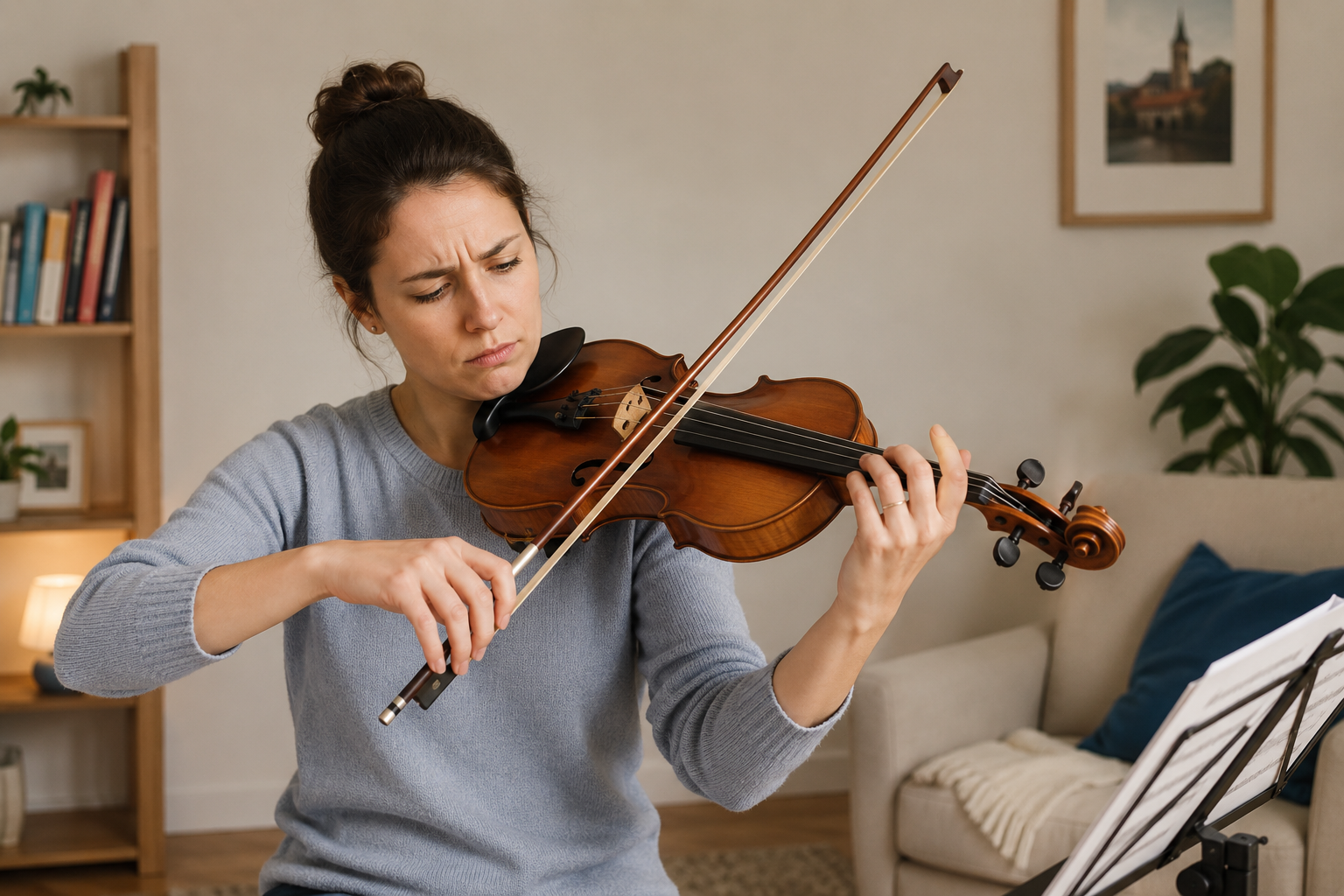
If you keep hitting other strings on the violin, it can feel like your bow or fingers have a mind of their own.
You try to play one string, but another string speaks too. You move from D to A and catch the wrong string. Or you put a finger down and accidentally mute the string beside it.
This is one of the most common problems for beginner violinists, especially adult beginners. It does not mean you are clumsy, untalented, or doing everything wrong. It usually means your bow arm, left hand, or setup needs a little more attention.
The good news is that this can improve with simple, slow practice. You do not need fancy exercises. You need to learn how each string feels, how much your arm should move, and how to notice the problem before it becomes a habit.
Why You Keep Hitting Other Strings
The violin strings are close together. That is part of what makes the instrument challenging.
A very small change in bow angle can move you from one string to the next. That means you do not have to swing your whole arm around to change strings. But if your arm level is too high, too low, too stiff, or moving too suddenly, the bow can catch a nearby string.
There are two main ways this problem usually happens.
Sometimes the bow hits another string. This often happens when changing strings, playing too heavily, or not knowing where each string level is.
Other times, the left-hand finger touches a nearby string. This can make a note sound muffled, unclear, or scratchy, especially when playing open strings next to stopped notes.
Before you try to fix it, it helps to figure out which side of the body is causing the problem.
First, Find Out Whether It Is the Bow or the Left Hand
A simple way to test this is to remove the left hand from the problem for a moment.
Place the bow on an open string, such as the A string. Play a slow, easy bow stroke. Then move to the D string and play another slow bow stroke. If you still hit other strings while playing open strings, the problem is probably coming from the bow arm.
Now try the opposite test. Play the same string with the bow, but place one finger down with the left hand. If the sound suddenly gets muffled or another string stops ringing, your left-hand finger may be leaning into a nearby string.
This matters because the fixes are different. A bow problem needs better string levels and bow control. A left-hand problem needs a cleaner finger shape and less squeezing.
Each String Has Its Own Bow Level
One of the biggest beginner mistakes is trying to find the right string only with the hand.
The hand matters, but the bow arm has to know where each string lives. The G string, D string, A string, and E string each have a slightly different arm level.
Think of your bow arm like a small elevator. It does not need to jump from floor to floor. It only needs to move enough to place the bow clearly on the string you want.
When you move from D to A, the change is small. When you move from G to E, the change is larger. But even then, the motion should feel controlled, not like you are throwing the bow at the string.
If your bow keeps catching a neighbor string, you may not be setting the bow on the new string level before you begin the note.
Practice Finding the String Before You Make Sound
Here is a simple exercise that helps a lot.
Put the bow on the A string, but do not play yet. Let the bow rest lightly on the string. Then slowly move the bow to the D string without making sound. Pause when you feel the bow sitting clearly on the D string. Then move back to A.
Do this a few times without playing. You are teaching your arm where those two strings are.
After that, play one slow bow on A, stop, silently move to D, then play one slow bow on D.
The goal is not speed. The goal is accuracy. You want your arm to arrive on the new string before the bow starts moving.
Try this with these pairs:
- A to D
- D to A
- A to E
- D to G
Once those feel easier, you can add simple rhythms. But at first, keep it plain and slow.
Do Not Cross Strings Too Late
Many beginners start the bow stroke before the bow has fully arrived on the new string.
That creates a messy sound because the bow is moving while it is still between two strings. The bow may touch one string, then scrape another, then finally settle where it belongs.
Try this instead:
Place first.
Then play.
Before the note starts, let the bow find the new string. It only takes a tiny moment. Over time, this will become natural and you will not have to think about it so much.
This is especially helpful when you are practicing a piece and notice the same string crossing causing trouble every time. Do not keep repeating the whole measure at full speed. Stop at the string crossing and practice only that tiny motion.
Check Where the Bow Is Touching the String
If your bow is too close to the fingerboard, it may feel harder to control. The string is softer there, and the bow can slide around more easily.
If your bow is too close to the bridge, the sound can become tight, scratchy, or harsh, especially if you press.
Most beginners do best when the bow stays in a clear, steady lane between the bridge and fingerboard. You do not need to stare at the bow the whole time, but it helps to glance now and then.
If you are not sure where the bow should sit, see How Close Should the Bow Be to the Bridge When You Play Violin?
A steady bow path makes it much easier to avoid nearby strings.
Use Less Pressure When Changing Strings
When a note does not sound clean, many beginners press harder.
That usually makes the problem worse.
A heavy bow is harder to move cleanly from one string to another. It can dig into the string, grab the wrong string, or make a rough sound during the crossing.
Try using a lighter bow when you change strings. You do not need the bow to float above the string. Just avoid pushing down while you are moving from one string level to another.
A good test is this: can you move from A to D with a calm sound, without the bow crunching or grabbing?
If the answer is no, slow down and lighten the bow before you try again.
If your sound is scratchy in general, not just when changing strings, read Why Your Violin Sounds Scratchy And How to Fix It
Keep the Bow Hold Flexible
A stiff bow hand makes string crossings harder.
If your thumb is locked, your fingers are tight, or your wrist is frozen, the whole arm has to do more work. That can make every string crossing feel bigger than it needs to be.
You do not need a loose, floppy bow hold. You need a bow hold that can respond.
The fingers should help balance the bow, not clamp it. The thumb should be bent enough to act like a small cushion. The hand should feel steady, but not rigid.
If your bow hand feels tense, spend a minute playing open strings with a relaxed hand before practicing string crossings.
For more help with this, see How to Hold the Violin Bow for a Smoother Sound
If Your Left Fingers Keep Touching Other Strings
Sometimes the bow is not the real problem.
If your left-hand fingers are leaning too flat, they may touch the string next to the one you are playing. This can make open strings sound dull or cause notes to feel blocked.
This often happens when the hand squeezes the neck or when the fingers collapse instead of landing on the fingertip.
Try this simple check.
Place your first finger on the D string. Then pluck or bow the open A string. If the A string sounds muted, your first finger is probably leaning into it.
To fix this, bring the finger a little more onto the fingertip. You do not need to make the finger straight up and down. That can create tension. You just want enough fingertip shape so the nearby string can ring.
Also check your thumb. If your thumb is squeezing hard, the fingers often flatten. Let the thumb support the hand gently instead of pinching the neck.
If this is the part that gives you trouble, see How to Place Your Fingers Correctly on the Violin Without Guessing
Practice Open-String Crossings Before Adding Fingers
When you are trying to fix messy string crossings, it is tempting to practice the full song over and over.
That can help eventually, but it is usually not the best first step.
Start with open strings. No left hand. No notes to read. No rhythm pressure. Just the bow moving from one string to another.
Try this:
- Play four slow bows on A.
- Play four slow bows on D.
- Then alternate A, D, A, D.
When that feels clean, try two notes per string:
- A A D D
- D D A A
Then try one note per string:
- A D A D
Keep the sound calm. If you hit another string, pause and reset. Do not rush through the mistake.
After the open strings improve, add one easy finger. Then add the passage from your music.
This kind of practice may feel too simple, but it is one of the fastest ways to clean up the problem.
Use Smaller Sections in Your Music
If you keep hitting another string in the same place, do not start the whole piece again.
Find the smallest spot where the problem happens. It may only be two notes.
For example, if the problem happens when going from D to A, practice only those two notes. Play them slowly. Then pause. Then repeat.
Once that feels clean, add one note before and one note after.
This keeps your attention on the real problem. It also keeps you from practicing the mistake over and over.
Common Mistakes That Make This Problem Worse
A few habits can make accidental string noise happen more often.
One is moving too fast before your arm knows the distance between the strings.
Another is pressing harder when the bow feels insecure.
Another is trying to fix everything with the wrist or hand while the arm level stays in the wrong place.
It can also happen when you stare only at the left hand and forget to notice where the bow is.
The fix is not to become stiff or overly careful. The fix is to slow down enough that your body can learn the motion correctly.
Could It Be a Violin Setup Problem?
Most of the time, hitting other strings is a playing issue, not a violin problem.
But setup can matter.
If the bridge is too flat, the strings may not have enough clear separation. If the violin is very inexpensive or poorly adjusted, it may be harder to play one string cleanly. This is not the first thing to blame, but it is worth checking if the problem feels extreme.
You may want a luthier to look at the violin if:
- You cannot play one open string at a time even very slowly.
- The bow seems to hit two strings no matter how carefully you place it.
- The bridge looks oddly shaped, very low, or uneven.
- The instrument has other problems, such as buzzing, rattling, or strings that feel unusually hard to press.
For more setup checks, see Signs Your Violin Needs a Luthier
A Simple 3-Minute Practice Plan
You do not need to spend your whole practice session on this.
Try adding three minutes near the beginning of your practice.
First, play slow open strings and listen for a clean sound.
Next, practice silent string changes from A to D and D to A.
Then play simple open-string crossings with sound.
After that, take one small spot from your music where you usually hit another string and practice only that spot slowly.
That is enough to start improving. The key is doing it often, not forcing it for a long time once in a while.
If you want help building small technique work like this into a daily routine, Practical Violinist Studio can help you create a guided practice plan that keeps tone, technique, and music practice organized without making the session feel overwhelming.
Final Thoughts
Hitting other strings on the violin is frustrating, but it is also fixable.
Most beginners are not missing some secret trick. They simply need more time learning the bow levels, preparing the new string before playing, using less pressure, and keeping the left-hand fingers from leaning into nearby strings.
Slow down, separate the problem, and practice the smallest motion first.
Clean playing comes from small, repeatable improvements. If you practice this calmly for a few minutes a day, the violin will start to feel less crowded and much easier to control.
Leave a Reply