

Last Updated: August 2026
If you are an adult beginner learning violin, finger tape can be helpful, but only if it is used the right way.
The goal is not to stare at the fingerboard forever.
The goal is to give your hand a simple starting point while your ear, finger spacing, and muscle memory begin to develop.
Finger tape can be especially useful if you are learning on your own, returning after many years away, or struggling to place your fingers in roughly the same spot each time. But not all finger tapes are equally useful, and some options can be more distracting than helpful.
This guide will walk through what kind of violin finger tape is best for adult beginners, what to avoid, and how to use it without becoming dependent on it.
How finger tape helps when you’re learning
Violin finger tape is placed across the fingerboard to mark where certain fingers usually go.
Because the violin does not have frets, beginners have to learn where each note lives by feel and sound. Finger tape gives you a visual and physical reference while your fingers are still learning the distances between notes.
For many beginners, the first few tapes are used to mark common first-position notes, often where the first, second, third, and sometimes fourth finger should land.
This takes some of the guesswork out of early practice. Instead of wondering whether your finger is even close, you have a visible reference point.
But finger tape does not make the violin automatically in tune. Your finger still needs to land cleanly, your hand position still matters, and your ear still needs to check the sound.
Think of finger tape as a temporary guide, not a permanent way to find notes.
Should adult beginners use finger tape?
Yes, many adult beginners can use finger tape, especially in the early stages.
It can be helpful if you:
- are not sure where your fingers should go
- keep placing the same finger in a different spot each time
- are practicing without a teacher nearby
- feel overwhelmed by intonation
- want a little more structure during the first few months
That said, finger tape is not required. Some teachers prefer beginners to learn by ear from the start. Others use tape temporarily and remove it once the student becomes more consistent.
For adult learners, finger tape is perfectly reasonable if it helps you practice with less guessing. Just do not let it replace listening.
You should still check your sound with a tuner, drone, open string, teacher, or recording. The tape only helps you find a likely starting place.
If finger placement is one of your biggest struggles right now, you may also want to read How to Place Your Fingers Correctly on the Violin (Without Guessing). That article explains the hand and practice side of the problem, while this one focuses on the gear.
The best type of finger tape for most beginners
For most adult beginners, the best finger tape is thin, removable, easy to see, and not overly sticky.
You do not need anything fancy. A simple strip of narrow fingerboard tape is usually enough.
The tape should be thin enough that it does not interfere with your finger landing naturally. You want a small guide, not a thick ridge under your fingers.
For most adults, I would start with simple tape lines instead of a full fingerboard sticker. Tape lines mark only the spots you need right now, so the fingerboard still feels clean and uncluttered.
A full fingerboard guide can still work, especially if you are completely new and feel lost without a visual layout. But those guides can also become busy. Some beginners end up reading the sticker instead of listening to the note.
For most beginners, a few clean strips of removable fingerboard tape are all you need.

Best for: Beginners who want easy-to-see finger markings
A simple multi-color option that makes finger positions easier to see at a glance. This can be a helpful starting point if you are still getting used to the layout of the fingerboard.

Best for: Adults who want a subtler look
A less noticeable option that blends in better with the fingerboard. Good for players who want finger placement help without bright colors standing out during practice.
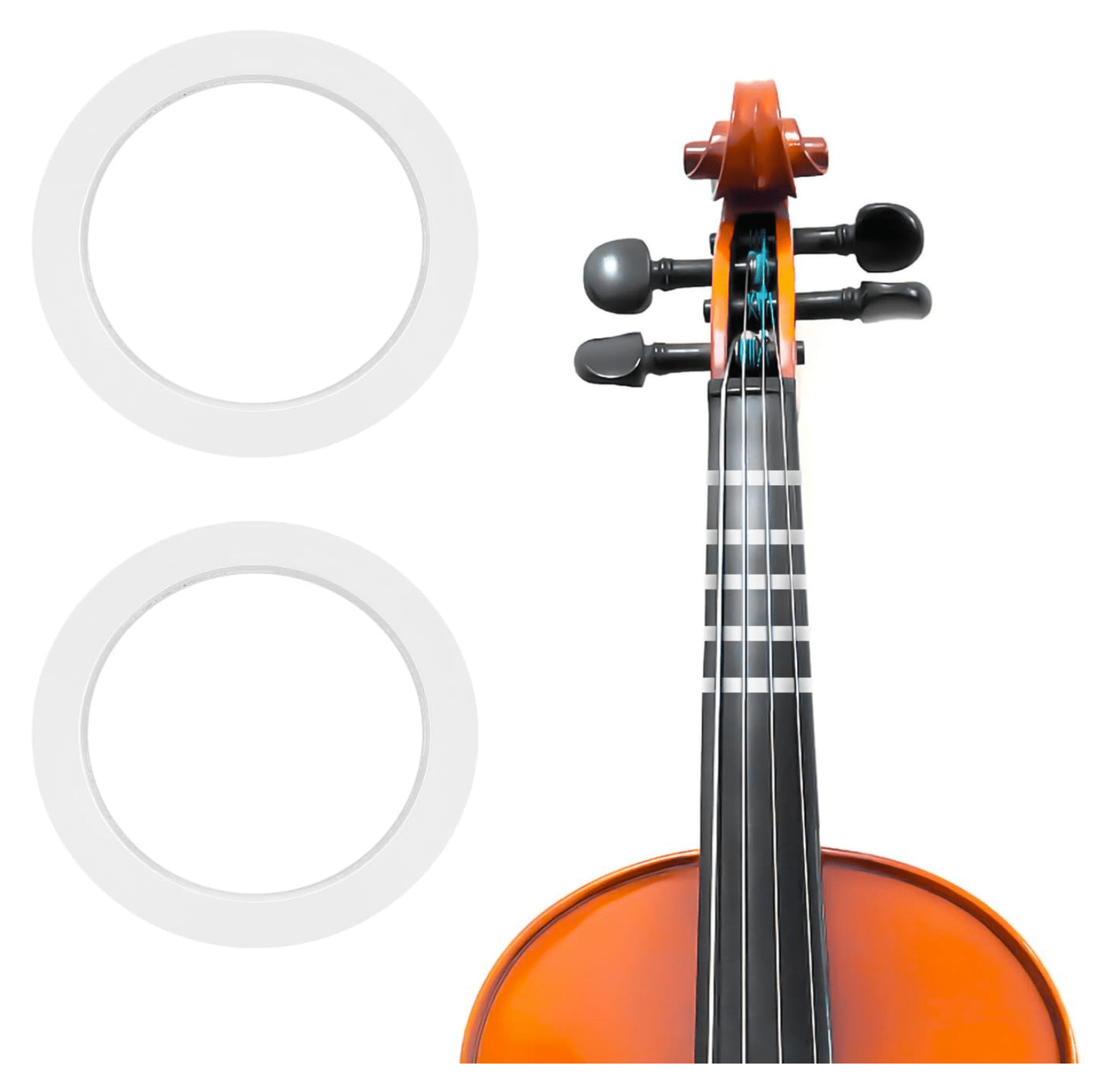
Best for: Players who want clear markings in one simple color
A clean, easy-to-see choice for players who want visible tape lines without using multiple colors. A good middle ground between subtle black tape and brighter color-coded options.
What about full fingerboard guides?
Simple tape rolls are usually the better first choice, but full fingerboard guides do have a place.
A full guide may help if you are brand new to violin, practicing without a teacher, or still trying to understand how the notes are laid out across the fingerboard. Some guides show several finger positions at once, and some include note names.
That can be useful in the very beginning, but it can also become too much information. If you are constantly looking down to read the guide, your ear and hand are not learning as much as they could.
I would treat a full fingerboard guide as a short-term aid for getting familiar with the fingerboard. It can help you understand the layout, but it should not become the main way you find notes.
If your goal is cleaner, more confident finger placement, simple tape is usually enough. If you feel completely lost, a full guide may give you a little extra orientation at the start.

Best for: Beginners who want a visual guide without sticky tape
A removable fingerboard guide that uses a non-adhesive design instead of sticky backing. This can be a good choice if you want more visual help than simple tape lines but are concerned about adhesive residue on the fingerboard.
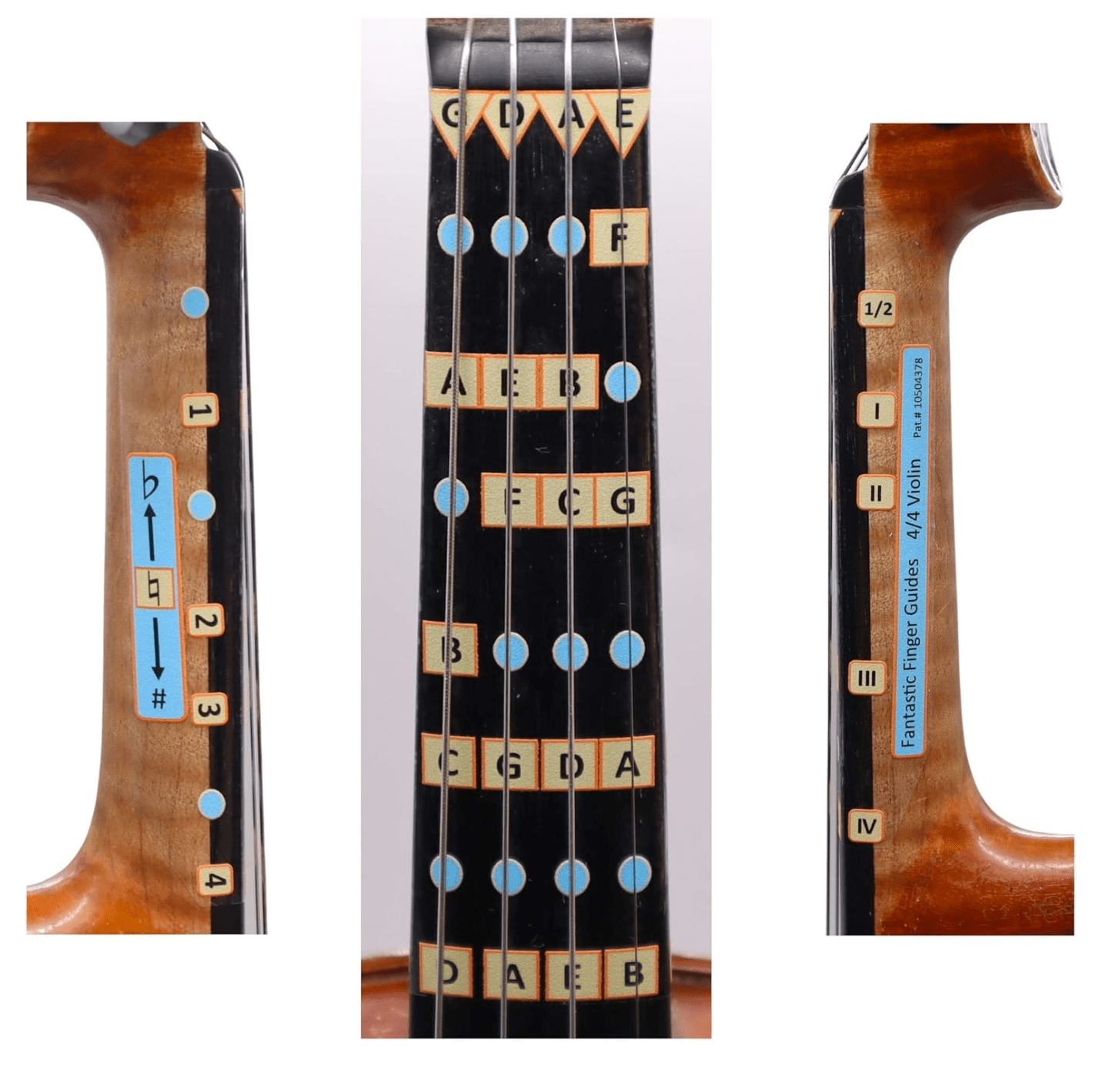
Best for: Visual learners who want a fuller beginner guide
A fuller fingerboard guide for players who want more orientation than a few tape strips can provide. Best used as a temporary aid while you learn the basic layout of first position and begin listening more closely for pitch.
What to avoid when choosing violin finger tape
The biggest mistake is using tape that is too sticky, too thick, or not meant to be removed cleanly.
Avoid strong adhesives. The violin fingerboard is usually ebony or another dark hardwood, and you do not want glue residue building up on it. You also do not want to use anything that might be difficult to remove later.
Avoid thick tape. If the tape feels like a raised bump, it can change how your finger lands. A small tactile guide is fine, but your fingers should still contact the string naturally.
Avoid messy DIY materials. Some people use household tape, labels, or craft tape. That may work in a pinch, but it is not always ideal. Some tape leaves residue, slides around, or gets gummy after a while.
Also avoid using finger tape as a way to ignore tuning problems. If every note sounds wrong even when your fingers are near the tape, the issue may be something else: your violin may be out of tune, your hand may be collapsed, or the tape may not be placed correctly.
For tuning-related issues, see Why Your Violin Sounds Out of Tune Even After Tuning.
Can finger tape damage a violin?
Finger tape is usually safe when it is thin, removable, and placed only on the fingerboard.
The fingerboard is not the same as the varnished body of the violin. You should never put tape on the top, back, ribs, or varnished areas of the instrument.
The main risk is adhesive residue. Cheap or overly sticky tape can leave a film behind, especially if it stays on too long or gets warm.
If you are renting a violin, it is also worth checking with the shop or teacher before adding tape. Many rental shops are used to beginner finger tapes, but it is still better to be careful.
When removing tape, do it gently. Do not scrape the fingerboard with anything sharp. If residue remains, avoid household cleaners unless a teacher, luthier, or reputable violin shop specifically recommends a safe method.
How many tapes do you need?
Most beginners do not need tape for every possible note.
A common setup is to mark the first few finger positions in first position. For many beginners, that means markings for:
- first finger
- second finger
- third finger
- sometimes fourth finger
You do not need to mark the entire fingerboard at the beginning.
In fact, fewer guides may be better. Too many lines can make the fingerboard confusing, especially if you are still learning string names, finger numbers, and note names.
For an adult beginner, I would usually start with the notes you are actually using in your current songs or exercises. If your beginner book only uses first, second, and third finger at first, you may not need a fourth-finger tape right away.
The tape should support your current practice, not turn the fingerboard into a map you are trying to memorize all at once.
If you are still learning how written notes connect to strings and finger numbers, see How to Read Violin Sheet Music for Adult Beginners. It explains open strings, first-position notes, and how beginner violin music translates into left-hand fingers.
Use a tuner to place the tape accurately
Finger tape needs to be placed accurately. Guessing where the tape goes defeats the purpose.
A clip-on tuner, tuning app, or digital tuner can help you check whether the note is actually close. You play the note, look at the tuner, adjust the finger location, and place the tape where that finger consistently needs to land.
This is one reason I often think of finger tape and a tuner as a pair. The tape gives your hand a target. The tuner helps confirm whether that target is in the right place.
If you already have a good tuner, you may not need anything else. If you do not, see Best Metronomes and Tuners for Adult Violinists for simple options that work well for beginner practice.
How to use finger tape without depending on it
Finger tape becomes less helpful if you start relying on it for every note. If you always look down before placing a finger, your ear gets less practice and your hand has a harder time learning the spacing on its own.
As you improve, gradually use the tape less.
At first, you can look at the tape as much as you need. You are just trying to understand the basic fingerboard layout.
After a while, begin placing the finger first, then check whether it landed near the tape. That small change matters. It teaches your hand to aim without waiting for your eyes.
Later, try short exercises where you do not look at the fingerboard at all. Play slowly, listen, and then check. You may be surprised how quickly your hand begins to remember the spacing.
The tape should slowly become a backup, not the main guide.
When should you remove violin finger tape?
There is no perfect timeline, but most players should not need finger tape forever.
You may be ready to remove one or more tapes when:
- your finger lands in the right area without much thought
- you can hear when the note is too high or too low
- you are looking at the tape less often
- the tape is starting to distract you
- your teacher says your hand is becoming consistent
You do not have to remove all the tapes at once.
A good approach is to remove one tape at a time. For example, if your first and third fingers are fairly stable, you might remove those first and leave the second finger a little longer.
Some adult beginners keep one reference tape for a while, especially if they are self-teaching. That is okay. Just keep working toward listening and feeling instead of checking visually every time.
Finger tape will not fix every intonation problem
Finger tape can show you roughly where a finger belongs, but there are plenty of other reasons a note can still sound out of tune.
Your violin may not be tuned accurately. Your left wrist may be bending in a way that changes finger placement. Your fingers may be pressing too hard. Your thumb may be squeezing. Or your second finger may need to move depending on whether the music calls for a high or low second finger.
That last point is important. Finger tape can make beginners think every finger has one permanent location. But violin intonation changes depending on the key, pattern, and note you are playing.
So use the tape as a beginner guide, not as a rule for every situation.
For more help with the playing side of this, read What Is Intonation on the Violin — and How to Improve It.
Are finger tapes “cheating”?
No. Finger tape is simply a learning aid.
If it helps you understand finger spacing and play with more confidence, there is nothing wrong with using it. The goal is just to rely on it less as your ear and hand become more consistent.
Best choice for most adult beginners
For most adult beginners, I would choose simple, thin finger tape instead of a full fingerboard sticker.
It gives you enough guidance to get started without overwhelming you with too many markings. It is also easier to remove gradually as your ear and hand improve.
A full fingerboard guide can still make sense if you are completely new and feel lost. Just be careful not to rely on it for too long.
If you already have a teacher, follow their placement method. If you are self-teaching, use a tuner carefully and keep checking the sound, not just the tape.
Affiliate Disclosure: Some links in this article may be affiliate links. As an Amazon Associate and participant in other affiliate programs, we may earn from qualifying purchases at no additional cost to you.
Leave a Reply