
Last Updated: September 2026
If you’ve been around classical violin music for even a little while, you’ve probably come across a title that looks something like this:
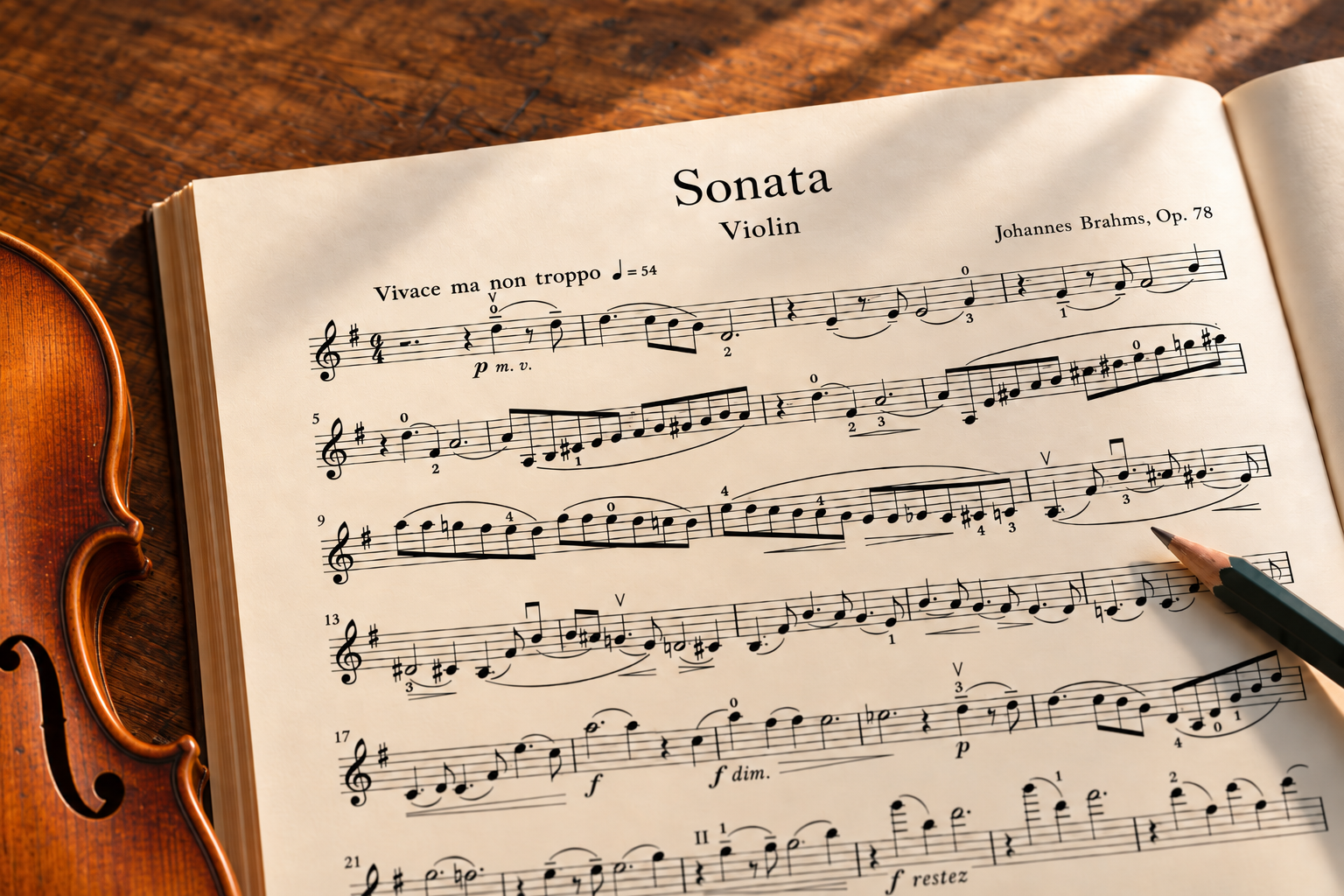
Johannes Brahms: Violin Sonata No. 1 in G Major, Op. 78: I. Vivace ma non troppo
You probably recognize Brahms, and you may have a general idea of what a violin sonata is. But the rest can feel like a jumble of numbers, abbreviations, Roman numerals, and Italian words.
What does Op. 78 mean? Why is the key included? What is the Roman numeral doing there? And what exactly is Vivace ma non troppo telling you?
At first, classical titles can seem unnecessarily complicated. But most of that information is there for a reason, and once you begin recognizing the different pieces, those long titles start to make a lot more sense.
What Are All Those Letters and Numbers?
Spend much time looking through classical recordings or sheet music and you’ll begin seeing abbreviations such as Op., BWV, K., RV, and Hob.
They are not all the same kind of number.
That is why Bach has BWV numbers, Vivaldi has RV numbers, and Mozart has K. numbers. You may also notice that two completely different composers can both have a work labeled Op. 47.
These systems developed in different ways, and understanding what kind of number you are looking at can tell you quite a bit about how a piece has been identified and organized.
The Italian Words Mean More Than “Fast” or “Slow”
Most beginning musicians learn words such as Allegro, Adagio, Andante, and Presto fairly early. They are often introduced as tempo markings, which is useful, but that is only part of what some of them can tell you.
Sooner or later, you run into markings such as Vivace ma non troppo, Allegro molto appassionato, or Affettuoso. Simple definitions like “fast” and “slow” no longer seem quite enough.
Some of these words also say something about the character of the music. Even familiar markings can have more meaning behind them than the short definitions we first learn.
Why Are Violin Movements Named After Dances?
Then there are names such as Allemande, Courante, Sarabande, Gigue, Gavotte, Bourrée, and Minuet.
Many of them began as actual dances.
That raises an interesting question for a violinist: why would a composer write a Sarabande or Gigue for music that nobody was expected to dance to? And why do certain dance names appear together so often?
The history behind those names can tell you something about the character and structure of a movement before you ever play it.
Then there is Minuet and Trio. A beginner might naturally assume that the Trio is written for three musicians, yet an entire orchestra can play the Trio section and it is still called a Trio.
There is a historical explanation for that name, but it is not something you would guess just by looking at the title.
Familiar Terms Can Still Be Confusing
Some classical terms become confusing because they look familiar long before anyone really explains them.
Take Sonata. You might see Sonata in the title of a complete work and then hear someone talk about sonata form. They are related ideas, but they are not the same thing.
The same is true of words such as Suite, Partita, Concerto, Symphony, Fugue, and Rondo. You can encounter those terms for years without ever being completely sure what separates one from another.
For a beginner violinist, that can leave a strange gap. You recognize the words, but you still do not quite know what they are telling you.
Once the Pieces Start to Connect
You do not need to understand every term in a title before you can enjoy or play classical music. But once you begin recognizing the language, the music becomes easier to navigate.
A long title no longer looks like something you are simply expected to understand. You begin to see which part identifies the work, which part refers to the movement, what some of the numbers are doing, and why those unfamiliar words keep appearing.
And the interesting thing is that one answer usually leads to another question. Once you understand why a movement is called a Gigue, you may start wondering how it differs from a Sarabande. Once Op. makes sense, you begin noticing BWV, RV, K., and other catalogue numbers. And once you understand that Sonata and sonata form are not quite the same thing, other musical forms start to make more sense too.
That is why I wanted to go further with this subject in The Violinist’s Guide to Classical Music. The main course follows the composers, music, and history that shaped the violin, but these titles and terms kept coming up along the way and deserved more room than a few short definitions could give them.
So the complete course also includes a separate 14-part bonus guide, Making Sense of Classical Music Titles & Terms. It takes a closer look at the movement names, Italian markings, dances, musical forms, work types, and numbering systems that violinists encounter again and again.
The goal is not to memorize a long list of terminology. It is to get to the point where a title such as:
Johannes Brahms: Violin Sonata No. 1 in G Major, Op. 78: I. Vivace ma non troppo
starts telling you something instead of looking like a collection of information you are somehow supposed to already know.
Leave a Reply