
Last Updated: February 2026
If you’ve ever noticed that your violin has four fine tuners while your teacher’s—or a professional’s—has only one, you might wonder:
- Is something wrong with my setup?
- Does this mean my violin is “cheap”?
- Should I remove the extra tuners?
- Will switching improve my sound?
The short answer: your violin isn’t broken, and you’re not behind.
This difference is intentional—and understanding it can help you tune more confidently, protect your strings, and choose upgrades that actually support your progress.
Let’s break it down.
What Are Fine Tuners?
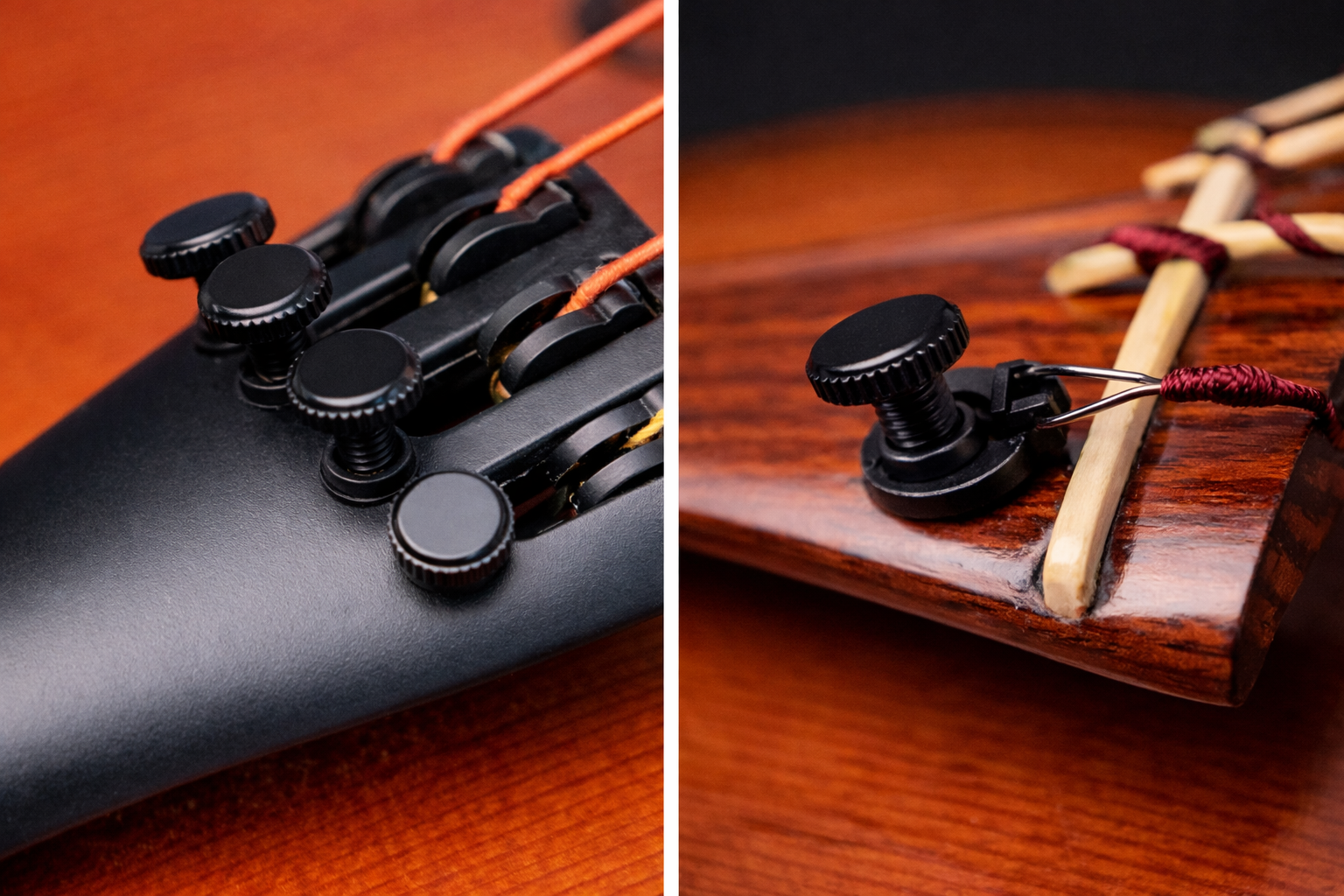
Fine tuners are the small metal screws on the tailpiece that make tiny pitch adjustments after you’ve tuned close with the pegs.
They’re designed for precision—especially useful for beginners who are still learning how to control tuning pegs without slipping or snapping strings.
You’ll see two common setups:
- One fine tuner (usually on the E string only)
- Fine tuners on all four strings
Each serves a different purpose.
One Fine Tuner (E String Only)
This is the traditional setup on higher-quality violins.
The E string is thin, high-tension, and sensitive. Even experienced players rely on a fine tuner for it. The other strings (A, D, G) are tuned entirely with the pegs.
Pros
- Lighter tailpiece = better resonance
- More responsive feel
- Cleaner, traditional look
- Preferred by advancing players and professionals
Cons
- Requires confident peg use
- Harder for beginners
- Small tuning changes take more care
- Greater risk of over-tightening if you’re new
This setup favors tone and tradition over convenience.
Fine Tuners on All Four Strings
This is the most common beginner setup—and for good reason.
Pros
- Much easier to tune accurately
- Less risk of snapping strings
- Faster daily tuning
- Builds confidence early
Cons
- Adds weight at the tailpiece
- Can slightly dampen resonance
- Looks “student-like” (though this doesn’t affect your progress)
On entry-level violins, the sound difference is usually minor. The ease and safety often outweigh the tonal tradeoff for beginners.
Does This Actually Affect Sound?
Yes—subtly.
More metal at the tailpiece increases mass where the strings end. This can:
- Reduce resonance slightly
- Make the violin feel less “alive”
- Affect responsiveness on better instruments
On beginner violins, this difference is often masked by the instrument itself. As your violin quality improves, the impact becomes more noticeable.
Modern Middle Ground: Built-In Fine Tuner Tailpieces
Many modern setups use lightweight composite tailpieces with built-in fine tuners for all four strings.
These offer:
- Easy tuning
- Less added weight
- Cleaner appearance
- Better tone than traditional metal tuners
They’re ideal for adult beginners who want convenience without sacrificing sound.
When (or If) Should You Switch?
You do not need to rush this change.
Stay with four fine tuners if:
- You’re still learning to use pegs
- Tuning feels stressful
- You’re focused on consistency and comfort
Consider switching when:
- You can tune confidently with pegs
- You upgrade to a higher-quality violin
- You want more resonance and responsiveness
- Tuning feels routine rather than intimidating
Many adult learners switch gradually—often starting with removing A/D/G tuners or upgrading to an integrated tailpiece.
There’s no “level” you must reach first. This is about readiness, not rank.
A Smart Alternative: Wait Until Your Next Violin
For many adult beginners, the most practical option is simply to wait until your next violin upgrade rather than modifying a low-priced starter instrument.
Entry-level violins are designed as learning tools. Spending money on a new tailpiece, installation, and setup can quickly approach the value of the instrument itself—without meaningfully changing how it plays or sounds.
If you plan to stick with violin:
- Your next violin will likely come with a better tailpiece already
- You’ll be able to choose a setup that matches your skill level
- The tonal benefits will actually be noticeable
In other words, your current violin doesn’t need to become perfect—it just needs to stay playable, stable, and comfortable while you build skill.
Let your upgrade happen with your instrument, not in isolation.
What This Choice Says About You (and What It Shouldn’t)
Having four fine tuners does not mean:
- You’re a beginner forever
- Your violin is bad
- You’re doing something wrong
It means your setup supports learning safely and confidently.
Progress isn’t measured by hardware—it’s measured by consistency, comfort, and control.
Bottom Line
- One fine tuner favors tone and tradition.
- Four fine tuners favor ease and safety.
- Integrated tailpieces bridge the gap beautifully.
Choose the setup that keeps you practicing—because that’s what truly improves your sound.
Leave a Reply