
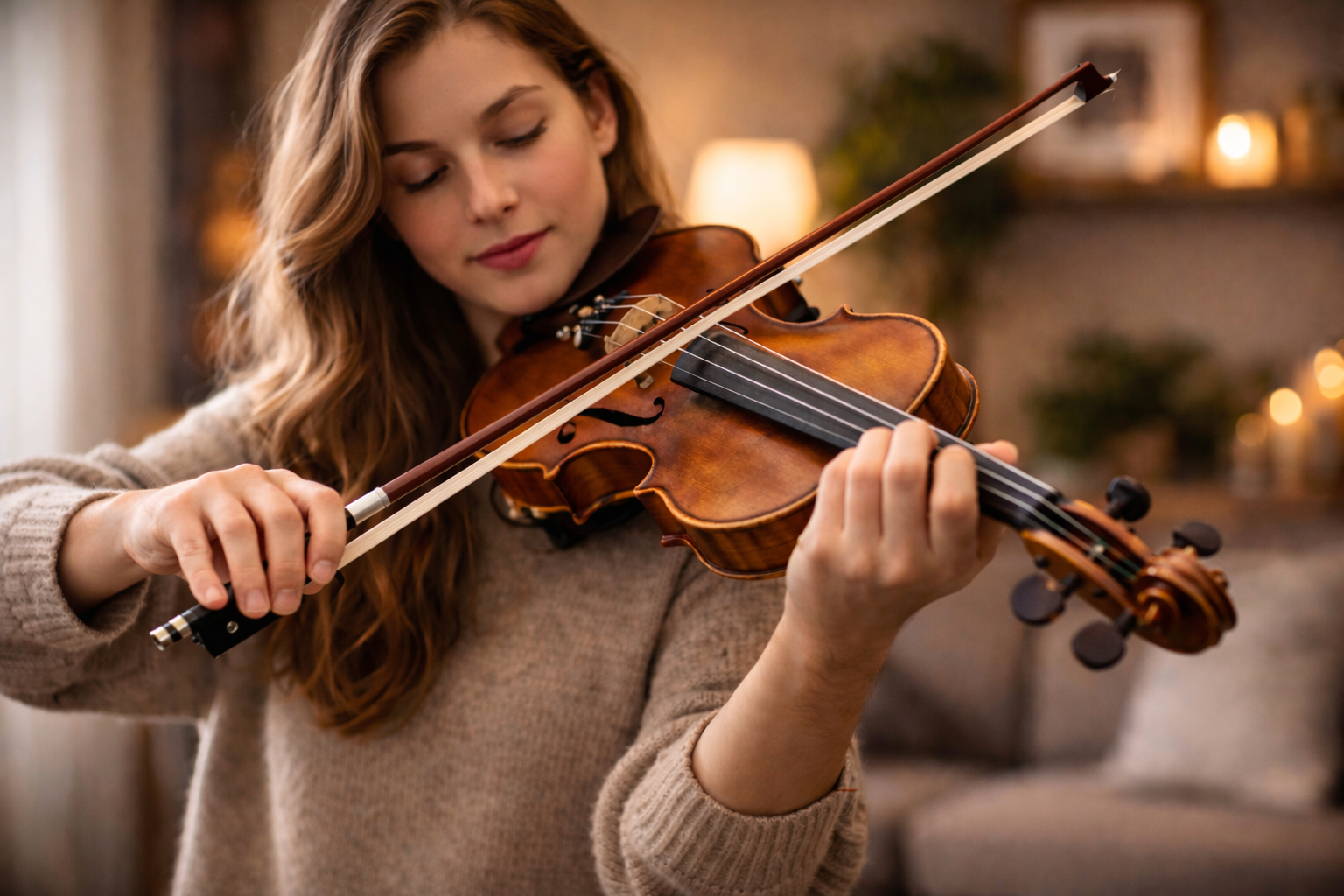
Last Updated: October 2026
Who This Guide Is For
- Adult beginners learning violin for the first time
- Returning players rebuilding fundamentals
- Early–intermediate players who want clearer understanding of bow technique
- Anyone wondering “Is this something I should already know?”
Advanced strokes are included for recognition and context, not expectation.
How Bow Strokes Develop
Bow strokes develop gradually as your control of the bow improves and your playing becomes more advanced.
Most named strokes simply describe:
- how the bow contacts the string
- how weight, speed, and balance are used
- how coordinated your arm, wrist, and fingers have become
Learning the names helps you recognize what’s happening. It doesn’t mean you’re expected to master everything at once.
The Parts of the Violin Bow (What Each One Does)
Understanding bow strokes starts with understanding the bow itself. Each part contributes to balance, comfort, and response.
Major Bow Parts
- Frog
The end of the bow you hold. It contains the tightening mechanism and contributes much of the bow’s weight and control. - Eye
A decorative inlay on the frog. It does not affect playing, but often reflects craftsmanship or style. - Screw (Button)
Located at the very end of the bow. Turning it tightens or loosens the bow hair. - Ferrule
The metal band at the front of the frog that spreads and holds the bow hair flat. - Winding (Grip)
Wire or thread wrapped around the stick near the frog. It adds weight and helps balance the bow. - Thumb Leather
The leather wrap where your thumb rests, providing comfort and protecting the bow. - Stick
The long body of the bow, traditionally wood or carbon fiber. Its flexibility affects response and bounce. - Hair
Horsehair stretched from frog to tip. This is what actually contacts the string to create sound.
In early playing, you probably won’t think consciously about each part. You’ll mostly experience the bow through its balance, resistance, and responsiveness, especially around the middle where control is easiest to develop.
Bow Location: Frog, Middle, and Tip
For practical playing, the bow is often thought of in three zones:
- Frog: Heavier, powerful, less forgiving
- Middle: Balanced, stable, easiest to control
- Tip: Light, quieter, requires refined balance
Most beginners build control in the middle of the bow first. This provides stability and allows good habits to form before exploring the extremes.
On-String vs. Off-String Bowing
Nearly all bow strokes fall into one of two families.
On-String Bowing
The bow stays in contact with the string.
- Produces a grounded, sustained sound
- Control comes from smooth motion and balanced weight
Off-String Bowing
The bow briefly leaves the string between notes.
- Produces lightness and clarity
- Relies on balance and natural rebound, not lifting
Off-string strokes only become reliable after on-string control is established.
Foundational Bow Strokes (Where Everyone Starts)
Détaché
What it is: One bow stroke per note, with the bow staying on the string.
How it works: Smooth forearm motion with relaxed fingers and a straight bow path.
Why it matters: This is the foundation of nearly all bowing.
How it appears in sheet music: Usually unmarked. Each note simply receives its own bow.
Legato (Slurred)
What it is: Multiple notes played in one continuous bow stroke.
How it works: Even bow speed and relaxed string crossings.
Why it matters: Builds steadiness and connection between notes.
How it appears in sheet music: Notes connected by a curved slur line.
Hooked (Portato-style articulation)
What it is: Two or more notes in the same bow direction with gentle re-articulation.
How it works: Small releases of weight within one bow stroke.
Why it matters: Bridges smooth and articulated playing.
How it appears in sheet music: Usually two notes under one slur, often with light markings or dots.
Articulation and Control Strokes
Staccato (On-String)
What it is: Short, separated notes with clear starts and releases.
How it works: Releasing bow weight between notes rather than stopping abruptly.
Common issue: Tension from “jabbing” the string.
How it appears in sheet music: Small dots above or below the notes.
Martelé
What it is: A firm, accented stroke with a clean start and immediate release.
How it works: A controlled bite followed by relaxation.
Why it matters: Teaches clarity without sustained tension.
How it appears in sheet music: Accent marks or wedge symbols.
Collé
What it is: A compact stroke initiated by the fingers.
How it works: Finger motion supported by a flexible wrist and hand.
Why it matters: Builds precision at the beginning of the sound.
How it appears in sheet music: Often implied by context rather than a unique symbol.
Expressive and Lighter Bow Strokes
Portato (Louré)
What it is: Gently pulsed notes within one slur.
How it works: Subtle shaping of bow weight and speed.
Musical role: Adds warmth and expression.
How it appears in sheet music: Slurred notes with light emphasis markings.
Spiccato
What it is: A controlled bouncing stroke where the bow leaves the string between notes.
How it works: Natural rebound from a balanced bow rather than deliberately lifting the bow after each note.
Key idea: Spiccato becomes easier to control once your bow balance and timing are consistent.
How it appears in sheet music: Often written like staccato, especially in faster passages.
Pizzicato and Arco (Changing How Sound Is Produced)
Pizzicato
What it is: Plucking the string with a finger instead of using the bow.
How it fits: Pizzicato is a common contrast to bowed playing rather than a bow stroke itself.
How it appears in sheet music: Marked “pizz.” above the staff.
Arco
What it is: The return to playing with the bow after pizzicato.
Why it matters: Without this marking, the player would continue plucking.
How it appears in sheet music: Marked “arco” to indicate bowing resumes.
Advanced and Specialized Bow Strokes (Recognition Level)
These strokes rely on refined coordination and should not be rushed.
- Sautillé – Very fast, natural bouncing created by speed
In music: Appears as very fast, light staccato passages - Ricochet – Multiple rebounds in one bow direction
In music: Several notes grouped under one slur - Flying / Solid Staccato – Multiple fast notes in one bow stroke
In music: Repeated notes grouped in one bow direction
How Bow Strokes Typically Develop
Rather than a checklist, bowing skills tend to emerge in overlapping stages:
Foundational Control
- Détaché
- Legato
Developing Articulation
- Hooked strokes
- On-string staccato
- Martelé
Expanding Expression
- Portato
- Collé
Lightness and Agility
- Spiccato
Advanced and Specialized
- Sautillé
- Ricochet
- Flying staccato
These stages overlap and reinforce one another. Revisiting earlier strokes is part of healthy progress.
Bowing Changes with Musical Style
The same bow stroke does not appear in every piece for the same reason. Different musical periods developed their own approaches to articulation, phrasing, and bowing, and those differences became part of the sound we associate with Baroque, Classical, Romantic, and later music.
Learning the mechanics of détaché, legato, staccato, or spiccato is one part of playing them. Understanding the composer, the period, and the kind of music you are playing can also help explain why a particular articulation belongs there.
If you’d like to explore that larger musical context, The Violinist’s Guide to Classical Music covers the composers, major works, history, forms, and terminology that shaped the violin’s classical repertoire.
Put Bow Control Into Practice
Knowing what the different bow strokes are is helpful, but working them naturally into regular practice can be harder.
That is one of the reasons I created Practical Violinist Studio. Instead of giving you a list of techniques to drill, Studio builds guided practice sessions that combine bow control with tone, rhythm, technique, and the music you are actually working on.
If you sometimes finish practicing and wonder whether you spent your time on the right things, take a look at how Practical Violinist Studio works.
The Big Picture
Learning the names of bow strokes helps you recognize what you see in music and understand what a teacher or other violinist is describing. The more important goal, though, is developing the control needed to produce different kinds of articulation when the music calls for them.
As your bow becomes steadier and your hand, wrist, and arm work together more comfortably, techniques that once seemed advanced become much easier to approach.
Leave a Reply