
Last Updated: February 2026
So you’ve had the thought: “I kind of want to learn violin.”
That idea shows up for a reason—maybe you love the sound, maybe you’ve always wanted to play, or maybe you’re craving a hobby that feels meaningful.
The good news: adults can absolutely learn violin. The “secret” is not talent—it’s making a few smart choices early so you don’t waste money, time, or motivation.
Below is a simple step-by-step path you can follow from your first spark of interest to actually playing.
Step 1: Decide what you want the violin to be for you
Before you buy anything, take two minutes to clarify your goal. This helps you choose the right instrument, the right practice plan, and the right kind of help.
Pick one:
- I want a calm, satisfying hobby (play simple pieces, enjoy the sound)
- I want real progress (structure, skills, consistent improvement)
- I want to join a group someday (community orchestra, church group, ensembles)
- I’m not sure yet (totally fine—start light and learn what you enjoy)
A practical mindset for adult beginners: aim for “consistent” before “impressive.”
Step 2: Be honest about time, patience, and expectations
This is the part most adults skip—and it’s why many quit early.
Violin has a steep beginning sound phase. That doesn’t mean you’re bad at it. It means violin is a precision instrument and your hands are learning tiny movements.
A good adult starter expectation:
- First 2–4 weeks: you’re learning how to hold everything and make controlled sound
- Weeks 4–8: you’ll start hearing improvement (cleaner tone, better control)
- Month 3+: progress becomes more rewarding and less fragile
If you want a simple plan that fits real adult schedules, start with A Simple 5-Minute Daily Violin Practice Routine for Adults.
If you can practice 5–20 minutes most days, you can move forward. Real progress usually shows after consistent practice over months, not days—and that’s completely normal. Early effort is about building foundations, not sounding impressive.
Step 3: Rent or buy your first violin outfit (the easiest way to avoid mistakes)
This is where a lot of beginners accidentally sabotage themselves.
A poor-quality violin outfit can cause:
- squeaky, scratchy sound even when you’re doing things right
- tuning instability
- frustration that feels like “I’m not improving”
Renting (often the smartest first step)
Renting is ideal if:
- you’re brand new and not sure you’ll stick with it yet
- you want a properly set-up instrument without a big upfront cost
- you want an easy upgrade path later
A good rental program usually includes:
- violin + bow + case
- rosin
- basic maintenance support
- trade-in or upgrade credit
Buying (fine—if you buy the right way)
Buying is a good choice if:
- you’re committed
- you can invest in a decent beginner outfit
- it’s set up properly (bridge, strings, pegs, soundpost)
Choosing the right beginner violin isn’t about buying the most expensive option—it’s about selecting a reliable instrument from a trusted source. This complete guide explains what price range makes sense, where to buy safely, and how to avoid common beginner mistakes:
How to Buy a Beginner Violin: Complete Adult Guide (What Matters and What to Avoid)
Once you understand what to look for, this guide to the best beginner violins for adults walks through proven options that are properly set up, easier to play, and designed to support long-term progress.
What a good beginner violin outfit should include
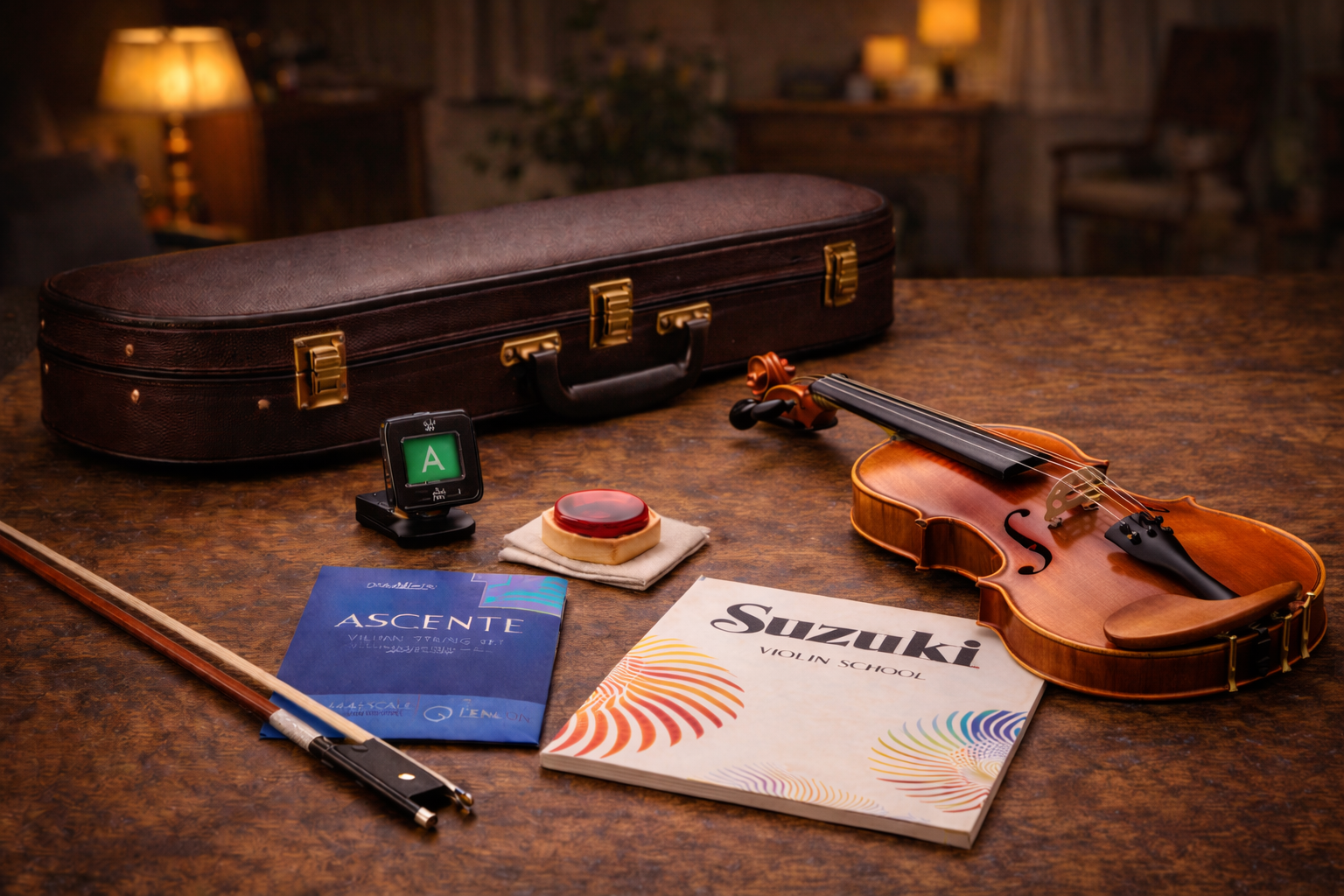
Look for a complete beginner outfit that includes:
- Beginner violin (4/4 full size for most adults)
A properly set-up violin with smooth pegs and a correctly cut bridge makes learning dramatically easier. A decent beginner instrument holds tuning better and produces a clearer tone with less effort. - Violin bow for beginners
A balanced, responsive bow helps you learn bow control and tone from day one. Even an entry-level bow can feel stable and predictable compared to the flimsy bows often bundled with ultra-cheap violins. - Protective violin case
A hard or semi-hard case protects your instrument from temperature changes and bumps. Look for one with backpack straps and accessory storage so everything stays together. - Violin rosin
Rosin allows the bow hair to grip the string. Without it, the violin will barely speak. A beginner-friendly rosin makes it easier to produce sound with less pressure. - Adjustable shoulder rest
A shoulder rest supports the violin and reduces tension in your neck and left hand. The right fit helps you hold the instrument comfortably without squeezing. - Clip-on violin tuner
A tuner trains your ear and prevents frustration. Early on, you want quick feedback so you can spend your practice time playing—not guessing. - Fine tuners (what they are & why beginners often have four)
If you’re unsure why some violins have multiple fine tuners and others don’t, Why Some Violins Have One Fine Tuner and Others Have Four explains what’s normal for beginners and when (or if) upgrades matter. - Spare violin strings
Strings eventually break. Having a spare set means you’re never forced to stop practicing for days while waiting for replacements.
Tip: “Violin outfit” usually means violin + bow + case. Always check what’s actually included.
Step 4: Make key setup decisions: chin rest, shoulder rest, and comfort
Now that you have your violin outfit, don’t assume discomfort is normal. Good comfort and ergonomic fit make learning easier and more sustainable.
When you first hold a violin, your body is learning new angles and support points—especially around your shoulder, neck, and jaw. A poorly fitted setup can lead to tension, soreness, and habits that make playing harder than it needs to be.
Here’s how to approach setup with comfort in mind:
Chin rest basics
The chin rest is the small attachment on the violin that allows you to support the instrument with your jaw and shoulder instead of gripping with your left hand. A good chin rest:
- lets your jaw rest comfortably without clenching
- helps keep the violin stable
- reduces neck and jaw tension during longer practice sessions
Everyone’s anatomy is different. Some players rest more on the chin, others on the jaw. What feels “normal” for one person may feel awkward for another. It’s common for beginners to experiment with different chin rests or adjust placement before finding what feels natural.
If you feel like you have to squeeze the violin to keep it from slipping, that’s usually a setup issue—not a technique problem.
Shoulder rest basics
A shoulder rest sits between your shoulder and the back of the violin. It:
- lifts the instrument to a comfortable height
- helps the violin stay in place
- reduces the need to grip with your left hand or raise your shoulder
Start with a basic adjustable shoulder rest. Comfort and fit matter far more than brand at this stage.
Finding your comfort sweet spot
- Set the violin on your shoulder and see if it stays in place with minimal effort.
- Adjust the chin rest so your jaw can rest naturally without lifting your shoulder.
- Use a shoulder rest that supports the instrument without forcing your arm up or your neck down.
When your setup fits your body, practice becomes calmer and more focused. You spend your energy on sound and movement instead of fighting the instrument.
If your neck or jaw gets sore early on, How to Reduce Chin Rest Pain: A Comfort Guide for Adult Violinists will help you fix the most common causes.
Step 5: Learn bow + rosin basics (this prevents 80% of early frustration)
This is the “why does it sound so bad?” step that nobody explains well.
Rosin: what it is and how to use it
Rosin creates the friction that allows your bow hair to grip the string. Without it, the bow just slides across the strings.
Beginner rules:
- Apply a light, even layer to the bow hair before playing
- New bows need more rosin at first
- Too little rosin = whispery, slippery sound
- Too much rosin = dusty, gritty tone
Use slow, full strokes along the cake. Two or three passes is usually enough once the bow is “broken in.”
Bow basics you should know on day one
- Never touch the bow hair with your fingers (skin oil ruins grip)
- Tighten the bow before playing (leave a pencil-width gap at the middle)
- Loosen the bow after every session to protect the stick
- Store the bow in the case when not in use
Getting these habits right early prevents warped bows and uneven sound.
Beginner-friendly rosin options
These are all widely used, forgiving choices for adult beginners:
- D’Addario Natural Light Violin Rosin – clean tone, easy grip
- Hill Dark Violin Rosin – slightly warmer sound, great for dry climates
- Evah Pirazzi Gold Rosin – powerful projection and excellent bow response
- Jade L’Opera Violin Rosin – popular for its balance of grip and clarity
Any of these will serve you well while you’re learning basic bow control and tone production.
Step 6: Choose your path: teacher, self-teaching, or a hybrid
You don’t need to decide forever. You just need a starting approach.
Before you decide format (online vs in-person), first decide whether you want guidance, self-paced work, or a mix of both.
Option A: Learn with a teacher
Best if you want structure, clear feedback, and faster correction of habits.
Option B: Self-teach
Best if you enjoy independent learning and can follow a routine consistently.
Option C: Hybrid
Many adults thrive with occasional lessons plus simple daily practice on their own.
If you’re still deciding whether you want guidance or prefer learning solo at first, Should Adults Learn Violin With a Teacher or Self-Teach? breaks down the real pros and cons for adult beginners.
Step 7: Decide what kind of lessons you want (in-person vs online)
If you go the teacher route, the format matters less than you think. What matters is consistency and clear feedback.
In-person lessons are great for:
- hands-on posture help
- immediate correction
- accountability
Online lessons are great for:
- flexibility with busy schedules
- access to teachers outside your area
- lower stress for self-conscious beginners
If you’re unsure which format fits your schedule and learning style, Online vs. In-Person Violin Lessons for Adults: Which Is Right for You? will help you choose confidently.
Step 8: Start with a simple “first month” practice plan
You don’t need an hour a day. You need a routine you’ll actually do.
If you want the easiest routine to start with, follow A Simple 5-Minute Daily Violin Practice Routine for Adults and repeat it daily for your first month.
If you’re able to practice a little longer and want a fuller daily structure, A Simple 20–30 Minute Violin Practice Routine for Busy Adults gives you a complete, balanced session you can grow into.
A strong first-month structure:
Week 1: Setup + sound control
- holding violin and bow comfortably
- open strings with slow, steady bow
- learning to stop and reset tension
Week 2: Add rhythm + coordination
- short bow strokes
- counting and clapping rhythms
- simple string crossings
Week 3: Add left-hand basics
- finger placement (slow and accurate)
- simple note patterns
- frequent breaks
Week 4: Combine into simple music
- tiny pieces or exercises
- tone first, speed later
- record yourself once a week
Feeling overwhelmed trying to turn all of this into a daily routine?
Many adult beginners know what they should practice, but struggle to turn good advice into calm, consistent progress.
I created Practical Violinist Studio to turn these early setup, tone, and practice principles into calm, guided, time-aware practice sessions that evolve as you improve—so you can focus on showing up and playing instead of planning what comes next.
Create your first guided practice plan →
Free to try. No account required.
Step 9: Avoid these common adult-beginner mistakes
Most adults don’t quit because violin is “too hard.” They quit because something unnecessary makes it feel discouraging. These are the traps that derail progress early:
- Buying the cheapest instrument available
Ultra-budget violins often won’t stay in tune, respond poorly, and make even good technique sound bad. That frustration feels personal—but it’s really the instrument. Choosing a properly set-up beginner outfit makes a dramatic difference. This guide to the best beginner violins for adults shows reliable options that avoid the most common beginner equipment problems. - Practicing too long too soon
Long sessions in the first weeks lead to tension, soreness, and burnout. Short, calm practice builds skill without overwhelming your body or your schedule. If you’re unsure what “enough” really looks like, How Often Should Adults Practice the Violin? breaks down realistic, sustainable practice expectations. - Chasing speed before tone
Fast notes on a shaky foundation create messy habits. Slow, controlled playing builds confidence and a sound you’ll actually enjoy. - Ignoring pain or discomfort
Neck, jaw, or shoulder pain is usually a setup issue, not something to “push through.” Comfort is part of good technique. If soreness shows up early, How to Reduce Chin Rest Pain: A Comfort Guide for Adult Violinists and Violin Shoulder Pain for Adult Beginners: Causes and Simple Fixes will help you correct the most common problems. - Comparing your beginning to someone else’s middle
You’re seeing highlight reels, not their first months. Your progress is supposed to look like yours.
Every one of these mistakes is fixable. Awareness alone puts you ahead of the curve. Your goal isn’t perfection—it’s steady, healthy progress that fits your life.
Step 10: What to do next
You don’t need to do everything at once. You just need a clear, gentle path forward.
Use this simple checklist to move from “thinking about violin” to actually playing:
- Choose your learning path
Decide whether you’ll start with a teacher, self-teaching, or a hybrid approach. You can always change later—this just gives you direction. - Get a decent violin outfit
Rent or buy a beginner setup that includes the violin, bow, case, rosin, and basic accessories. A properly set-up instrument removes a huge amount of early frustration. - Set up for comfort
Adjust your chin rest and shoulder rest so the violin feels secure without squeezing. Comfort isn’t a luxury—it’s what makes practice sustainable. - Learn bow and rosin basics
Apply rosin correctly, tighten and loosen your bow properly, and build good habits from day one. This alone can transform your early sound. If you’re unsure which rosin to start with, Best Violin Rosin for Adult Beginners: What Actually Matters explains what makes a difference and what doesn’t. Also see Step #5 above. - Start a short daily routine
Begin with just a few focused minutes a day. A small routine done consistently will take you farther than long, irregular sessions. - Add one small goal each week
One new skill. One tiny improvement. One small win. Let progress build naturally.
You don’t need to be fast. You don’t need to be perfect. You just need to show up.
Consistency beats intensity.
Affiliate Disclosure: Some links in this article may be affiliate links. As an Amazon Associate and participant in other affiliate programs, we may earn from qualifying purchases at no additional cost to you.
Leave a Reply