
Last Updated: February 2026
If you’re learning violin as an adult, this question comes up quickly:
Should I leave my violin out so I practice more — or keep it safely in the case?
Both choices have advantages. But the safest and most effective approach depends on your environment, your habits, and your goals as a player.
Understanding when to keep your violin in its case — and when it’s safe to leave it out — helps protect your instrument while also supporting consistent, enjoyable practice.
The safest default: keep your violin in its case
In most situations, the safest place for your violin is inside its case.
A good case protects your instrument from the most common sources of damage:
- accidental bumps or falls
- sudden humidity changes
- dust buildup
- pets or small children
- temperature fluctuations
Even a minor fall from a table or chair can cause cracks, bridge damage, or soundpost issues that require professional repair.
The case acts as a controlled, protective environment.
If you’ve invested in a decent beginner instrument, protecting it properly helps preserve both its sound and its lifespan. This is part of the same basic care covered in a simple violin maintenance checklist for adult players.
Why many adult learners leave their violin out
Despite the risks, many violinists — especially beginners — choose to leave their instrument out intentionally.
The reason is simple: visibility encourages consistency.
When your violin is already accessible, it’s much easier to pick it up for a few minutes of practice. When it stays in the case, it’s easier to delay or forget.
This effect is powerful. Reducing small barriers between you and your instrument makes regular practice feel more natural.
Even short sessions build skill over time. If consistency is your goal, accessibility matters.
When it’s safe to leave your violin out
Leaving your violin out can be safe if certain conditions are met.
Your environment should be:
Stable in temperature and humidity
Free from pets that could knock it over
Free from small children who could handle it unsupervised
Away from direct sunlight, heaters, or air vents
Placed in a secure location where it cannot fall
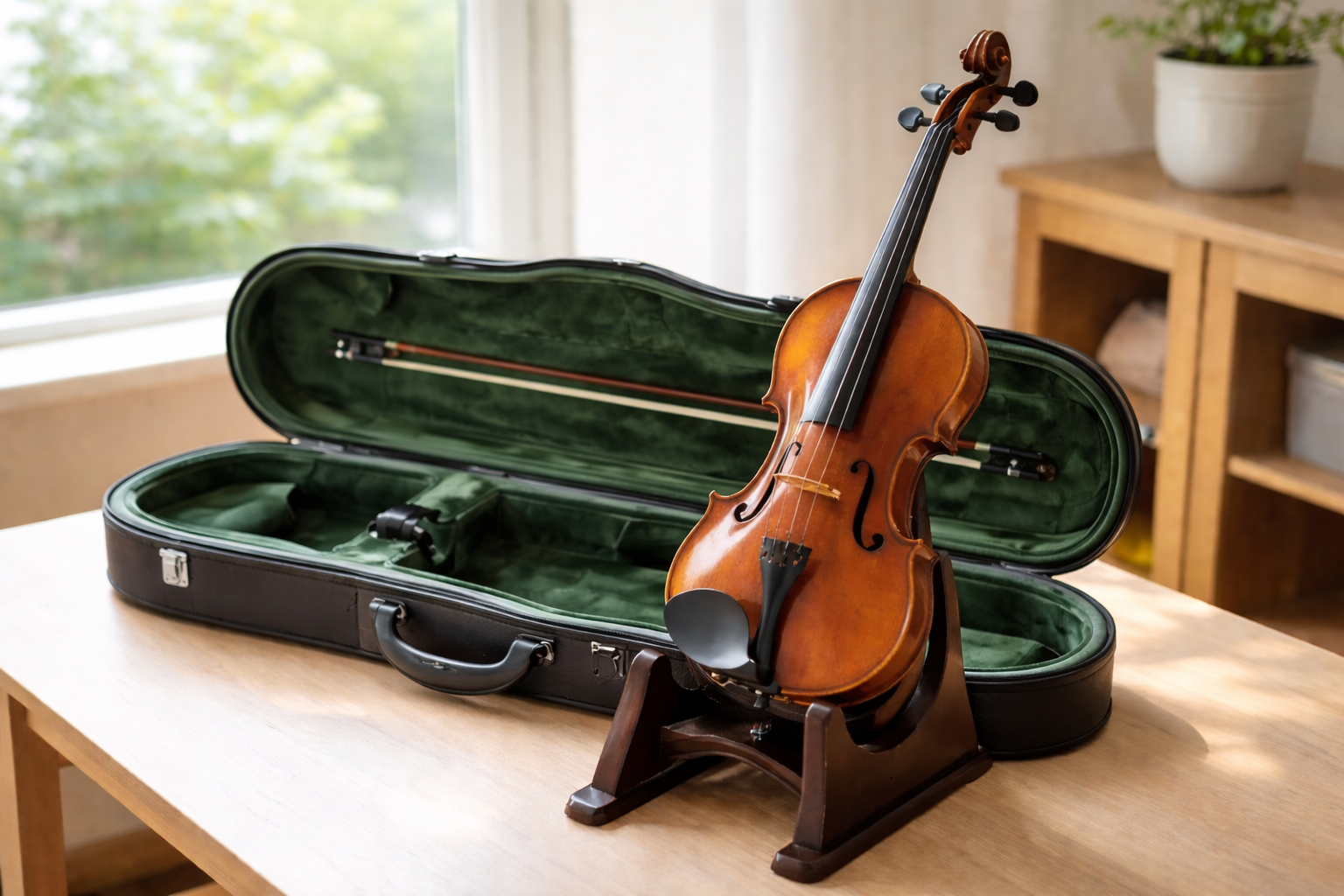
A dedicated violin stand is much safer than balancing the instrument on a table or chair.
If your room already maintains stable humidity, your violin will tolerate short periods outside the case without harm. If you live in a dry or highly variable climate, proper humidity control becomes more important. This guide on how to protect your violin from humidity damage explains how to keep conditions safe year-round.
When you should always use the case
There are situations where the violin should always be stored in its case:
Overnight storage (especially in unstable environments)
Transporting the instrument
Homes with pets or young children
Rooms with direct sunlight or temperature swings
Long periods without playing
The case provides consistent protection when you’re not actively using the instrument.
This becomes especially important for preserving strings, bow hair, and structural stability. If you’re unsure how long your strings should last, how often adult players should change violin strings explains how storage and use affect string lifespan.
A balanced approach many adult players use
Many adult learners find a balanced routine works best.
For example:
Keep the violin out during the day in a safe, controlled space
Return it to the case overnight
Use a stand during active practice periods
Use the case for long-term storage or travel
This approach combines protection with accessibility.
The goal is to make practice easy while still protecting your instrument.
Dust and cleaning considerations
Leaving your violin out will expose it to more dust over time.
Dust itself won’t damage the instrument immediately, but buildup can affect sound quality and appearance.
A simple habit helps prevent problems:
Wipe your violin and strings gently after each practice session
Use a clean microfiber cloth
Return the violin to its case if it won’t be played again that day
If you’re unsure how to clean safely, this guide on how to clean violin strings without damaging your instrument explains the proper technique.
The biggest risk isn’t storage — it’s instability
Most violin damage doesn’t happen because the instrument was left out briefly. It happens because it was left in an unsafe environment.
Common risks include:
Falling from unstable surfaces
Exposure to extreme dryness or heat
Accidental contact with people, pets, or objects
A stable environment matters more than whether the violin is technically “in” or “out” of the case.
The case simply provides the safest default environment.
Consistency matters more than perfection
Many adult learners worry about storing their violin “correctly.”
But the most important thing is consistency — both in care and in practice.
A violin that is protected reasonably well and played regularly will stay in good condition for years.
Making practice easy and sustainable is part of caring for the instrument.
A calm way to make practice easier to maintain
One of the biggest barriers to consistent practice isn’t motivation — it’s uncertainty about what to work on.
When your violin is accessible and your practice plan is clear, it becomes much easier to follow through.
I created Practical Violinist Studio to provide guided daily practice that removes this uncertainty. Each session gives you a clear, structured plan designed to support steady progress, so when you pick up your violin, you already know exactly what to do.
Create your first guided practice plan →
Free to try. No account required.
Final thoughts: protect your violin — and make practice easy
The safest place for your violin is usually in its case.
But leaving it out briefly in a stable, safe environment can help build the habit that matters most: consistent practice.
A good balance protects your instrument while keeping it accessible.
With simple care and regular playing, your violin will remain reliable, responsive, and ready whenever you are.
Leave a Reply