
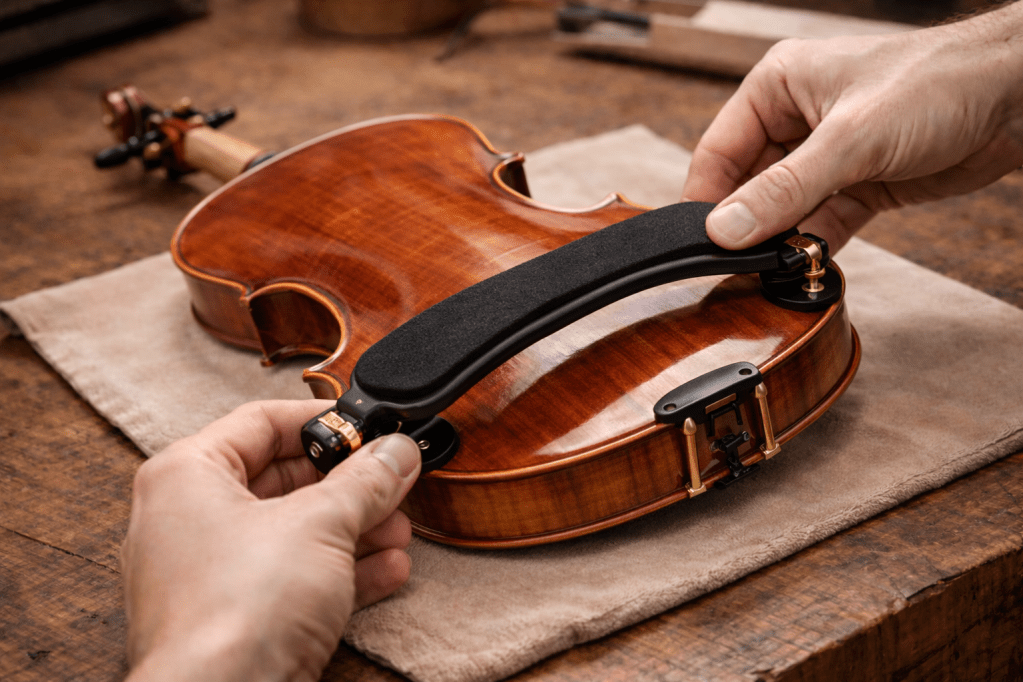
Choosing a shoulder rest can be one of the most frustrating parts of setting up the violin as an adult. Advice is often aimed at children or advanced players, and many recommendations don’t account for adult posture, neck comfort, or physical tension.
For adult violinists, a shoulder rest should do two main things: support the instrument comfortably and help you stay relaxed while playing. In this guide, we’ll look at how shoulder rests affect comfort and stability, what matters most for adult players, and how to choose an option that works for your body rather than against it.
Why Shoulder Rests Matter More for Adults
Adults bring different physical realities to the violin than younger students.
Common challenges include:
- Neck and shoulder stiffness
- Tension from daily work or posture habits
- Less flexibility than childhood beginners
- Discomfort from holding the violin for longer sessions
A well-chosen shoulder rest can:
- Reduce neck strain
- Improve balance and control
- Help you hold the violin with less effort
- Make practice sessions feel more sustainable
A poorly chosen shoulder rest can do the opposite, creating tension and discouraging regular practice.
Comfort vs Stability: What’s the Difference?
When evaluating shoulder rests, it helps to understand the balance between comfort and stability.
Comfort-Focused Shoulder Rests
These prioritize cushioning, shape, and contact with the body. They often feel softer and more forgiving, especially for players sensitive to pressure.
Comfort-focused rests tend to:
- Reduce pressure on the collarbone
- Feel gentler against the shoulder
- Encourage relaxed posture
They are a good choice if you experience:
- Neck soreness
- Collarbone discomfort
- Tension after short practice sessions
Stability-Focused Shoulder Rests
These emphasize grip and support, helping the violin stay securely in place.
Stability-focused rests tend to:
- Hold the violin firmly
- Reduce slipping or shifting
- Provide consistent positioning
They are helpful if:
- Your violin slides while playing
- You feel unsure about instrument balance
- You use more movement in your playing
Some stability-focused rests feel firmer, which can be comfortable or uncomfortable depending on your body.
What Adult Violinists Should Look For
Rather than chasing a specific brand or model, focus on these practical factors.
Adjustability
Adults benefit from shoulder rests that allow:
- Height adjustment
- Angle adjustment
- Width changes
This helps accommodate different neck lengths, shoulder slopes, and posture preferences.
Shape and Curve
No two shoulders are the same. Some rests are flatter, while others are more curved.
- Curved rests often feel more natural on sloped shoulders
- Flatter rests may suit broader shoulders
Trying different shapes can make a noticeable difference in comfort.
Padding and Materials
Padding affects both comfort and feel.
- Thicker padding can reduce pressure
- Thinner padding provides more direct feedback
There’s no “correct” amount — the right choice is the one that lets you relax.
Common Shoulder Rest Styles
Understanding the main styles can help narrow your options.
Traditional Shoulder Rests
These attach to the violin with adjustable feet and provide consistent support.
They are:
- Widely used
- Adjustable
- Available in many shapes
This is the most common starting point for adult beginners.
Minimal or Low-Profile Rests
Some players prefer less structure.
These options:
- Offer light support
- Encourage natural balance
- May feel less restrictive
They can work well for adults who dislike bulky equipment.
Pad-Style or Cushion Options
These rest directly on the shoulder or attach lightly to the violin.
They:
- Prioritize comfort
- Reduce pressure points
- Offer moderate stability
These can be especially appealing for adults with neck or shoulder sensitivity.
Signs Your Shoulder Rest Isn’t Working
It may be time to re-evaluate your shoulder rest if you notice:
- Persistent neck or shoulder pain
- The violin slipping frequently
- Excessive tension in your left hand
- Fatigue after short practice sessions
Discomfort is not something you need to “push through” as an adult learner.
Do You Need a Shoulder Rest at All?
Some violinists play without a shoulder rest, but this is not required or expected — especially for adults.
Many adult players find that a shoulder rest:
- Makes practice more enjoyable
- Reduces tension
- Encourages consistency
Using a shoulder rest is a practical choice, not a shortcut or a crutch.
Final Practical Advice
The best shoulder rest for an adult violinist is the one that allows you to:
- Hold the violin securely
- Stay relaxed
- Practice comfortably and consistently
There is no single perfect solution for everyone. Small adjustments and experimentation are normal and encouraged.
If a shoulder rest helps you practice longer and feel better while playing, then it’s doing its job.
 Practical Violinist
Leave a comment