
Last Updated: January 2026
Violins are made primarily of wood — a living, breathing material that constantly reacts to its environment. Changes in humidity can affect your violin’s sound, playability, and long-term structural health, especially for adult learners who may store their instrument at home year-round.
In this guide, we’ll cover:
- Why humidity matters for violins
- The ideal humidity range
- Signs your violin is too dry or too humid
- Simple ways to control humidity at home and in your case
- Practical tools that help protect your instrument
Whether you live in a dry winter climate or a humid summer region, understanding violin humidity is one of the easiest ways to prevent costly damage.
Why Humidity Matters for Violins
Wood naturally expands and contracts as humidity changes. Violins are built with thin, precisely shaped plates and delicate glue joints, which makes them especially sensitive to environmental shifts.
When humidity drops too low, the wood shrinks. When humidity rises too high, the wood swells. Either extreme can lead to problems such as:
- Cracks in the top or back plate
- Open seams
- Warping or distortion
- Changes in tone and response
Humidity issues often develop slowly — which is why many players don’t notice until damage has already occurred.
Ideal Humidity Range for Violins
Most luthiers recommend keeping violins in an environment between:
40%–60% relative humidity, with 45%–55% being ideal.
Short-term fluctuations are normal, but prolonged exposure outside this range increases the risk of damage. Central heating in winter and air conditioning in summer are two of the most common causes of humidity imbalance.
Signs Your Violin Is Too Dry
Low humidity is the most common problem for violins, especially in colder months.
Watch for these warning signs:
- Sharp edges feel more pronounced along the ribs
- Strings feel unusually low or buzz more than usual
- Pegs slip more frequently
- Small cracks appear near the f-holes or seams
- Sound becomes thin, brittle, or less responsive
If you notice any cracking, stop playing and consult a luthier — continuing to play can worsen the damage.
Signs Your Violin Is Too Humid
Excess humidity can be just as harmful, though it’s often less obvious.
Common signs include:
- Muffled or sluggish sound
- Sticky or unstable pegs
- Fingerboard swelling slightly
- Open seams due to softened glue
- Increased difficulty tuning
High humidity is especially common in summer months or in coastal regions.
How to Measure Humidity (Essential First Step)
Before trying to fix humidity issues, it’s important to know what you’re dealing with.
Digital Hygrometers
A small digital hygrometer lets you monitor humidity levels accurately:
- Inside your violin case
- In your practice room
- Near where your violin is stored
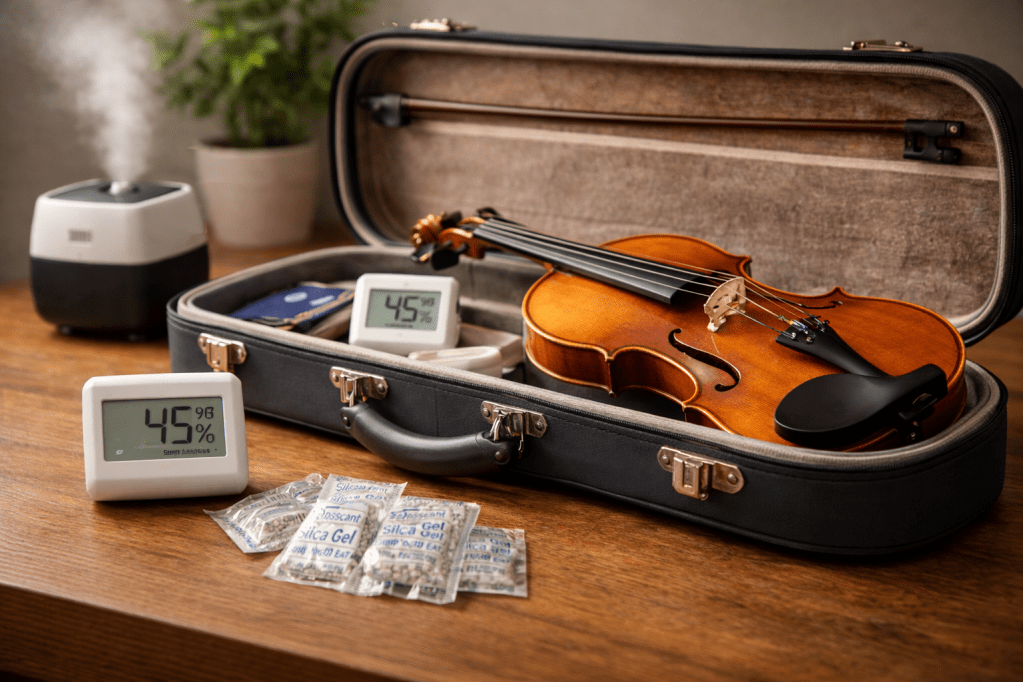
Many violinists keep a compact case hygrometer inside the accessory pocket so they can check humidity every time they open the case. Models with clear digital displays and fast readings make daily monitoring effortless.
Case Humidifiers: Simple Protection on the Go
For most adult violinists, case humidifiers are the easiest and most affordable way to prevent dryness, especially during winter.
Popular options include:
- Tube-style violin humidifiers that rest between the strings
- Soft pouch humidifiers that attach inside the case
- Gel-based case humidification systems that release moisture gradually
A reliable violin case humidifier helps stabilize moisture levels even when room conditions fluctuate, making it one of the most effective tools for everyday protection.
Room Humidifiers for Home Practice Spaces
If you practice regularly in one room, a room humidifier can protect not only your violin but also your bow and other wooden instruments.
A quiet, cool-mist room humidifier is often the best choice for music spaces, as it raises humidity evenly without heat. Models with built-in humidity controls make it easier to maintain a safe range without constant adjustment.
Many adult players find that a single room humidifier provides more consistent protection than relying on case humidifiers alone.
Dehumidifying in High-Humidity Environments
If you live in a humid region, controlling excess moisture is just as important.
Helpful solutions include:
- Silica gel humidity packs placed inside the violin case
- Reusable case dehumidifiers designed for string instruments
- Compact room dehumidifiers for practice spaces
Silica gel packs are especially useful for travel or summer storage, as they help absorb excess moisture without over-drying the instrument.
Seasonal Humidity Changes to Watch For
Winter
Indoor heating dramatically lowers humidity, increasing the risk of cracks and open seams. During colder months, most violinists rely on case humidifiers combined with regular humidity monitoring to keep their instrument safe.
Summer
High humidity can soften glue joints and affect tuning stability. In warm, humid weather, dehumidifying tools and proper air circulation become more important than adding moisture.
Common Humidity Myths (and Mistakes)
- “My violin is fine without humidity control.”
Damage often develops gradually and isn’t obvious until repairs are needed. - “Keeping the violin in its case is enough.”
A case protects from impact, not humidity changes. - “Only expensive violins need humidity care.”
Student and intermediate violins are often more vulnerable to environmental stress.
Simple Violin Humidity Checklist
- Store your violin in its case when not playing
- Monitor humidity using a digital hygrometer
- Use a case humidifier during dry seasons
- Avoid placing your violin near heaters, vents, or windows
- Adjust humidity tools as seasons change
For a full set of routine care habits that complement humidity management — from daily cleaning to seasonal checks — be sure to check out our simple violin maintenance checklist.
Final Thoughts
Humidity control is one of the simplest and most cost-effective ways to protect your violin’s sound and structure. With basic monitoring and a few well-chosen tools, adult violinists can avoid many common maintenance problems before they start.
Taking care of humidity doesn’t require expensive equipment — just awareness, consistency, and the right setup for your environment.
Affiliate Disclosure: Some links in this article may be affiliate links. As an Amazon Associate and participant in other affiliate programs, we may earn from qualifying purchases at no additional cost to you.
 Practical Violinist
Leave a comment