Last Updated: January 2026
An adult beginner’s guide to comfort, control, and better tone
One of the fastest ways to improve your violin sound isn’t buying new strings or upgrading your instrument—it’s learning how to hold the bow correctly. A tense or awkward bow grip makes the violin feel harder than it needs to be and often leads to scratchy, unstable tone.
The good news? Bow hold is a skill, not a talent. With a few small adjustments, you can feel more relaxed and immediately sound smoother.
This guide is designed specifically for adult beginners—no tiny hands, no childhood muscle memory, and no assumptions.
Why Bow Hold Matters More Than You Think
Your bow hand controls:
- Tone quality
- Volume
- Smoothness between notes
- How tired your arm feels
A stiff grip transfers tension straight into the string. That’s why many beginners feel like they’re “fighting” the violin.
If your sound feels gritty or unstable, it often starts here. You may also want to read Why Your Violin Sounds Scratchy (And How to Fix It) for a full tone checklist.
The Relaxed Bow Hold Shape
Think balanced, not gripped.
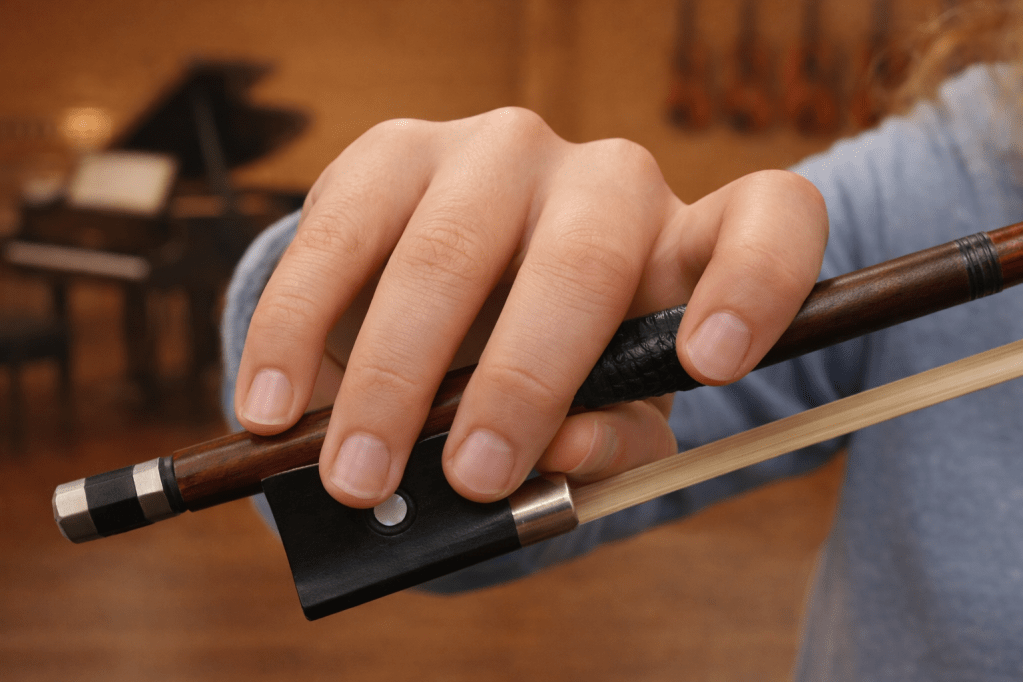
Your fingers should drape over the bow like they’re resting on a rail:
- Thumb: Bent, touching the stick near the frog
- Index finger: Rests on the stick, providing gentle guidance
- Middle & ring fingers: Curve naturally over the frog
- Pinky: Curved on top of the stick for balance
Your hand should look soft and rounded—never clenched.
A helpful test: If someone lightly taps your bow, your hand should flex, not freeze.
Common Beginner Mistakes (and Easy Fixes)
1. Straight, locked thumb
- Fix: Let it bend gently—like holding a pen.
2. White knuckles
- Fix: Loosen until the bow feels “held” rather than “squeezed.”
3. Collapsed pinky
- Fix: Place it on top of the stick, curved like a tiny spring.
4. Raised shoulder
- Fix: Drop your shoulder and let the arm hang naturally.
These small changes often feel strange at first—but your sound improves fast.
A 60-Second Bow Hold Reset
Use this before every practice session:
- Let your arm hang at your side.
- Bring your hand up—keep that natural curve.
- Set the bow into your relaxed fingers.
- Place the bow on the string without pressing.
- Draw one slow, quiet stroke.
That single stroke should feel easy.
If it doesn’t—reset.
Practice That Builds Control
Short, focused practice works better than forcing long sessions with tension.
Add this bow drill to your routine:
- Open-string bows
- 10 slow strokes per string
- Listen for evenness
- Keep your fingers soft
These slow bow strokes fit naturally into a short daily routine, and our guide A Simple 5-Minute Daily Violin Practice Routine for Adults shows exactly how to structure them into a habit you can actually keep.
You’re not trying to play music yet—just teaching your hand what “calm control” feels like.
What “Correct” Really Means
There is no single “perfect” bow hold.
There is a healthy one:
- Comfortable
- Flexible
- Tension-free
- Repeatable
If your grip lets you play longer, smoother, and with less fatigue—you’re doing it right.
Bow hold isn’t about copying a photo. It’s about building a relationship with the bow that feels natural in your hands.
And once that relationship clicks, everything gets easier.
 Practical Violinist
Leave a comment